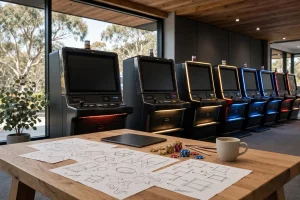
Plinko’s peg-board format, payment claims and bonus language need to be assessed separately from familiar pokies and slot categories.

“Slot” is often used as a loose label for a digital game built around chance, even when its visible action does not resemble the reels of a conventional pokie. Plinko sits awkwardly inside that vocabulary. A ball falls through rows of pegs and lands in a lower position; the familiar image is closer to a pin board than to spinning symbols. Yet casino menus and search results may group it with slots, so the label can describe where a game is filed rather than how it works.
That distinction matters in Australia, where “pokie” is the ordinary local word for a poker machine and “slot” can sound like a promise of a particular format. The terminology does not settle the matter. A Plinko-branded game might be presented in a slot category, styled as a casino game, or given a name that suggests a separate theme. None of those choices, by itself, establishes the game’s rules, supplier, or mathematical design.
The same looseness follows into phrases such as “Plinko slot machine” and “Plinko slots game”. The word machine may evoke a physical EGM, while the underlying reference may be to software displayed on a screen. “Slot” may mean a casino section or a game with a chance-based result, not a machine with reels. Search language compresses those meanings; a careful description has to separate them again.
Choosing a Plinko casino in Australia means checking the practical details behind the game, not just the theme. This list offers a concise reference to the licensing, deposit and payout information available for each operator.
Rollero Casino
Rollero Casino is listed with a Curacao Gaming Control Board licence, OGL/2023/176/0095, held by Hollycorn N.V.
LuckyVibe
LuckyVibe is listed with a Curacao Gaming Control Board licence, OGL/2023/176/0095, held by Hollycorn N.V.
House of Pokies
House of Pokies lists an international iGaming licence, though the source does not name its jurisdiction. PayID withdrawals are stated as taking 1–24 hours, and the minimum deposit is A$30, or A$10 when using PayID.
Wild Tokyo
Wild Tokyo lists a Curacao licence and a minimum deposit of A$10. Its stated payout times are 30–60 minutes for crypto and 1–5 days for fiat.
Uptown Pokies
Uptown Pokies lists a Curacao licence and has been operating since 2017. Its minimum deposit is A$20.
MrPacho
MrPacho lists a minimum deposit of A$30. Stated payout times are 30–120 minutes for crypto and 24–72 hours for fiat.
Golden Pokies
Golden Pokies is listed with a Curacao licence.
WinSpirit Casino
WinSpirit Casino lists a Curacao eGaming licence, OGL/2024/923/0383, held by Antillephone N.V. Its minimum deposit is A$30.
JustCasino
JustCasino is listed with a Curacao Gaming Control Board licence.
Kingmaker
Kingmaker lists a minimum deposit of A$30. Its stated payout times are about 90 minutes for crypto and 1–5 days for fiat.
Names add another layer. A title such as “Gods of Plinko” or “Plinko Rush” may be used to identify a particular listing, but the words alone reveal little about whether the listing refers to a distinct game, a themed presentation, or simply a promotional label. A page headed “Plinko slots” could collect several offerings under one umbrella without showing that they share a developer or common rules. The label is easy to print. The underlying identity is harder to establish.
“Top” is similarly elastic. A claim that something is a leading Plinko slot might refer to popularity, placement on a page, a reviewer’s preference, or an advertising position. Without a stated measure, the adjective carries atmosphere rather than information. “Slot Temple” may appear beside Plinko as a destination or category phrase, but that pairing does not make it a game title or establish any relationship between the named place and a particular Plinko product. Search terms often stack nouns until the boundaries between game, site, category, and judgement disappear.
The phrase “Plinko slot game” sounds more definite than “Plinko”, but it does not answer the central classification question. A digital Plinko game can use a falling object and pegs rather than reels, while still being placed among casino slots. Calling it a slot may be convenient for a catalogue. It is not a technical description. Nor does the phrase “casino slot machine” prove that a physical machine exists; in online language, “machine” is often borrowed from the older vocabulary of gambling, where the object once stood plainly in front of the player.
Demo wording raises a different question of format, not identity. A free-play or demonstration label can describe a mode in which a game is shown without real-money stakes, but the label does not tell what version is being displayed or whether its settings match another version. The term should not be mistaken for a technical certificate. It describes a presentation, not necessarily the origin or design of the game.
RTP figures illustrate why categories need boundaries. KA Gaming slot RTP percentages typically range from 94% to 96%. That is a bounded example about the provider’s slots, not a Plinko figure and not a basis for assigning a return percentage to a game merely because a listing calls it a slot. The same caution applies when a casino page groups different kinds of games together: a figure attached to one provider or category cannot quietly migrate to another.
The vocabulary has grown by borrowing. A pin-board game acquires the “slot” label because it appears in a casino environment; a listing gains a grand title because names help distinguish one tile from another; a category becomes a verdict when it is called “top”. These shifts are not proof of deception. They are evidence that commercial language is often broader than technical language.
So “Plinko slot” can be understood as a filing term, a casual description, or a title fragment. Which meaning applies depends on the actual page and game information, not on the phrase itself. The name points toward a family resemblance with casino play. It does not settle the family tree.
A game can be reachable from Australia without being lawful to offer here. That distinction is easy to miss when a website loads, accepts an Australian payment method or presents its games as open to local visitors. Access describes what the site permits technically; legality describes what the operator is allowed to provide to people in Australia. They are not the same thing.
The Interactive Gambling Act 2001 restricts the provision of online casino services to people physically in Australia. Casino-style offerings, including games presented as slots or table games, fall within that boundary. Calling a game Plinko, placing it in a casino lobby or styling it as a live experience does not, by itself, change the legal position. The name on the tile is not the test.
This matters because a plinko game may appear alongside familiar casino language: an online casino with Plinko, a Plinko casino game, or a live version presented as entertainment. Some sites may also describe the game as a pokie. Those labels can help explain how an operator packages a product, but they do not establish that the service is authorised to provide online casino gambling in Australia. Nor does the presence of an Australian-facing page settle the question.
Offshore operators may accept payments from Australians while operating under licences issued elsewhere. An offshore licence may be relevant to the operator’s obligations in the place that issued it, but it does not amount to Australian permission to offer online casino services to people here. The two jurisdictions are not interchangeable. A badge or licence number on a site should not be read as a local endorsement.
There is a social history in that gap. The internet makes borders feel like interface settings: a language selector, a currency option, a payment button. Law is less pliable. Australia’s framework places responsibility on the operator providing the prohibited service, rather than treating a site’s apparent availability as proof of lawful status. A polished localised page can therefore coexist with a legal boundary it cannot remove.
For players, the distinction is also important. Australians are not criminalised simply for using offshore casino sites. That does not make the operator’s service lawful in Australia, and it does not turn an overseas licence into local regulation. It means the legal position of the player and the legal position of the business are different questions. Confusing them produces either needless alarm or unjustified reassurance.
The same applies when a site advertises real-money Plinko as an online casino game. Descriptions such as “golden” or “live” may refer to branding or presentation, not to a different legal category. A game presented as a ball-drop challenge can still be offered as casino gambling. The format does not create an exception simply because it looks unlike a conventional pokie.
There is also a difference between finding a page and finding a lawful service. A site may be visible at one moment, then become inaccessible; a payment may be accepted without the service gaining Australian approval. Neither event is a reliable legal test. Availability is a fact about technology and business choices. Permission is a matter of law.
That distinction gives the Australian setting its particular shape: offshore casinos can be encountered by residents, but the law restricts operators from providing real-money online casino services to people in the country. The player is not made a criminal by visiting such a site; the operator’s overseas licensing does not erase the restriction. These statements can sit together without contradiction.
So a page advertising online Plinko for Australian users should be read as an offer made by an offshore business, not as evidence that Australia has licensed online casino play. The wording may promise access, and the interface may accept a local payment, but neither changes the boundary established by the Act.
A border in law, not on the screen.
“Real money” describes the kind of balance an operator says can be used for gambling; it does not, by itself, establish that a balance can be withdrawn. The distinction matters when a Plinko game is presented alongside a cash balance, a promotional credit or a prize display. Each may look like a number on a screen, but the conditions attached to it can be different. A displayed amount is not proof that it is payable, and a game label is not a cashout policy.
The same caution applies to a Plinko casino game presented as available for real-money play in Australia. The wording may describe what an offshore site claims to offer, but it cannot settle whether a particular balance is withdrawable or how a withdrawal will be assessed. The route from a game screen to money received runs through the operator’s rules: withdrawal thresholds, identity checks and, where a bonus is involved, conditions on the funds. The language of play is often immediate. The language of payment is not.
An advertised withdrawal facility can also come with a minimum amount that must accumulate before a request is accepted. Offshore sites commonly set that threshold somewhere between A$75 and A$150. A small balance below the stated minimum may therefore remain unavailable for withdrawal, even if it appears in an account. The threshold is not a fee and does not necessarily mean money will be paid once reached; it is a gate to submitting a request. Terms about maximum withdrawals, payment methods or processing can add further conditions, so the headline presence of a cashout option tells only part of the story.
This is where the cost of waiting begins. A player may have to continue using an account, wait for the balance to meet a minimum, and then wait again while a request is checked. Each step depends on the written terms and the operator’s handling of the account. A balance that cannot yet be requested is different from one that has been approved, and both are different from funds received in a bank account. The screen compresses those stages into one figure. The payment process restores them.
First withdrawals commonly bring KYC checks: identity verification using documents such as a passport or driver’s licence, along with a utility bill. These checks are intended to match the account holder with the person requesting payment. A request may therefore be delayed while documents are supplied and reviewed, particularly if account details and documents do not align. The practical point is not that every operator follows an identical procedure; it is that a first cashout can involve more than pressing a button. The account’s apparent balance does not perform the identity check.
Withdrawal Process
Identity Verification
Supply required documents such as a passport, driver’s licence, and a utility bill to match the account holder with the requester.
Meeting Thresholds
Accumulate the minimum balance, commonly between A$75 and A$150, to enable the submission of a withdrawal request.
Review and Processing
Wait for the operator to check documents and assess the balance according to their specific rules and terms.
Bonus funds add a separate layer. Bonus-derived funds are not cash simply because they appear beside cash funds, and they may carry wagering requirements before related winnings can be withdrawn. A specialist review has reported requirements in the range of 30–50 times the bonus amount. That is a report about the terms it examined, not a fixed rule for every operator or promotion. The exact wording matters: a requirement may apply to the bonus, to bonus plus deposit, or to particular games under stated contribution rules. Without those details, the multiplier alone cannot show how much qualifying play is required.
A “no deposit” label changes neither the nature of a bonus nor its conditions. It may indicate that a promotional credit is offered without an initial deposit, but it does not establish that the credit itself can be cashed out. Nor does a prize shown during play necessarily become withdrawable funds immediately. The promotion’s terms determine what counts, which games qualify, whether a cap applies, and what must happen before a withdrawal request is possible. A bonus is a conditional offer, not money already in hand.
The same distinction travels across different presentations of Plinko: a browser game, an app, a downloadable file, or a version described as Plinko 2.0. The format does not answer the payment question. A download is not evidence of a payout route; an app is not a guarantee of a cashout; and a game that accepts a real-money balance does not thereby prove that a withdrawal will be approved. Payment claims need to be read as claims, with the account rules beside them.
The delay is not merely administrative trivia. When promotional funds, identity checks and withdrawal floors meet, a displayed win can be several conditions away from money available outside the account. That distance is where careful wording matters. For anyone gambling, the minimum age is 18, and gambling can cause serious harm. A cashout label may be brief. Its conditions are not.
A Plinko-style title and an Australian pokie can share a casino label without sharing the same mechanics. The name Plinko suggests a ball moving through a field of pegs towards different outcomes, but that image does not establish how a particular digital game is built, what its payout rules are, or whether it includes a jackpot. Those details belong to the game’s own stated rules. A jackpot attached to pokies should not be carried across by association.
Progressive jackpots are a separate feature. Their value grows as play contributes to a pool, either through linked machines or through a network of pokies. The shared pool changes the scale of the prize, not the basic fact that the game must qualify for it under its own terms. A Plinko game might be described with jackpot language, but that wording alone does not show that it has a progressive prize, or that it participates in a pokie network.
The distinction between local and networked jackpots matters. A standalone progressive is tied to an individual machine: its pool grows through play on that machine. A networked progressive links many machines, or an operator’s online fleet, so eligible play across that group can feed the same prize. The first is local; the second depends on a wider system. Neither description is a general feature of casino games, and neither can be assumed from a game’s visual style.
That is where the familiar pokie offers a useful comparison, even if it is not a template for Plinko. Pokies with progressive prizes can be connected in ways that are described in their rules. For a Plinko-style game, the relevant question is narrower: does its published information actually describe a progressive jackpot and explain how it is funded? Without that detail, a falling ball and a prize display do not establish a shared pool. A graphic can suggest abundance. It cannot explain the accounting.
Eligibility can be less visible than the headline prize. A specialist review advises checking both the contribution rate and the minimum bet needed to qualify. The contribution rate explains how eligible play adds to the jackpot; the minimum bet sets the threshold for participation. Some games specify a minimum qualifying stake, with A$1.00 as one example. That figure is an example, not a universal rule, and it should not be transferred to another title.
The distinction also matters when jackpot terminology appears beside a Plinko game. A payout table, a displayed top prize and a progressive jackpot are not interchangeable claims. A top prize may be fixed, while a progressive amount changes as qualifying play feeds the pool. The game information needs to say which arrangement applies and what conditions attach to it. If it does not, the word “jackpot” is too broad to settle the matter.
This is the limit of the comparison. Pokies provide a well-established example of local and networked progressive structures; they do not prove that the same structure belongs to every casino game, let alone every Plinko title. A game’s own rules must carry that weight. The mechanics are not inherited.
A Plinko review is useful when it separates observable details from promotional language. The name alone does not identify a particular game, developer or set of rules. A page calling something “Plinko Rush”, “Plinko Verde” or “Plinko Deluxe” may be describing a named product, a themed version or simply using familiar wording; the label is not proof of who made it or how it works. Nor does a reference to MrBeast establish that a casino or game is connected to him.
A careful review can report what the game information actually states: the provider, the displayed rules, the available settings and any stated return figures. It can also note what remains unclear. A confident rating cannot fill gaps in a game description, and a promise of a particular experience is not evidence that the product delivers it. “Plinko casino” is a broad label, not a verification mark.
The same standard applies to bonuses. Their conditions are part of the offer, not fine print that can be replaced by a headline. A specialist review described one offer with a $100 bonus and a 40x wagering requirement: under those terms, $4,000 in bets would be required before bonus-derived winnings could be withdrawn. That is an illustration of a particular set of conditions, not a rule for every offer. A separate specialist review said blackjack counted at only 10% toward wagering. Such details matter because a contribution rate changes how much eligible play is needed; the percentage should be checked in the relevant offer’s own terms, not assumed to travel from one promotion to another.
Reviews can also distinguish a free-play label from a claim about cash access, without treating one as proof of the other. The wording should be precise: what is available, under which conditions, and whether the terms say anything about withdrawing funds. A colourful demonstration or an endorsement-style video cannot answer those questions by itself.
In Australia, that evidence-focused approach has a firm setting: real-money online casino services are prohibited for operators offering them to people in the country. A review should not turn a description into an invitation to play. It can assess the clarity and consistency of claims while keeping promotion out of the frame. And any discussion of gambling belongs to adults; gambling can cause serious harm to vulnerable people.
Evidence, not theatre.
The phrase “Plinko casino Australia” can sound like a description of a local entertainment industry. In practice, the Australian setting is marked less by a domestic casino market than by the machinery used to restrict prohibited online services. That machinery has a name: the Australian Communications and Media Authority, or ACMA.
ACMA oversees compliance with federal interactive gambling laws, including the Interactive Gambling Act 2001. Its role is not limited to publishing rules. When a website provides prohibited interactive gambling services in Australia, or advertises them, ACMA can ask internet service providers to block access. The request turns a legal boundary into a practical obstacle on the screen. A site may still be described overseas as a casino, but that description does not settle whether it can lawfully serve people in Australia.
Blocking is one part of a wider enforcement record. Since November 2019, ACMA has blocked more than 1,455 illegal gambling and affiliate websites after taking enforcement action. Affiliate pages matter here because the path to a gambling service is not always a direct one: promotional sites can help lead people towards the service itself. The border is drawn around both the door and some of the signs pointing to it.
Counts of services that have left the Australian market are reported differently. One figure says more than 210 illegal services have withdrawn since ACMA began enforcing the rules in 2017; another puts the number above 190. The larger point survives the disagreement: enforcement has also been followed by services leaving the market, not only by websites being blocked.
This context changes the meaning of an Australian-facing Plinko casino. The label may describe a game or an offshore site’s intended audience, but it cannot establish approval by Australian authorities, nor does a page’s continued appearance prove that access will remain available. The same distinction applies when a casino-style game is grouped under a different name or promoted through an intermediary. Labels travel more freely than permissions.
A Canadian reference attached to the same kind of Plinko listing belongs to a different national context; it does not alter ACMA’s Australian remit. Regulation is not a search result that can be carried across borders. In Australia, the central facts are the regulator’s monitoring role, its ability to seek blocking, and the scale of action already taken. The obstacle is institutional, not cosmetic.
“Free play” can describe a demonstration with fictional credits, a set of complimentary turns, or a promotion attached to an account. Those are not interchangeable arrangements. A Plinko-style game labelled free may let a visitor see the drop-and-payout format without staking money; that does not create a balance that can be withdrawn later.
The distinction is easy to blur because the same screen can display credits, wins and a running total. In a simulation, those figures may exist only to keep the demonstration moving. They are not evidence of money held for the player. A free-spin offer may look different, but the word “free” still says nothing by itself about whether any resulting funds are withdrawable, or what conditions apply.
So a pond-themed Plinko demo and a real-money service should not be treated as two versions of the same entitlement. One may be a self-contained practice mode; the other involves money and falls under rules that a free-play label cannot alter. In Australia, real-money online casino games are prohibited services when offered to people in the country. A no-cost mode does not make an unlawful real-money service lawful, nor does it establish that a later cashout is available.
That is the small print hidden in plain sight. A displayed score is not a payment promise. Nor does a page’s use of “free spins” settle whether those turns are merely simulated or part of an account offer. The terms attached to the activity would have to say what happens to any credited winnings; the label alone cannot answer it.
Lists calling something the “best” free Plinko site add another layer of confidence without resolving the basic question. A ranking is not proof of withdrawal rights, and a demo is not a test of a cashout process. Free can mean no stake is needed to try a simulation. It does not mean winnings are payable.
For anyone under eighteen, gambling is not an option. For adults, the distinction matters too: gambling can cause serious harm, particularly for vulnerable people, and a practice screen should not be mistaken for a safe route into real-money play. Free is a description, not a promise.
Crypto payment language and a Plinko script describe different things. The first concerns how funds may move; the second points to software. Putting both beside the game’s name does not make them evidence of one another.
A crypto deposit or withdrawal says nothing by itself about who made the game, how its outcomes are generated or whether a site’s description is accurate. Nor does a script establish that it is authorised, safe to run or connected to an official version of a game. It is code, not a payment method—and a label is not proof of provenance.
That distinction matters because the attraction of speed can obscure the amount that finally arrives. One specialist review reports that crypto withdrawals can clear faster than other methods, but network fees and conversion spreads may reduce the value received. A transfer can be quick and still cost more than its headline figure suggests. Speed is not the same as value.
The same caution applies when a site presents cryptocurrency as a mark of technical sophistication. It may identify a payment option, but it cannot establish the quality of the game or the standing of the service accepting the funds. The software question remains separate: what the code does, who controls it and whether it has any reliable connection to the named game.
For anyone aged eighteen or older, these terms are best read narrowly. Crypto describes a possible route for funds; a script describes software. Neither term, alone, confirms fairness, legitimacy or a player’s ability to recover money. Two different claims. No shortcut between them.
A no-deposit bonus can sound like money arriving without a purchase, but a displayed bonus is not cash in a withdrawable balance. Its terms determine whether it can be used, what happens to any winnings made with it, and what must be completed before those winnings can be withdrawn. The label alone settles none of that.
The arithmetic is plain when the condition is stated plainly. A specialist review gives the example of a $100 bonus carrying a 40x wagering requirement: $4,000 in bets must be placed before bonus-derived winnings can be withdrawn. That is turnover, not a debt to the operator and not a forecast of winnings. Repeating bets until the total is reached does not make the underlying play profitable; it merely satisfies a condition, if all other terms are met.
Contribution rules can make the calculation less straightforward. A specialist review describes blackjack as counting for only 10% towards wagering requirements. Under that kind of rule, $100 wagered on blackjack would count as $10 of qualifying turnover, rather than the full amount staked. A lower contribution rate therefore makes the practical burden heavier: more actual betting is needed to register the same qualifying amount. The specific terms matter.
The same distinction applies whether an offer is framed as a Plinko bonus or attached to a title styled as Gods of Plinko. Naming the game does not turn restricted bonus funds into cash, nor does an appealing label reveal the contribution rules. Those details belong in the written conditions.
A reference to Nederland belongs to a different context. It may reflect interest in a Dutch-language market or a page written for that jurisdiction; it does not establish that Australian rules, offers or eligibility conditions apply there. Search wording travels more easily than regulation. The border does not.
“Lucky” and “guru” are persuasive labels, but neither establishes that a Plinko game can be predicted or that a commentator has special insight. A reference to a UK casino does not change the Australian setting either. These phrases borrow the language of chance and authority; the harder question is what gambling means in the places where it has become ordinary.
Poker machines, or pokies, have long occupied that uneasy space in Australian public life: familiar entertainment for some, a source of serious harm for others. The scale of losses gives the debate its weight. Gamble.com.au reported that Victorian players lost $2.6 billion on pokies over the year covered by its account, more than $44.7 million above the figure it gave for 2015. The same report said the Epping Plaza Hotel in Melbourne’s north generated more than $21 million from 100 machines over the reported year. Those are reported figures, not timeless measures. Still, they make “luck” sound less like a private feeling and more like a question about who bears the cost.
Reform proposals have tried to put a boundary around that cost. Senator Nick Xenophon and MP Andrew Wilkie called for a $1 maximum bet on poker machines. The proposal was part of a wider argument about whether machine design and the pace of play should be left entirely to individual choice. It was not a claim that a small wager removes risk.
A lucky label cannot settle that argument, and a guru’s confidence cannot turn chance into expertise. Gambling is for adults aged 18 or older; even then, problem gambling can cause serious harm, particularly to vulnerable people. The social record matters more than the promise of a fortunate result.
Some games have a free-play or demo mode that lets you play without real-money stakes. Check the game listing to see whether that mode is available.
Check bonus wagering requirements, how different games contribute toward them, withdrawal limits and any identity documents required for your first cashout. Bonus wagering requirements are often 30–50x, and some games may contribute only 10%.
Check the game’s information and listing for its provider or developer. A game title or the category it appears in does not, by itself, identify who made it.