Hotel, gaming, dining and amenity searches are considered separately from evidence that a venue or service is actually available.
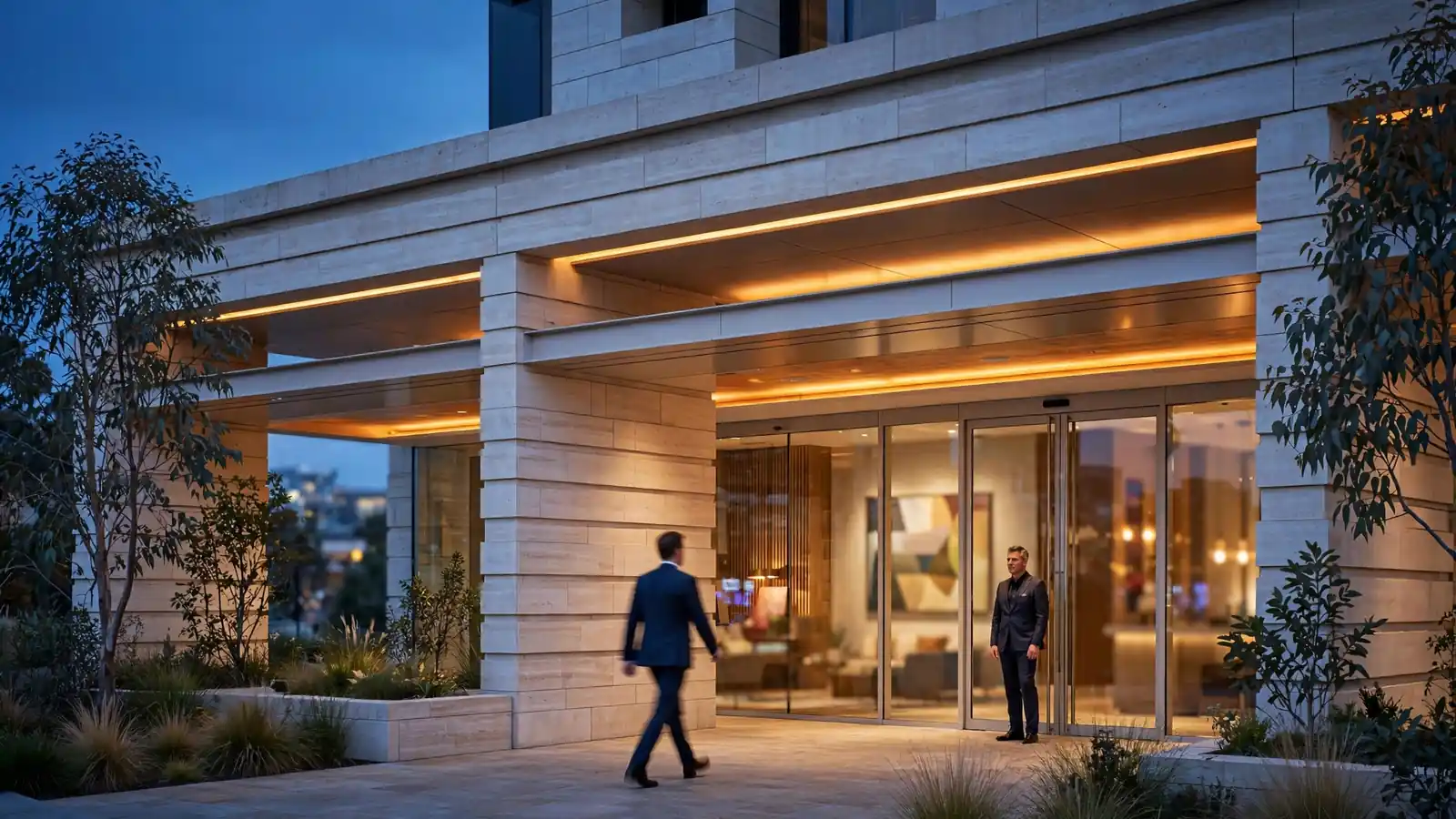
A casino hotel is an appealingly compact idea: a room upstairs, entertainment downstairs, and no need to make separate plans for the evening. That promise is built into the phrase itself. Yet a phrase is not a property record. Searching for a casino hotel in Canberra, or for rooms and deals attached to one, does not establish that a casino operates a hotel there.
The distinction matters because several different arrangements can hide behind the same label. A casino might own and operate a hotel; it might share a site with accommodation run by another business; or a hotel might simply be described as close to a casino. Those are not interchangeable claims. Each would need its own evidence: a confirmed property, a clear connection between the businesses, and current room information. Without that, the words “casino hotel” remain a description of what someone hopes to find, not a reliable account of what is available.
The same restraint applies to room searches. A request for Canberra casino hotel rooms sounds specific, but it does not name a property or establish that rooms can be booked. Nor does the appearance of “deals” turn a hoped-for package into an offer. A deal requires terms: what the price covers, when it applies, whether the room is actually part of a casino property, and what conditions govern the booking. A discount without those details is merely a persuasive noun.
Choosing an online casino while in Canberra calls for checking the details that matter to your own play, such as payment options and payout information where available. This list offers a concise starting point for reviewing the operators.
Rollero Casino
Rollero Casino lists a Curacao Gaming Control Board licence, OGL/2023/176/0095, held by Hollycorn N.V.
LuckyVibe
LuckyVibe lists a Curacao Gaming Control Board licence, OGL/2023/176/0095, held by Hollycorn N.V.
House of Pokies
House of Pokies lists an international iGaming licence, though the source does not name the jurisdiction. Its stated minimum deposit is A$30, or A$10 via PayID, and PayID payouts are listed at 1–24 hours.
Wild Tokyo
Wild Tokyo lists a Curacao licence and a minimum deposit of A$10. Its stated payout times are 30–60 minutes for crypto and 1–5 days for fiat.
Uptown Pokies
Uptown Pokies lists Curacao licensing and says it has operated since 2017. Its stated minimum deposit is A$20.
MrPacho
MrPacho lists a minimum deposit of A$30. Its stated payout times are 30–120 minutes for crypto and 24–72 hours for fiat.
Golden Pokies
Golden Pokies lists a Curacao licence.
WinSpirit Casino
WinSpirit Casino lists a Curacao eGaming licence, OGL/2024/923/0383, held by Antillephone N.V. Its stated minimum deposit is A$30.
JustCasino
JustCasino lists a Curacao Gaming Control Board licence.
Kingmaker
Kingmaker lists a minimum deposit of A$30. Its stated payout times are about 90 minutes for crypto and 1–5 days for fiat.
This is why a page promising the best casino in Canberra in 2026 cannot settle the hotel question by wording alone. “Best” implies comparison, and a hotel claim implies something more concrete still: a place, an operator, and a stay that can be described. In the absence of those particulars, confident language would make the sentence more polished, not more informative. The category may be familiar; the local arrangement is another matter.
There is a small but revealing change of emphasis in these searches. A casino is imagined as a destination, then the destination is imagined as a complete itinerary. The room is not an incidental detail. It is what turns an evening out into a planned stay, perhaps with a package price and a single booking. The commercial appeal is obvious: fewer decisions, more apparent certainty. But a tidy itinerary cannot be inferred from a tidy phrase.
Even the word “hotel” can do too much work. It may refer to a full-service property, a room offer connected to an event, or accommodation marketed in proximity to a venue. A casino-branded booking page, if one existed, would still need to make the relationship plain. A nearby hotel would not thereby become a casino hotel, and a hotel’s use of casino-related wording would not prove that the casino itself provided rooms.
The practical standard is simple: a named property should be identifiable, its relationship to the casino should be stated rather than assumed, and room availability and deal terms should be attached to an actual booking. Without those elements, there is no sound basis for comparing rates, describing room types, or claiming that a package exists. The distinction is modest, but it prevents an attractive label from becoming a fictional service.
Opening times are a separate question, not a clue that can fill the gap. A venue’s hours, even if established, would not confirm hotel ownership, room availability or a combined stay. One fact cannot quietly stand in for another. The search for a convenient overnight arrangement therefore remains distinct from questions about when a casino might open.
A room can be part of a casino experience. It can also be a separate business, a promotional association, or simply an assumption carried by the phrase “casino hotel.” Until a specific Canberra property and its booking terms are established, the most accurate account is not that such a stay is available, nor that it is impossible, but that the label alone proves neither. A reservation needs an address, a room and terms. Not atmosphere.
A poker room and a poker tournament are different propositions. The first suggests a dedicated place for play; the second suggests an organised event, with its own schedule and conditions. Neither follows merely from the word “casino”. The distinction matters: an appealing label can make an expectation feel like a fact before anything has been demonstrated.
The same caution applies to the phrase “poker at a Canberra casino”. It can describe a hoped-for activity as easily as a confirmed one. A reliable announcement would need to identify the venue and specify what is actually taking place. For a tournament, that would mean an event notice with details such as its date and format; for regular poker, it would mean a clear description of the room and its operation. Without such particulars, there is no sound basis for presenting either as an available local option.
This is not a technical quibble. Poker has a social architecture that differs from the solitary image often attached to gambling: players face one another, rules govern the contest, and the event may attract people for reasons beyond the game itself. A room can imply recurring play; a tournament can imply a calendar and a community. Those implications are precisely why the terms should not be used as decoration for a venue whose arrangements have not been established. Atmosphere is not evidence.
“Casino rooms” is less precise still. It might mean a poker room, but it can also suggest hotel accommodation, a meaning dealt with elsewhere. A sports bar is another separate facility: its presence would not demonstrate that poker is available, just as a poker tournament would not prove that a sports bar exists. Similarity in the imagined casino setting is no substitute for a direct statement about each service.
The distinction also matters in practical terms. Someone considering a poker event would need to know whether it is actually scheduled, whether it is open to the public, and what conditions apply. None of those details can be inferred from a general reference to a casino or from the existence of poker as a game. Inventing a tournament calendar, room rules or entry arrangements would turn a search for information into an advertisement for an event that may not exist.
There is a larger habit at work here. Casino language often gathers many separate promises under one roof: a room, a contest, a bar, perhaps a place to stay. The words make the package seem coherent; the underlying services still require separate confirmation. A tournament is not a synonym for poker facilities, and poker facilities are not a synonym for a casino as a whole. Small distinctions, real consequences.
For the same reason, an “open today” label cannot establish that poker is running. Even if a venue were open, that would not confirm a poker room, a tournament or the hours of either. Venue access and a particular game’s availability are different questions. A current, specific notice would be needed to settle them; a general impression of what a casino might contain cannot do so.
That leaves the subject unresolved rather than filled with plausible detail. In gambling, plausible detail is often the most persuasive kind—and the least useful when it has no footing.
A casino is often imagined as a single destination with several kinds of evening under one roof: a gaming floor, somewhere to have a drink, perhaps a concert, and a map that makes the whole arrangement legible. That picture is useful as a set of expectations, not as a description of a particular Canberra venue. Each feature needs its own confirmation.
Baccarat and craps are distinct games, and their appearance in a venue description would be a specific claim about what is offered. A general reference to casino gaming does not establish that either game is available, how it is played there, or whether it is part of a current programme. Game names can travel easily between countries and websites; a local offering cannot be inferred from their familiarity.
There is a social history in that distinction. Casinos are commonly presented as places where games, hospitality and entertainment meet, but the combination is not automatic. A bar is not proof of a gaming floor; a concert listing does not establish a permanent casino venue. These are separate arrangements, each with its own practical details and its own capacity to change. The glossy idea of “a night out” tends to blur them together. Administration does not.
The same caution applies to a bar associated with a casino in Canberra. The phrase may express a straightforward wish to find a drink before or after an event, but it does not settle whether a bar operates at a particular venue, what it serves, or when it opens. Those details belong to the venue’s own current information. Naming a city and a facility in one breath is not evidence that the facility is there.
Concerts bring another layer of assumptions. A casino may be imagined as a place for live entertainment, yet a performance requires more than a broad venue label: there must be an event, a date, and a location. Without those particulars, “casino concerts” describes a category of interest, not a Canberra programme. Event information is especially time-sensitive; an old listing can outlive the night it advertised.
Maps and contact details are practical tools, but they should be tied to an identified operator or venue rather than assembled from lookalike listings. A map pin can point to a business with a similar name, while a number copied between directories may not belong to the place being sought. The useful sequence is ordinary: establish the venue’s identity, then use its own published location and contact channel to confirm the details that matter.
That process also keeps the broad phrase “casino in Canberra” from doing too much work. It can refer to a hoped-for combination of games, drinks and entertainment, but a collection of search terms does not turn that combination into a confirmed destination. Baccarat, craps, a bar, concerts, a map and a phone number are not interchangeable signs of one established operation. Each needs to attach to the same real venue before they can form a coherent plan.
For anyone comparing destinations under the heading “best casino in Canberra 2026,” the useful distinction is between an appealing picture and a verifiable local offer. A name, a game or an event may sound familiar; the details that make it actionable are venue-specific. Until those details are attached to an identifiable operator, the imagined evening remains just that: an itinerary in search of an address.
Parking is an ordinary arrival question, but it depends on a specific place. A search for parking at a casino in Canberra cannot establish whether a venue has a car park, whether spaces are free, or whether valet service exists. Those details belong to an identified property and its current arrangements. Without that anchor, even a confident-sounding answer would be guesswork with a practical cost: a driver may plan around facilities that have not been established.
Bingo and dining belong to different parts of the same imagined outing. They are not evidence about parking, and their appearance alongside it does not confirm a particular casino or its services. The sensible distinction is between what a visitor might need to know on arrival and what a venue might offer inside. Neither category should be filled with invented particulars.
The online version of the Canberra casino search raises a more consequential distinction: a venue people might visit is not the same thing as an online gambling service. Under the Interactive Gambling Act 2001, operators based in Australia cannot provide real-money online casino games to people in Australia. That restriction covers games such as pokies, blackjack and roulette. It is a rule about the service and its provider, not a local parking policy translated onto a screen.
Offshore platforms occupy a less tidy position in public discussion. It is technically not illegal for an Australian player to use one, but that does not make the platform lawful under Australian regulation or protected by it. Offshore online casinos are not regulated under Australian law, and the legal position for operators remains restrictive: they cannot lawfully provide prohibited casino services to customers in Australia. A grey area for the player is not a local licence for the business.
The distinction matters because the words “online casino” can make a website sound like a digital branch of a physical venue. The resemblance is mostly commercial. A screen may offer familiar games, but Australian law does not treat that familiarity as permission for an Australian-based operator to supply them. The country draws a boundary around the service, even while offshore sites may present themselves to Australians as readily as any other web page. Access and regulation are not the same thing.
That is where the parking and online questions part company. Parking calls for a real address and current property information; online gambling calls for attention to who operates the service and which law governs it. A Canberra label, whether attached to a venue or a website, cannot settle either question on its own. One concerns a car’s destination. The other concerns a regulated service and the limits placed on its provision.
The phrase “best casino in Canberra 2026” therefore cannot, by itself, establish a local destination, a bingo offering, or a lawful online equivalent. Search language compresses several different intentions into one line. The distinctions matter more than the shorthand.
A stay described as “near the casino” depends on a point on the map. Without a confirmed venue address, proximity is only a promise in search-language: it might mean a short walk, a drive across town or a location that shares little beyond the same city name. For accommodation in Canberra, the first useful detail is therefore not a deal but the place to which the distance is being measured.
That distinction matters because a room’s apparent convenience can change with the route. A straight line on a map is not necessarily a practical journey; roads, access and the time of arrival shape what “near” means. A listing may use a casino as a landmark without establishing how a guest would get from the property to the entrance. The word is elastic. Maps are less so.
Price comparisons have a similar weakness when the destination is uncertain. A discounted stay can look attractive while leaving transport, parking and the actual location of the venue unresolved. A promotion attached to accommodation is not proof of a casino package, and the phrase “casino deal” can cover quite different arrangements. The offer needs to identify what is included and where the room is, rather than relying on the atmosphere of association.
The same care applies to promotions said to be connected with a Canberra casino. A room discount, a gaming offer and a combined package are not interchangeable. Their terms, dates and participating businesses would need to be explicit before any value could be assessed. Without that detail, a headline can do a great deal of work for very little information.
Location also sits behind practical questions about arrival. Parking nearby is not established merely by the presence of hotels in the same general area; availability, access and any charge depend on the individual property and venue. Nor does a request for opening or trading times settle the question of whether a particular destination is operating at the time of a planned stay. These are separate details, and one cannot stand in for another.
The broader phrase “Canberra casino accommodation” can suggest that a casino has rooms of its own, while “accommodation near” suggests independent places to stay. Neither wording proves which arrangement exists. A careful comparison keeps those possibilities apart: on-site rooms, if any, would be different from nearby hotels, apartments or other lodging, with different booking conditions and routes.
There is a civic oddity in the way destinations become shorthand. A venue can lend its name to a neighbourhood in a listing long before the practical geography is clear. That shorthand may help people begin planning, but it cannot supply an address, a measured distance or a reliable journey. Those details have to belong to a specific property and a specific destination.
For a Canberra stay tied to casino plans, the sound order is plain: establish the venue’s location, then compare nearby accommodation against that point, including route and parking details. Until the destination is clear, “near” remains a mood, not a measurement.
A breakfast listing can make a casino seem like more than a place to gamble: it suggests a morning routine, a dining room with its own hours, perhaps a hotel stay arranged around a late night. But a phrase linking Canberra and casino breakfast is not evidence of a particular venue, menu or service. The same caution applies to a buffet breakfast. The words describe what someone may hope to find; they do not establish that it is offered locally.
Buffets carry their own promise of abundance and ease. In a casino setting, they can be imagined as part of a longer visit, a meal between other activities, or a reason to stay on site. Yet a Canberra buffet cannot responsibly be described by its dishes, price, schedule or setting without information to support those details. The distinction is small but important: an appealing picture is not a confirmed service.
“Resort” expands that picture further. It implies a destination with several kinds of leisure gathered together, perhaps combining a stay with recreation and dining. The label can shape expectations before any specific facilities have been established. In Canberra, it should not be treated as proof of a casino resort, nor as a description of what a visitor would find there. A word can do a great deal of work in a search box. It cannot furnish a room.
Rewards programmes raise a different expectation: that repeat visits are recognised through points, offers or other benefits. Such schemes vary by operator, and their terms matter as much as their name. Without a confirmed programme and its actual conditions, there is no sound basis for describing how rewards accrue, what they can be exchanged for, or who qualifies. A familiar label is not a promise of a particular benefit.
The interest in jobs at a Canberra casino belongs to the same cluster of expectations, though it concerns work rather than leisure. Searches for casino employment may reflect curiosity about hospitality, gaming or venue operations. They do not identify an employer, a vacancy or the existence of a particular workplace. Job titles, hiring arrangements and duties would need to come from an actual organisation’s current notices, not from assumptions attached to the word “casino”.
That is the thread connecting breakfast, buffets, resort stays, rewards and employment: each phrase sketches an institution with routines and services around it. These details are often what make a venue feel tangible. They are also precisely the details that should not be filled in by imagination. Canberra’s casino-related searches may evoke a full-service destination, but the picture remains an expectation unless each element can be tied to a specific, current offering.
The restrained answer is less glossy. Breakfast might be a useful part of a stay; a buffet might suit a group; a rewards scheme might influence where regular visitors spend time. None follows automatically from the idea of a casino. A resort is not created by a search term, and a jobs page is not created by a job title. Detail has to be earned.
A question about whether a casino in Canberra is open sounds like a request for a timetable. It is more basic than that: opening hours matter only after the venue’s existence and operating status have been established. A name repeated in listings, plans or discussion is not, by itself, evidence of a place currently receiving visitors. Nor does an old reference settle whether anything has since opened, closed or changed hands.
The distinction matters because “reopening” carries a small history inside it. It suggests a venue once operated and then stopped. Without dependable confirmation of that history, a reopening date would turn an assumption into an apparent fact. The same caution applies to present-tense claims that a Canberra casino is open. A timetable without a confirmed venue is merely precise-looking uncertainty.
Development talk has a similar problem. A proposal, an application, a public announcement and a completed project are different stages, though they can blur together in headlines and online discussion. A casino development would be a question about planning and public decisions, not simply a new attraction appearing on a city map. Until those stages are clearly distinguished, a projected venue should not be described as an operating one.
Employment searches can make a possible project feel more concrete. Job listings, however, do not independently establish that a casino has opened: they may relate to a proposal, a future operation or something else entirely. The work itself would matter beyond the venue, too. A casino is an employer, but also a regulated activity whose rules express what a society is willing to permit and under what conditions. In Australia, the Interactive Gambling Act 2001 prohibits operators from providing real-money online casino games, including pokies, blackjack and roulette, to people physically in the country. That law concerns online services; it does not answer whether a land-based casino operates in Canberra. Different question. Different evidence.
Entertainment events are another tempting shortcut. A listing for a performance or gathering does not necessarily establish a casino venue, just as an event’s cancellation or absence cannot settle the larger question of a project’s status. Venue, operator, date and current operating arrangements all need to line up before an event can be treated as evidence of an active casino.
Even a review, or a reference to a menu, can outlast the circumstances it describes. Reviews may reflect an earlier time or a different place; menus may be copied, archived or detached from their original setting. Neither should be read as a current operating notice. The practical sequence is plain: establish what the place is, whether it is operating, and only then consider its hours, employment or programme.
For Canberra, the distinction between an announced possibility and an operating casino cannot be bridged by confident wording. A search result is not a ribbon-cutting.
A useful address is more than a street name: it should identify a real venue and make arrival possible. The phrase “casino in Canberra” does not, by itself, establish that such a venue has an address, entrance or reception desk. Naming a suburb or landmark without dependable confirmation would turn a practical answer into a misleading map pin. Until a venue is clearly identified, there is no sound basis for giving directions or describing where to arrive.
Dress-code searches run into the same difficulty. A dress policy belongs to a particular operator and may differ between gaming areas, bars and special events. Without an identified Canberra venue, claims about required shoes, formal clothing or entry standards would be guesswork. The sensible distinction is between a general convention and a venue rule: only the latter can determine whether someone is admitted.
The same applies to bars. A bar is not simply an amenity implied by the word “casino”; it is a separately operated space, with its own location, service and entry arrangements. Searches for casino bars in Canberra do not establish that one is open, what it serves or whether it is attached to a gaming floor. A vivid description would be easy to invent. It would also be useless at the door.
Spa searches often carry an added assumption: that a casino is part of a resort complex, with treatments and leisure facilities close at hand. That association is familiar in some destinations, but it cannot be transferred to Canberra without evidence of a specific property. “Day spa” and “casino spa” describe different kinds of service as well as different expectations of access. Neither phrase supplies an address, treatment menu or booking arrangement.
Career searches deserve a separate reading. They may reflect interest in hospitality, gaming or venue operations, but a search phrase is not a vacancy notice. Without a confirmed employer, there is no reliable way to identify roles, hiring conditions or an application channel. Treating a guessed business as a prospective workplace would waste more than a journey.
Even requests about games belong to a named venue before they can be answered in practical terms. The relevant questions—what is offered, where it is located and who may enter—depend on an operator’s actual premises and policies. A city name cannot answer them.
There is a quiet social history in these searches: people look for the thresholds around leisure as much as for leisure itself—where to go, what to wear, whether a drink or treatment follows. But a threshold needs a building. Without one established, addresses, dress rules, bars, spas and jobs remain claims that should not be dressed up as local facts.
A casino restaurant in Canberra sounds like a simple destination: a table, a menu, perhaps dinner before or after an evening’s entertainment. But the phrase carries an assumption that needs care. It suggests a particular venue, and with it the prospect of named restaurants, dishes, prices and service hours. None should be supplied on the strength of a location-shaped phrase alone.
That distinction matters because dining plans depend on particulars. A restaurant’s name gives somewhere to go; a menu helps decide whether it suits the occasion; opening times determine whether dinner is possible at all. Without those details, confident recommendations would be decoration rather than guidance. Canberra’s name cannot turn an unconfirmed venue into a dependable reservation.
The same caution applies to the plural: several casino restaurants might sound like a choice among cuisines or settings. Yet a plural description is not evidence of several places to eat. Nor does calling a casino “in Australia” settle what it offers. Location and amenities are separate claims, even when they arrive bundled together in a neat phrase.
A rooftop bar attached to a casino restaurant adds another layer of expectation. “Rooftop” suggests a particular setting; “bar” suggests a service; neither word establishes that such a place operates in Canberra. It would be easy to let the appealing picture do the work of proof. It should not. The view is imaginary until the venue is established.
This is not a small distinction for anyone arranging an evening. A meal at a casino, a nearby restaurant and a bar above the city are different plans, with different addresses and practical requirements. Treating them as interchangeable can send people chasing an experience that exists only in the wording. Dryly put, a picturesque noun is not a booking.
So a Canberra casino dining recommendation needs more than a plausible title. It needs an identifiable restaurant and current details that can be checked before plans are made. That is not a verdict on Canberra’s dining scene. It is simply the line between a destination and an appealing idea.
The distinction also keeps the subject clear. Restaurant dining is not the same as a buffet, breakfast service or a food court, and none can be inferred from the word “casino.” Each describes a different offer. In a city where the venue itself must first be identified, restraint is more useful than a menu invented to satisfy a sentence.
A food court and a swimming pool suggest a larger sort of destination than a gaming room: somewhere to spend time between activities, perhaps with meals available without a formal restaurant booking. That image is easy to attach to the word “casino”, especially when the word is used for everything from a gaming venue to a resort complex. It is not, by itself, a description of a particular place.
In Canberra, the idea of casino food courts cannot be treated as a confirmed local amenity. Nor can a pool be assumed to belong to a casino simply because the two are paired in a search. Each facility would need to be established on its own terms: whether it exists, who operates it, when it is open and whether access is tied to a stay or another service. Without those particulars, even a plausible picture of a convenient meal or a swim before dinner remains just that—a picture.
Food courts also occupy a different place in the visitor’s imagination from restaurants. They imply choice among several counters and a shared dining area, rather than a single menu or table service. That distinction may explain why people look for both, but it cannot supply evidence that either is present. A pool carries a similar promise of leisure, yet its practical details—access, facilities and operating arrangements—matter more than the association with a casino.
The careful answer to questions about food service or swimming facilities in Canberra is therefore not to turn possibility into itinerary. A casino’s name does not establish a food court, and a resort-like expectation does not establish a pool. Those are separate amenities, not automatic features of the category.
No inference follows.