Learn how venue licences, casino settings and online claims shape the meaning of a pokies parlour in Australia.
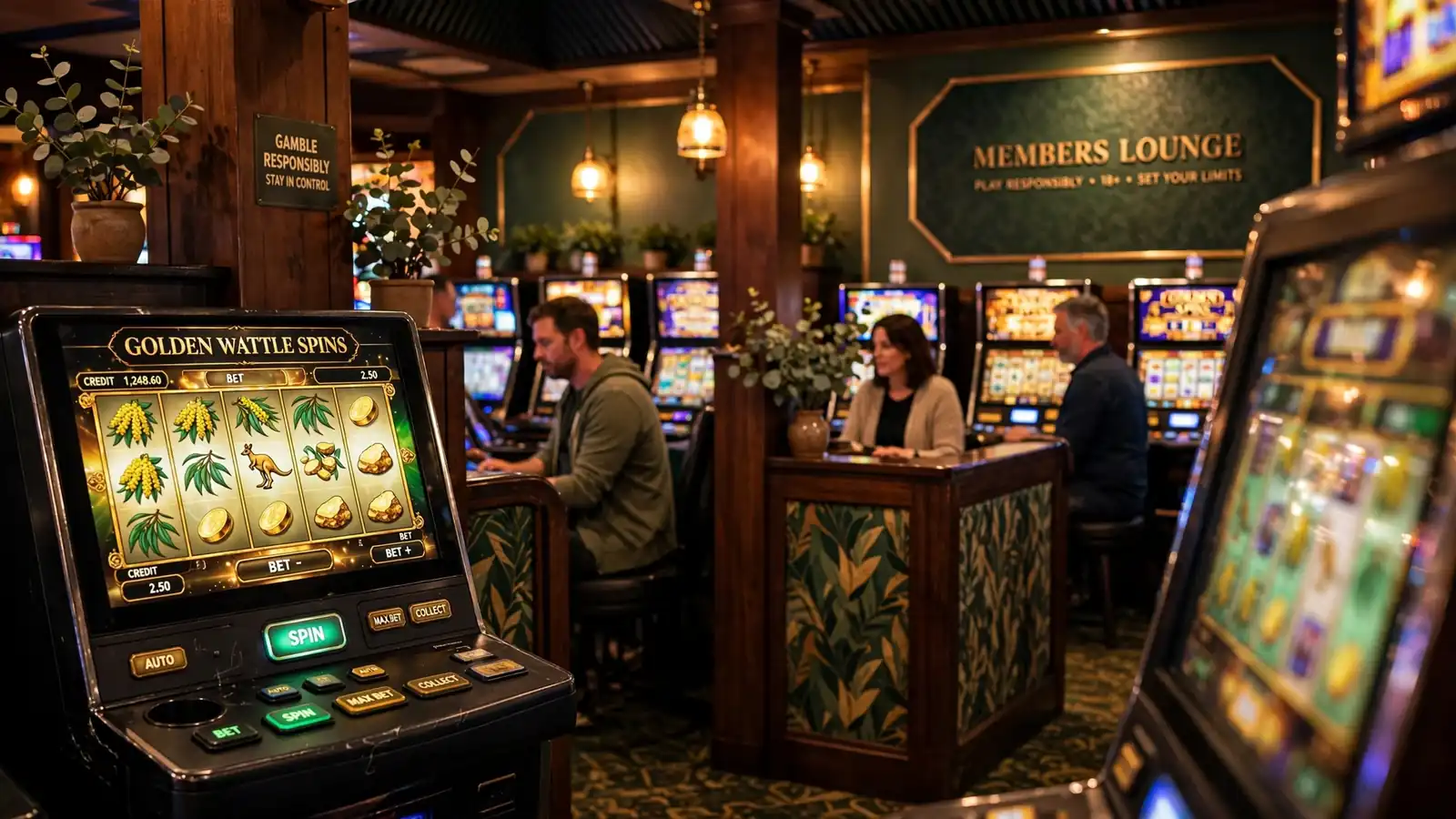
In Australia, “parlour” is not a reliable synonym for a full-scale casino. It is an informal word that can suggest a room or venue for gambling, while a casino is a specific kind of licensed property. The distinction matters: a place described casually as a pokies parlour does not become a casino through its name, its décor or the machines associated with it. The local meaning rests on the venue and its licence, not on a loose label.
A casino is a substantial, formally licensed operation. A broader gambling venue may be described in everyday language without carrying that same status or scale. In conversation, the categories can blur; in regulation, they cannot simply be swapped. Australia’s casino industry is controlled by state and territory jurisdictions, and each casino operates under a licence issued by the jurisdiction where it is located. There is no single national casino licence that turns every gambling room into the same kind of establishment.
That arrangement reflects an Australian habit of governing gambling close to the places where it operates. The national framework is not one uniform permission issued from the centre. Instead, each state or territory has responsibility for licensing its casino properties. A casino’s status therefore belongs to a particular property and jurisdiction. The word on a sign or in a description is not a substitute for that relationship.
Choosing a pokies parlour casino in Australia means weighing the available licensing and payment details before signing up. This list offers a concise reference to the information provided for each operator.
Rollero Casino
Rollero Casino is listed with a Curacao Gaming Control Board licence, OGL/2023/176/0095, held by Hollycorn N.V.
LuckyVibe
LuckyVibe is listed with a Curacao Gaming Control Board licence, OGL/2023/176/0095, held by Hollycorn N.V.
House of Pokies
House of Pokies lists an international iGaming licence, though the jurisdiction is not named. PayID payouts are stated as taking 1–24 hours; the minimum deposit is A$30, or A$10 via PayID.
Wild Tokyo
Wild Tokyo lists a Curacao licence and a minimum deposit of A$10. Its stated payout times are 30–60 minutes for crypto and 1–5 days for fiat.
Uptown Pokies
Uptown Pokies lists a Curacao licence, has been operating since 2017, and has a minimum deposit of A$20.
MrPacho
MrPacho’s stated payout times are 30–120 minutes for crypto and 24–72 hours for fiat. The minimum deposit is A$30.
Golden Pokies
Golden Pokies is listed with a Curacao licence.
WinSpirit Casino
WinSpirit Casino lists a Curacao eGaming licence, OGL/2024/923/0383, held by Antillephone N.V. Its minimum deposit is A$30.
JustCasino
JustCasino is listed with a Curacao Gaming Control Board licence.
Kingmaker
Kingmaker’s stated crypto payout time is about 90 minutes, while fiat payouts take 1–5 days. The minimum deposit is A$30.
The scale of the casino sector is sometimes expressed as a national count. A specialist review reports more than 20 full-scale casinos across Australia’s eight states. That figure is a snapshot attributed to that kind of publication, rather than a permanent definition of the market: properties can change and the count can become dated. Its useful point is narrower. A full-scale casino is one identifiable class within a much wider landscape of gambling venues; it is not a label for every room where gambling takes place.
The word “parlour” can make the distinction sound more settled than it is. In ordinary use, it may describe an atmosphere, a room or a venue associated with pokies. It does not, by itself, tell the public whether the property is a licensed casino, what jurisdiction governs it, or whether the term is simply promotional language. A casino parlour, then, is best understood as a phrase people use to picture casino-style gambling—not as a separate national licence category.
That difference is easy to miss because the experience of a building can seem more immediate than its legal structure. A large property may combine gambling with other forms of hospitality and entertainment. Yet the physical impression does not establish the venue’s regulatory identity. The licence does. Nor does a smaller or more intimate-sounding description tell the whole story. The language of “parlour” compresses a complicated institutional arrangement into a cosy room. Regulation is less cosy.
Major Australian casinos operate around the clock. Their continuous opening hours help distinguish the scale of the operation from the ordinary image suggested by a small parlour, though opening hours alone do not determine a venue’s legal category. Entry is also subject to a nationwide minimum age of 18. Major casinos require valid photo identification, making entry a controlled condition rather than an assumed right of access. Those rules attach to the casino setting, not to the charm or informality of a name.
The use of “casino” in property names can help identify particular establishments, but a name should still be read as part of a property’s identity rather than as a universal description for gambling venues. Lasseters Casino is at 93 Barrett Drive in Alice Springs; Jupiters Gold Coast Casino & Hotel is on Broadbeach Island; and Country Club Casino is listed on Country Club Avenue in Prospect, in Meander Valley. These names point to individual properties. They do not create a general meaning for every place called a parlour.
So the Australian distinction is less about whether a venue feels grand or modest than about what kind of operation it is and which authority licenses it. “Pokies parlour” may convey a popular image, but “casino” carries a more specific institutional meaning. A full-scale casino belongs to a state or territory licensing system, has defined entry conditions and sits within a nationally visible sector. The parlour is a description; the licence is the hard edge.
Australia’s gambling map is broad, but a count of places associated with gambling is not the same thing as a count of casinos. A specialist gambling-venue review puts the number of Australian cities with gambling facilities at 147. That figure describes a wide geographic spread; it does not mean that each city has a casino, or that every facility offers the same kind of gambling.
The distinction matters in a country where local names can blur unlike places together. A city may appear in a gambling directory because it has a gaming venue, while a full-scale casino is a more specific destination. Reading the map as a list of equivalent “parlours” would flatten those differences. Geography is not a licence category.
In the same specialist review’s city ranking, Sydney, New South Wales, is listed as the largest gambling city, with 11 gambling facilities. The figure belongs to that review’s way of counting and classifying venues, rather than serving as a permanent civic statistic. It nevertheless gives a sense of how concentrated a large urban market can look when facilities are counted together. Sydney’s place at the top of such a list says more about the scale of the city’s gambling footprint than about a single, uniform venue type.
The Northern Territory offers a different kind of scale. A specialist gambling-venue review records three casinos across three cities in the territory. Its city-level listing identifies Alice Springs as the territory’s leading city for casinos, with one. That is a modest count, and the ranking’s wording should not be mistaken for a large cluster: the largest local total in that account is still one casino.
Alice Springs gives the geography a precise point on the map. Lasseters Casino is at 93 Barrett Drive, in the town, placing a casino within a regional centre rather than a capital-city district. The address is useful as a location, not as evidence that the surrounding territory has a dense casino network. In remote regions, a named destination can loom large in the mental map precisely because alternatives are far apart.
That distance changes the feel of gambling geography. In a major city, facilities sit within a larger urban pattern; in a regional centre, one venue may become the obvious reference point for a much wider area. The same count can therefore carry different social weight depending on whether it belongs to a metropolis or a place separated from other centres by long stretches of country.
These figures are snapshots assembled through venue classifications, not a timeless census of Australian gambling. The city count, the Sydney ranking and the Northern Territory breakdown should be read as attributed descriptions from specialist review material, which can change as listings and classifications change. Their value is in showing contrast: gambling facilities are distributed widely, while casinos remain a narrower presence within that broader map.
A map, not a menu.
A review of a pokies parlour is most useful when it separates observable details from opinion. “Welcoming”, “lively” and “worth a visit” may convey a writer’s impression, but they do not establish what kind of venue is being described, who authorises its operation or what the review actually checked. A confident verdict can still rest on very little.
In Australia, casino licensing is handled by the state or territory where each property operates. That makes jurisdiction more than a line of fine print: it is part of the venue’s identity. A review that names a casino but leaves its licensing context unclear offers an incomplete account. The relevant question is not whether a page uses the word “licensed” prominently, but whether it identifies a property operating under a licence from its local jurisdiction.
The distinction matters because “parlour” is often used loosely. It may be a label in a review, a description of a gaming area, or simply part of a venue’s marketing language. The label alone does not demonstrate that a place is a full-scale casino, nor does it tell the reader what the reviewer saw. Stronger writing makes the subject precise: it identifies the property and distinguishes direct observation from general claims.
Numbers can help, provided their scope is clear. Across Australia, 3,308 gaming machines are endorsed on venue licences and installed in casinos. That national total gives scale to discussion of casino gaming machines; it does not describe the offering at any individual property. A review that uses the figure as though it were a local count has turned context into decoration. The difference is small in wording and large in meaning.
A careful review also signals the limits of its own evidence. Statements about a venue’s atmosphere are impressions, not regulatory findings. A claim about licensing should be tied to the relevant jurisdiction, rather than presented as a universal feature of Australian casinos. And a broad description of “pokies parlour reviews” should not blur together places whose legal status and operating arrangements are assessed locally.
This approach leaves room for human detail. A writer may describe how a space feels or how its layout shapes a visit, but those observations should not be made to carry claims they cannot support. The point is not to strip reviews of judgment; it is to keep judgment distinguishable from verifiable information. A star rating compresses both into a symbol. Useful prose opens the symbol back up.
The most reliable review is therefore not necessarily the most enthusiastic or the most severe. It is the one that makes clear what was checked, what is a personal impression, and what belongs to the wider regulatory picture. That standard is modest, but it resists the easy slide from description to endorsement. Plainly stated.
The phrase “parlour pokies” can suggest a separate room with a uniform layout and familiar machines. In Australian casinos, the more useful measure is the scale of the licensed machine pool, not an assumption that every property offers the same floor or arrangement.
Across the country, 3,308 gaming machines are endorsed on venue licences and installed in casinos. That total describes machines in the casino sector; it does not mean they are divided evenly among properties, nor that each casino has an identical selection. The number is a national snapshot of a regulated part of the industry, not a guide to a particular venue’s current floor.
The distinction matters because “pokies” is often used broadly in Australian conversation, while the licensing figure is narrower. It counts gaming machines installed in casinos and covered by venue licences. It says nothing about the layout of a gaming area, the atmosphere around it, or the range of machines at any one site. A search for a parlour may therefore lead to a description of a space, but the national figure cannot verify that description.
There is something distinctly Australian in the plainness of the word. “Pokies” turns a regulated machine into a familiar fixture of everyday speech; the licence turns it back into an accountable object. Neither tells the whole story. One belongs to social habit, the other to the administrative record.
The total gives a useful sense of scale without making every casino interchangeable. Individual venues remain shaped by their own licences and operations. A national count is a frame, not a floor plan.
“VIP” is a small word with a large social purpose. In casino language, it suggests a boundary between ordinary access and recognition: a named status, a separate entrance, perhaps a room set apart from the general floor. But the label alone establishes none of those things. It does not say who qualifies, what access is granted, or whether any particular benefit exists. Promotional language can make a hierarchy sound like a service.
The firmer boundary is legal and applies nationally. Casino entry begins at 18, whether a venue presents itself as grand, intimate or exclusive. Major Australian casinos require valid photo identification at entry. A title on a membership card, an invitation or a promise of special treatment cannot replace that check.
This is where the idea of a “VIP parlour casino” needs careful reading. It may describe a marketing category, a physical space or simply a phrase used to give a venue extra polish. Those meanings are not interchangeable. A public description of VIP access is not proof that a particular programme operates as advertised, and the word “VIP” does not itself confer permission to enter.
The distinction matters because casino hospitality borrows the language of clubs. It can imply a private society even where the practical threshold is the same one facing other adult entrants: age and identification. Some venues may impose further conditions, but the label by itself cannot establish them. Access has rules; prestige has adjectives.
There is a dry little truth in that contrast. The language promises distinction; the entry desk asks for proof. For anyone assessing a claim about privileged access, the useful details are the venue’s own stated conditions, not the aura built around a title. Membership, status and entry are separate questions. None should be inferred from the other.
A casino-style site can load on an Australian connection and still have no Australian authority to offer its games. The same is true if it accepts account traffic or reappears at a different web address. These are signs of technical access, not evidence of a local licence. In Australia, the distinction matters: the Interactive Gambling Act 2001 prohibits operators from providing real-money online casino games to people in the country.
That can make the online version of a familiar venue name seem deceptively straightforward. A page may use the language of a pokies parlour or casino, show account features and invite activity. None of those details changes the legal character of the service. Nor does an address that looks newly established, or one that resembles an earlier address, demonstrate that the operator is authorised to serve Australians.
The internet has its own geography, and it is less stable than a city map. The Australian Communications and Media Authority (ACMA), the federal regulator responsible for enforcing interactive gambling law, can ask internet service providers to block access to sites offering prohibited gambling services or advertising them. Blocking can affect whether a particular domain resolves for people using Australian providers. A domain that fails to load is not, by itself, a full account of the service’s status; a site that does load is no proof of legitimacy.
A specialist review has described website-blocking action involving Fair Go-related alternate domains. That is a reported enforcement detail, not a dependable way to identify a service or determine its present status. Website addresses can change over time, while the legal question remains tied to what the operator provides to customers in Australia. A new domain does not make a prohibited service permissible. A familiar name does not make it lawful.
This is why claims about online play need to be read carefully. “Available” may mean only that a page opened at the time someone checked it. “New address” may describe a technical workaround or a change in the site’s routing; it does not certify the operator. Account registration, promotional language or a polished interface cannot substitute for a regulatory basis that is not available for real-money online casinos in Australia.
Free-play wording can blur the same distinction. A site may present a mode as entertainment rather than wagering, but the label alone cannot establish what the service is, how it operates or whether its claims are accurate. It is sensible to separate a genuinely non-monetary demonstration from any invitation to deposit, stake or withdraw money; the latter raises a different legal issue. A “free” label is not a licence in disguise.
The practical lesson is less dramatic than the technology around it. A web address is an address, not a ruling. ACMA’s blocking activity is part of the federal response to prohibited online gambling, and domain changes do not erase that framework. Access can shift; the law does not shift with the URL.
A sign-up offer can make an online casino sound like a shop with a generous opening counter: create an account, receive something to play with, and decide later whether to spend. “No deposit” appears to remove the obvious cost; free chips and spins sound like small gifts. In Australia, though, the label on an inducement does not change the legal character of the service behind it.
The Interactive Gambling Act 2001 prohibits operators from providing real-money online casino games to people located in Australia. That category includes online slots and casino-style games such as poker, blackjack and roulette. A bonus attached to one of those services does not make the underlying offer lawful. Whether the promotion is described as a welcome bonus, a free-chip offer, a no-deposit reward or spins at no charge, it remains bound up with the provision or advertising of a prohibited online gambling service.
That distinction matters because the language of a promotion can make it appear separate from the activity it is designed to bring about. “Free” describes the advertised price of a particular offer; it does not establish that the service can lawfully be supplied in Australia. Nor does the absence of an initial payment turn an online casino into a permitted one. The relevant question is not whether money is required at the first step, but whether the operator is providing a prohibited interactive gambling service to someone in Australia.
A no-deposit bonus is commonly presented as a way to begin without funding an account. A sign-up bonus may be framed as a reward for registration or as an addition connected with a later payment. Free chips and free spins use different imagery, but the promotional purpose is familiar: to draw attention to an online casino and encourage participation. None of those descriptions creates an exception to the federal prohibition.
The same applies when a promotion is presented as a trial, a welcome gift or a limited introductory offer. Changing the name can soften the appearance of a transaction; it cannot change the legal framework. If an offer promotes online casino games to people in Australia, calling its credits “free” does not make the advertising permissible. If the offer is attached to a real-money online casino, the free element does not convert the service into a lawful one.
This is why claims about a “pokies parlour” bonus can be misleading when they refer to an online account rather than a physical venue. Familiar words can suggest a local gaming room, while the actual offer directs people towards internet casino play. The federal law is concerned with prohibited interactive services offered to people in Australia, not with the promotional vocabulary chosen for a webpage.
A physical venue and an online casino are not interchangeable simply because both use gambling language. Nor does the existence of a promotion establish that an online service holds a local entitlement to provide casino games. In Australia, real-money online casino services are prohibited for operators to provide to people here. A promotional banner cannot supply the authority that the service itself lacks.
The rules do not stop at the act of providing the service. The Australian Communications and Media Authority, or ACMA, administers the federal interactive-gambling framework and monitors whether operators comply with it. Its role includes enforcement where prohibited online gambling services are provided or advertised in Australia.
ACMA may ask Australian internet service providers to block websites that supply prohibited interactive gambling services or promote them to the Australian public. Blocking is one part of enforcement, not a declaration that every unblocked page is lawful. A promotion may be visible for a time, and a website may continue to circulate material, without that visibility changing the legal status of the advertised service.
The distinction between availability and permission is easy to blur in online commerce. A page can be written in Australian English, describe itself as welcoming Australian players, or display a bonus in familiar terms. Those details are claims made by the operator or promoter. They do not override the federal law. And the ability to view an offer does not mean that the offer may lawfully be advertised to people in Australia.
The restrictions on gambling advertising also matter for inducements. Promotions for prohibited online casino services are not made acceptable by adding a disclaimer, calling the message informational, or describing it as a neutral comparison. A commercial disclosure cannot turn prohibited casino advertising into permitted material. The substance and purpose of the communication still matter.
ACMA may request internet service providers to block websites that supply or promote prohibited interactive gambling services to the Australian public.
Timing does not create a general safe harbour either. Australian restrictions on gambling inducements and promotions are particularly relevant during the period from 5:00 AM to 8:30 PM. That constraint is not an invitation to advertise prohibited online casinos outside those hours. The underlying ban on advertising real-money online casino services to Australian audiences remains in place; a clock does not make the service lawful.
That point is worth keeping plain. No loophole.
Promotional language often focuses on what is supposedly given rather than what the offer is meant to do. A free chip may be presented as a token, a free spin as entertainment, and a no-deposit bonus as a low-risk introduction. But these are marketing descriptions, not legal classifications that displace the Interactive Gambling Act 2001.
A reward can have conditions, and those conditions may be set out at length. Yet fine print cannot alter the central fact that online casino games offered for real money to people in Australia are prohibited. Reading the terms of a bonus may reveal how the operator describes its promotion, but it cannot establish that the operator may provide the underlying service here.
The same reasoning applies where the bonus is said to be available only after registration, only to selected accounts, or only through a particular page. Such distinctions may shape the promotion’s mechanics, but they do not create a local licence for online casino play. A private invitation is still an invitation to the service being promoted. An offer presented as an exception is not an exception simply because access is limited.
Even the word “parlour” can obscure the difference. In ordinary Australian usage it may evoke a physical gaming venue. In an online promotion, however, that label does not prove that the service is a licensed physical venue, or that an online casino is allowed to accept Australian customers. The law concerns the service actually supplied and promoted, not the atmosphere suggested by a name.
ACMA’s enforcement record shows that the federal framework is not only a set of words on a statute page. Following enforcement action, the authority has blocked more than 1,455 illegal gambling and affiliate websites since November 2019. Blocking orders can affect operators as well as affiliate pages that promote services. The scale of that action gives a practical context to bonus advertising: promotional material is not outside the regulator’s view merely because it appears on a separate page from the casino itself.
There is also a reported count of services that have left the Australian market after enforcement began in 2017. The figures published for that measure disagree: one account says more than 210 services withdrew, while another gives a figure of over 190. Both versions describe withdrawals following enforcement, but they are not the same count.
Website blocking and withdrawals serve different functions. A blocked address can become harder to reach through Australian internet providers; a service that withdraws has stopped targeting the Australian market, according to the reported account. Neither measure should be confused with approval. In particular, the absence of a block at a particular moment does not amount to ACMA authorisation, and the appearance of a replacement page does not reverse the law.
Enforcement also clarifies who the rules address. The prohibition in the Interactive Gambling Act is directed at operators providing prohibited services, and at the advertising of those services. It is not a reason to imply that an individual who encounters or plays at an offshore site faces the same penalties as the provider.
For operators, the consequences are substantial. The maximum daily penalty under the Act is $360,000 for an individual and $1.8 million for a company. Those amounts concern violations of the law, not the value of a bonus or a user’s account. A promotional offer cannot insulate a provider from enforcement; if anything, advertising may bring the prohibited service more plainly into view.
A page advertising a pokies sign-up offer may use familiar phrases, but those phrases should be read as claims about marketing, not evidence of lawful access. “No deposit” describes an asserted payment condition. “Free spins” and “free chips” describe the advertised reward. “Casino bonus” is a broad promotional label. None answers the decisive legal question: whether the operator is permitted to provide online casino games to people in Australia.
The same caution applies to affiliate material. A comparison page may repeat an offer, summarise its conditions or place it beside other promotions. That presentation does not create a separate regulatory status for the bonus. ACMA’s enforcement activity has included affiliate websites, and the law’s concern with advertising cannot be avoided merely by placing the promotional message on a third-party page.
A bonus may also be described as entertainment, a demonstration or a way to explore a site. Such wording should not be mistaken for an exemption. The legal distinction is not between a large reward and a small one, or between paid play and a purportedly free first step. It is between services that the law permits and online casino services that it prohibits for operators to provide to people in Australia.
This leaves little room for the reassuring shorthand often used in online promotions. “Available to Australians” is an operator’s claim, not a legal finding. “No deposit required” does not mean no regulatory issue. “Free” does not mean lawful. And a polished set of terms does not turn a prohibited online casino offer into a permitted one.
The sober conclusion is less marketable than the banner. In Australia, no-deposit offers, sign-up rewards, free chips and free spins cannot legalise or legitimise the online casino service they promote. The federal framework treats the service and its advertising as the central matters. The gift is the wrapping.
A real-money offer can borrow the language of a familiar pokies parlour without sharing its legal footing. A website may describe casino games, invite account activity or present itself as serving Australian players. None of that establishes that it is licensed to provide online casino gambling here.
The legal distinction is not a technicality. Under the Interactive Gambling Act 2001, operators may not provide real-money online casino games to people physically in Australia. That prohibition covers casino-style games such as slots, poker and table games. A local casino licence, meanwhile, belongs to a physical property and is issued by the state or territory where that property operates; it does not turn an online service into an authorised Australian casino.
The screen can make the difference seem small. The law does not. A claim that a service offers real-money play in Australia is not proof of permission, and an online casino should not be treated as the digital counterpart of a licensed gaming venue. The familiar label is not a licence.
The law is directed at providers, not at players: a person using an offshore casino is not subject to a fine or criminal prosecution simply for playing there. That does not make the service lawful for the operator to offer to people in Australia, or make its claims about Australian standing reliable. Federal penalties for contravening the Act can be substantial: the stated maximum daily penalty is $360,000 for an individual and $1.8 million for a corporation.
This is why “real money” describes a payment arrangement, not a regulatory status. In Australia, an online casino claim and an authorised local service are not interchangeable ideas. The difference is plain, if inconvenient.