Venue rules and gaps in local evidence shape what can be confirmed about opening claims and pokies availability in Geelong.
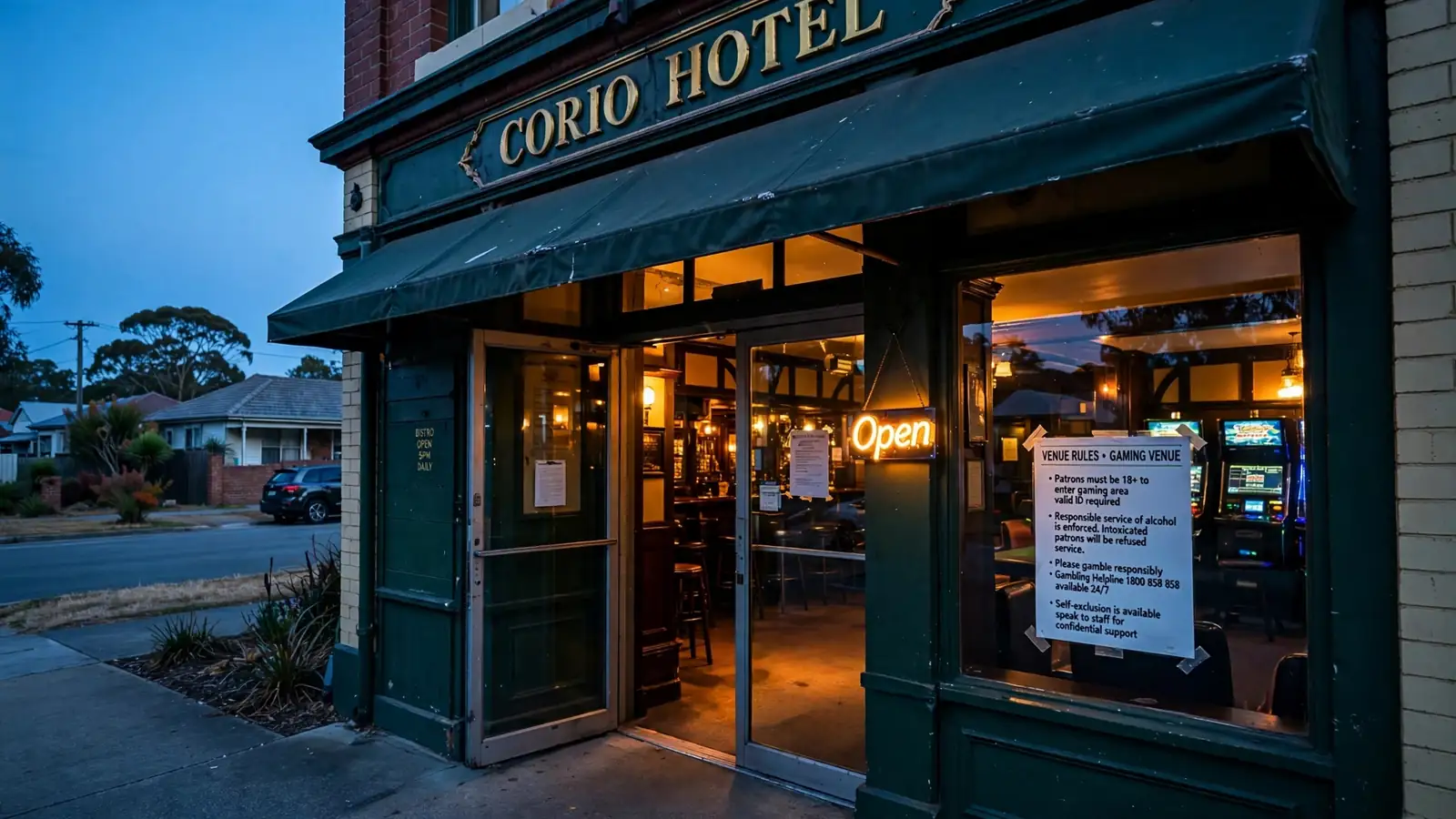
A venue can be open to the public while its gaming machines are subject to a separate set of operating requirements. In Geelong, the phrase “open now” can therefore mean more than a door unlocked and a room in use. It also sits against rules about who must be present when machines are running. That distinction matters because a venue’s general opening status does not, by itself, describe the conditions attached to its gaming floor.
A report published by regionriverina.com.au says that, from 1 July, venues operating more than 20 gaming machines must have a dedicated responsible gambling officer (RGO) on duty whenever those machines are operating. The threshold is about the number of machines at a venue, while the staffing requirement is tied to their operation. It is not framed as a rule that applies only at the busiest hour, or only when a particular patron needs assistance.
The wording makes the RGO part of the operating environment rather than a name on a notice. When the machines are in use, the officer is to be on duty. That is the practical hinge in the rule: the relevant condition follows the machines’ activity, not simply the venue’s public-facing schedule. A venue’s bar, dining room or other facilities may have their own routines, but this requirement concerns the period in which the gaming machines are running.
There is a social idea embedded in that arrangement. Gambling regulation has often been presented as a matter of individual choice: a person decides to play, and the consequences are treated as personal. A requirement for a dedicated officer places some responsibility back inside the institution where the play takes place. The venue is not only the setting for private decisions; it is also expected to have a designated presence while gaming is underway.
That does not, on its own, explain every task the officer performs, or make a promise about what will happen in a particular interaction. It does establish a condition of operation for venues above the stated machine threshold. In that sense, the rule is less a prediction about how patrons will behave than a decision about what the venue must have in place while its machines are active.
The report also describes a one-month grace period for venues to make the change, including introducing responsible gambling officers and removing signage. A transition period recognises that a new requirement may need to be put into practice across venues rather than appearing fully formed on its first day. It is a limited accommodation, not a permanent alternative to the rule. Once that period has passed, the reported requirement remains tied to machine operation.
The mention of signage belongs to the same transition, but it should not be confused with the staffing condition. One concerns what venues need to remove; the other concerns the presence of an RGO while machines operate. Both point to the way regulation is made visible in a physical venue: through what is displayed and through who is present. Neither tells a traveller whether a particular Geelong venue is open at a chosen moment.
That is where the wording “open now” can become misleading. An opening listing speaks to access or business hours; the requirement described in the report speaks to a venue’s responsibilities during gaming operations. These are related in practice, but they are not interchangeable. A venue might be accessible for other purposes when its gaming machines are not operating, and the RGO rule, as reported, follows the latter activity. The distinction is modest, but useful.
Nor does the rule identify which Geelong venues fall above the threshold. It describes a condition for venues with more than 20 machines, not a local directory or a count of machines at any named establishment. The threshold can clarify how the obligation is structured without serving as evidence about an individual venue. Regulations define categories; they do not automatically supply the particulars of every place a person might be considering.
For people looking at a venue as a place of entertainment, this can seem like administrative detail. Yet administration is where a public promise becomes a routine requirement. The officer’s presence is not a decorative assurance that play is harmless. It is a specified feature of operation in the circumstances described by the report. That is a narrower claim, and a more meaningful one, than broad language about safety.
Geelong’s gaming venues belong to a wider culture in which leisure and oversight occupy the same room. The machines offer one kind of invitation; the RGO requirement marks the point at which the venue’s own obligations become part of the scene. The rule does not settle every question raised by a search for a place to play. It does set a condition around how qualifying venues operate.
A rule for the room.
Choosing pokies in Geelong for 2026 means checking the details that matter before you play, including licensing and the payment information available. This list offers a concise starting point for reviewing your options.
Rollero Casino
Rollero Casino lists a Curacao Gaming Control Board licence, OGL/2023/176/0095, held by Hollycorn N.V.
LuckyVibe
LuckyVibe lists a Curacao Gaming Control Board licence, OGL/2023/176/0095, held by Hollycorn N.V.
House of Pokies
House of Pokies lists an international iGaming licence, though its jurisdiction is not named in the available information. PayID withdrawals are listed at 1–24 hours, with a A$30 minimum deposit or A$10 when depositing by PayID.
Wild Tokyo
Wild Tokyo lists a Curacao licence and a A$10 minimum deposit. Its listed payout times are 30–60 minutes for crypto and 1–5 days for fiat.
Uptown Pokies
Uptown Pokies lists a Curacao licence, has been operating since 2017, and has a A$20 minimum deposit.
MrPacho
MrPacho lists crypto payouts at 30–120 minutes and fiat payouts at 24–72 hours. Its minimum deposit is A$30.
Golden Pokies
Golden Pokies lists a Curacao licence. That licensing detail is the available point of note.
WinSpirit Casino
WinSpirit Casino lists a Curacao eGaming licence, OGL/2024/923/0383, held by Antillephone N.V. Its minimum deposit is A$30.
JustCasino
JustCasino lists a Curacao Gaming Control Board licence. This licensing information is the available point of note.
Kingmaker
Kingmaker lists crypto payouts at approximately 90 minutes and fiat payouts at 1–5 days. Its minimum deposit is A$30.
A claim that one pokie is the best in Geelong sounds precise. It may mean the game is more entertaining, pays more often, or returns a larger share of wagers over time. Those are different claims, and none can be established simply by naming a game. A ranking of the best-paying pokies in Geelong would need evidence about the games and the settings actually in use, not just familiar titles or stories about a lucky session.
Every spin is generated separately by a Random Number Generator. Its result does not become more favourable because earlier spins were losses, nor less favourable because a win has just landed. A run of outcomes can look patterned to the person watching it; that does not make the next result predictable. Randomness has no memory. The machine does not owe anyone a turn.
This matters because short sessions are a poor basis for comparing games. One player’s payout, or a handful of wins observed in a venue, cannot show that a pokie pays better in general. Chance can produce a striking result without revealing anything reliable about what will happen in the next session. A memorable win is evidence that someone won; it is not a performance table.
Return-to-player figures can appear to offer a firmer measure. They describe a proportion of wagers returned across play, rather than a promise about what a particular person will receive. Even where a figure is published, it cannot forecast an individual outcome. And the figure attached to a game name may not settle the matter: a specialist review reports that some providers let casinos choose between different RTP settings for the same pokie. The same title could therefore operate with different return percentages at different casinos.
That distinction is easy to miss. A game name can stay constant while its configuration differs. A comparison based only on titles, promotional descriptions or a player’s recollection may present unlike settings as though they were identical. Without the relevant setting for the particular machine, a confident ranking risks measuring the label rather than the game as configured.
The phrase “best pokies in Geelong” also slides between meanings. It can refer to the experience of playing a particular game, to its advertised return figure, or to the venues where pokies are available. Those questions require different kinds of evidence. A game-level ranking cannot establish which venue is preferable, and a venue’s name cannot establish the RTP setting of every machine there. Geography does not make a random result less random.
Nor does the word “best” become objective when attached to the CBD, the city or a casino. A local label tells little about the mechanics of a spin. A player may prefer a game’s pace or presentation; another may care about its features. Those are preferences, not proof of higher returns. The distinction is not pedantic. It separates a judgement about taste from a claim about money.
For the same reason, online pokies associated with Geelong do not supply a shortcut to a local ranking. A game’s availability or title alone cannot establish its settings, and an online listing cannot stand in for evidence about a physical machine. The question is not where a name appears, but what claim is being made about it and what supports that claim.
A meaningful comparison would need to identify the precise game and its relevant configuration, then explain what the return figure measures and what it cannot promise. Even then, no RTP setting predicts the result of a single spin or guarantees a session’s outcome. Without those particulars, the most honest answer is not a list dressed up as certainty. It is a recognition that “best” may describe preference, but “pays best” is a factual claim.
The distinction is less glamorous than a winner’s story. It is also the useful one.
Geelong does not sit outside the national rules for online gambling. The Interactive Gambling Act 2001 prohibits companies from providing real-money online pokies to people in Australia, and no Australian licences for online casinos have been issued. There is no domestic online casino industry operating under such a licence.
That distinction matters because searches for online pokies connected with Geelong can make the activity sound like an ordinary local service: a venue moved onto a screen, perhaps with a bonus or a larger bet. The legal position is not a matter of which suburb appears on a website. The relevant question is whether an operator is allowed to offer real-money casino games to people physically in Australia. Under the Act, it is not.
The law is directed at operators, rather than imposing the same prohibition on individual players. Australians may play on offshore sites that accept them, but that does not make those services licensed or protected in Australia. The difference between a player’s legal position and an operator’s obligations is easy to flatten in casual discussion. It should not be. A person’s ability to reach a site is not evidence that the site is authorised to serve them.
Nor is access assured. The Australian Communications and Media Authority enforces the Act and blocks illegal offshore gambling sites; internet service providers must comply with its blocklist. A site may therefore be unavailable, or its access may change. This is a national enforcement measure, not a guide to which services are suitable or dependable.
The most consequential limit appears when a dispute arises. If an offshore casino refuses to pay winnings, an Australian player has no legal recourse in Australia against that operator. The absence of a domestic licence is not merely a label on a website. It means there is no Australian-licensed online casino standing behind the transaction, and no local casino regulator through which a player can pursue unpaid winnings from an offshore operator.
That is why claims about “best-paying” online pokies, real-money play, or a no-deposit offer cannot be treated as a simple extension of choosing a local venue. A promotional promise may describe what an offshore business says it will do; it does not create Australian oversight or a domestic route for resolving a payment dispute. Nor does a Geelong reference change the legal status of the service. The city name can be attached to a page from anywhere.
The distinction is plain, if not reassuring. Operators are barred from supplying these services to Australians, while individual players are not the target of that prohibition. Yet the player who chooses an offshore site carries the practical exposure: if winnings are withheld, Australian legal recourse is unavailable. That gap is part of the system, not a footnote to a bonus.
For anyone comparing local pokies with online offers, the important point is therefore not a claimed payout, stake ceiling or welcome incentive. It is the jurisdiction behind the offer—and, in this market, no Australian-licensed online casino exists. A screen can suggest proximity. It cannot supply protection.
A request for pokies near Geelong Airport sounds like a question about geography. It is really a question about evidence: which venue, at what address, and how far from the airport? Without a confirmed venue location and a reliable distance, a claim of proximity is only a suggestion dressed as a direction.
The same applies to searches for pokies in Geelong, Victoria, or around North Geelong. A suburb or city name narrows a map, but it does not identify a particular venue. Nor does it establish that a venue is close to a landmark. “Near” can mean a short walk to one person and a drive to another; without a stated starting point and a measured route, the word has no stable meaning.
That distinction matters around an airport. A place name may appear in a venue description, a map label or a search result without proving that the venue is inside the airport, beside it, or conveniently reachable from it. The phrase “pokies at Geelong Airport” makes a stronger claim still: it implies that gaming machines are located there. No such conclusion follows from the wording alone.
Maps can help once an address is known, but they do not solve the first problem. A pin needs to refer to an identifiable venue, and a distance needs a chosen route or measurement. Straight-line distance and road distance are not interchangeable; neither tells the whole story of access. Without the underlying location, a neat number would be false precision.
There is a small social history in this reliance on proximity. Older directories offered names and addresses; digital maps promise an answer at a glance. The promise is useful, but the map is not an independent witness to every label attached to it. A result can look settled because it is displayed with confidence. Confidence is not confirmation.
For someone looking around Geelong’s central area, the same restraint applies. Asking about pokies near the CBD does not establish that a specific club is there, and a broad city result does not show how far away a venue might be. Those are separate claims, each requiring a dependable address and a clear point of comparison. The wording of a location label cannot carry both.
This is not a reason to treat every map or listing as wrong. It is a reason to separate what a listing says from what can be checked: a venue’s identity, its address, and the distance from the relevant starting point. Until those pieces line up, neither “near Geelong Airport” nor “near me” is a dependable description. The latter is especially personal; distance changes with the person’s position, and no general label can settle it.
A careful account can leave a blank where a distance ought to be. That blank is less satisfying than a pin and a travel estimate, but more honest than turning an unconfirmed association into a local recommendation. On a map, a confident label is easy. A verified place is harder.
A venue’s record-keeping obligation concerns more than the machines on the floor. A report by regionriverina.com.au says venues will be required to keep a gambling incident register, recording details of occurrences that include a patron showing behaviour suggesting they may be at risk of gambling harm or already affected by it.
That is a different kind of measure from a rule about what a venue offers. It makes attention itself part of the system: an occurrence that might otherwise pass as a private moment becomes something the venue is expected to document. The register does not make a judgement about which pokie is “best”, nor does it turn a venue into a measure of the quality of the games. Its subject is the incident, and the possible harm visible in a patron’s behaviour.
For people comparing Geelong pokies venues, that distinction matters. A description of a room, a machine or a club cannot establish how an individual patron will fare. Nor does the existence of a register mean that every difficult session will be recognised in the same way. The reported requirement is narrower: details of relevant occurrences are to be recorded, including circumstances in which behaviour indicates risk or harm.
There is a social history inside that paperwork. Gambling has often been treated as a matter of personal choice, while the places that host it have been understood as ordinary parts of hospitality and entertainment. An incident register shifts some attention from the individual to the institution around them. The venue is not merely a backdrop; it has a role in noticing and recording signs that a person may be in trouble.
That shift is modest in form and consequential in principle. A record cannot undo a loss or explain the full circumstances behind someone’s behaviour. It can, however, make an occurrence legible to the organisation rather than leaving it as an unrecorded impression. The difference is administrative, but administration is often where public responsibility becomes visible.
The register also gives the phrase “best pokies venue in Geelong” a less convenient meaning. A venue cannot be assessed responsibly by treating its machines as the whole story. The way a gambling business responds to signs of harm belongs in the picture too, even though the existence of a register alone cannot show how carefully that responsibility is carried out. Paperwork is evidence of a process, not proof of its quality.
For venues in Geelong, including those in the CBD, the reported requirement is therefore not a guide to finding a winning machine or a ranking of local rooms. It concerns what happens when play appears to be affecting a person. That is a less marketable feature than a bright bank of pokies. It is also the point.
A round-the-clock label looks decisive. It compresses a complicated question into a neat promise: doors open, machines available, no need to wonder about the clock. But a listing is a statement about a venue, not the venue itself. Without current confirmation from the venue, the label cannot establish that pokies are operating at the moment someone arrives.
Opening information can be copied from one directory to another, retained after circumstances change or presented without saying when it was checked. The format may look authoritative; the underlying detail may still be stale. Repetition does not make it confirmation. A claim appearing in several places can have travelled from the same original entry rather than being checked independently.
“Open now” carries an even shorter shelf life. It depends on the time the information was updated and on what the status actually refers to. A venue may be open while its gaming area is not available; a general business-hours entry may say nothing precise about access to pokies. Those distinctions matter because a person is not travelling for a phrase on a screen. They are trying to establish whether a particular activity is available at a particular time.
The wording “24-hour pokies venue” can also blur two separate claims: that a venue operates around the clock, and that pokies are accessible throughout that period. One does not automatically prove the other. A listing that gives a broad opening status may not explain which parts of the premises it covers, or whether the information concerns the venue as a whole rather than its gaming facilities.
For Geelong, a reliable statement about opening hours needs a clear connection to the venue and a current basis. A dated update, a direct notice from the venue or a recent confirmation would be more informative than an undated directory label. Even then, the wording should be read narrowly: an opening time is not necessarily a promise that every service is available for the entire period.
This is less a technical problem than a familiar one of modern information: convenience makes claims easy to circulate, while responsibility for keeping them current is less visible. The clock on a listing does not prove that anyone has checked it. A plausible entry is still only an entry.
So a search for late-night or all-night pokies in Geelong cannot be settled by the shape of a listing alone. The distinction is modest but important: published hours are a claim; verified hours require evidence tied to the venue and the time in question. No shortcut in typography can do that work.
Crown and Geelong can appear together in a search, but the pairing is not evidence of a Crown casino in Geelong. The name alone does not establish a local venue, a pokies room, or a particular collection of machines. Those are separate claims, and each would need reliable, location-specific confirmation.
This distinction matters because a familiar casino brand can become a shorthand for an imagined place. A person looking for pokies in Geelong may add “Crown” because the name is associated with casino gaming elsewhere; the words then travel together, even when the local connection remains unproven. Search language can express an expectation, not document a fact.
Nor does the phrase “Crown pokies” identify which venue is meant. It might refer to a brand association, a comparison someone hopes to make, or simply a set of terms placed side by side. Without a confirmed Geelong location, there is no sound basis for describing a Crown gaming floor there, naming its machines, or treating it as one of the city’s options.
That leaves little room for a meaningful “best pokies room” judgement. A room cannot be assessed as a local destination until its identity and location are established. And the phrase “maximum cash payout” does not supply that missing foundation: it does not identify a machine, a venue, or a verified payout condition. A large-sounding claim is still only a claim.
There is a broader habit at work here. In leisure, a recognised name can stand in for the practical details people need: where a venue is, what it offers, and whether it exists in the place being discussed. The shortcut is understandable. It is not confirmation.
For a Geelong venue guide, the careful description is therefore limited: the Crown association is not established as a local casino or pokies room. That is not a claim that no connection could ever be documented; it is a refusal to turn a string of words into a venue listing. No local games or payout terms can responsibly be attached to the name on this basis.
The difference may seem modest, but it is the difference between a useful local reference and a confident-sounding fiction. In a town guide, a name should lead to a place that can be identified, not merely to another name. Until that link is clear, Crown belongs outside any factual list of Geelong pokies venues.
A club in Geelong’s central business district can mean a social organisation, a licensed venue or simply a place described that way in a directory. Those categories are not interchangeable. A familiar name, a central address and the presence of pokies are separate claims; one does not establish the others.
That distinction matters when looking for a place to play. A venue description may identify a club without saying whether it has pokies. A reference to pokies may not establish the club’s precise identity or address. And a label such as “CBD” can describe an area broadly without resolving which premises it means. The language is compact; the real-world details are not.
The idea of a “best” CBD club also carries more than one possible meaning. It could refer to atmosphere, location, facilities or the availability of pokies. Without a specific venue and a clear basis for comparison, the word offers a verdict without showing what has been judged. It is easy for a directory label to sound more definite than it is.
There is a more personal question beneath these searches, too: what happens when someone wants distance from gambling? Self-exclusion is among the standard responsible-gambling tools, alongside deposit, loss and session-time limits. But a general description of the tool does not establish how a particular Geelong club handles it. The venue’s identity matters because the practical arrangements belong to the place, not to the broad label “CBD”.
This is a small problem of urban naming. A district can feel legible on a map, while the institutions within it remain harder to distinguish: a club with one purpose, a venue with another, a directory entry that compresses both. Search terms flatten those differences into a few words. A useful account has to put them back.
For Geelong CBD, the careful distinction is between the kind of place being sought and a particular club that can be identified as offering pokies. The first is a recognisable category. The second requires a name and details that can be tied to that venue, rather than inferred from its description or location. Otherwise, a list of clubs would look precise while leaving the central question unanswered.
“Parkes” can do several kinds of work in a place description. It might be a suburb, a street, a business name or simply a word carried into a listing from somewhere else. Those meanings are not interchangeable. A name placed beside Geelong does not, by itself, establish that a venue is in the city, or that the name identifies a particular venue at all.
That distinction matters when the subject is pokies. The phrase “pokies in Parkes, Geelong” sounds like a location, but its grammar cannot settle what Parkes refers to. A venue name can resemble a place-name; a place-name can appear in a copied description; and an incomplete label can travel further than the details that once explained it. The result looks precise while leaving the essential question unanswered.
Geelong pokies are not made easier to identify by attaching a second name without context. Nor does the word “best” turn an uncertain location into a useful recommendation. Before a place can be compared with another, it has to be identifiable as a place: its name, address and relationship to the city need to point to the same real-world location. Otherwise, the description offers a suggestion, not a dependable local guide.
This is a small problem with a familiar shape. Place-names are treated as evidence because they look like coordinates. But a label is not a map, and repetition is not confirmation. In a city-based list, an unexplained Parkes reference can blur the boundary between a Geelong venue and something merely associated with the word.
The distinction is less dramatic than a claim about machines or winnings, but it affects the basic task of choosing where to go. A local listing should make its geography legible, not ask a name to carry more meaning than it can bear. Until the relationship is clear, Parkes remains a label rather than a reliable address.
Cashless gaming sounds like a small change in the machinery of a venue: less paper, fewer coins, a different way to move money between a patron and a pokie. But the label can cover distinct arrangements, and a search for cashless pokies in Geelong does not establish which, if any, are available locally. No specific Geelong venue or machine arrangement can be identified on that basis.
That distinction matters. A payment method used by an online operator is not evidence about how a physical pokie accepts funds. PayID, for instance, is a transfer system built on Australia’s New Payments Platform. Its existence says nothing about whether a club or hotel in Geelong uses cashless gaming, what equipment it has, or how a patron would pay at a machine. The digital vocabulary is familiar; the local fact remains separate.
There is also a geographical hitch in searches joining Newcastle and Geelong. The wording might reflect a comparison, a mistaken association or an attempt to find a particular service across two places. It does not, by itself, identify a Newcastle connection to a Geelong venue. No club, operator or machine system can responsibly be attached to that phrase without evidence.
The same restraint applies to the word “best”. A cashless payment arrangement would not establish that a pokie is better, fairer or more rewarding. Nor would it settle what the venue offers. Payment infrastructure and game outcomes are different questions, however neatly they fit into one search.
For now, the useful distinction is between a general technology and a confirmed local offering. Geelong venues may be discussed in broad terms, but no particular cashless arrangement can be attributed to one here. A tidy label is not a local record.
Yes, Australians can legally play on offshore sites that accept them, but operators cannot legally offer real-money online pokies to Australian residents without a domestic licence, and none have been issued. If an offshore casino refuses to pay, players have no legal recourse in Australia.
Check the wagering requirement and what it applies to before accepting: a $500 bonus with 40x wagering requires $20,000 in bets, while 35x on a $500 deposit plus a $500 bonus requires $35,000. Also check for cash-out caps on free-spin winnings and withdrawal limits.
Yes, PayID is treated like any other qualifying deposit method. You need to link it to a bank account first, and some banks may block transfers to known gambling merchants.