The guide separates operator restrictions from gameplay, covering dealer streams, betting choices, payments, strategy and baccarat rules.

The legal position of online baccarat in Australia begins not with the table but with the operator. Under the Interactive Gambling Act 2001, Australian-licensed operators cannot offer online casino games. There are no locally licensed online casinos officially operating in the country. That leaves a conspicuous gap between the familiar language of casino play and the services that Australian law permits operators to provide.
Baccarat sits within that wider category of online casino games. Its reputation for restraint—a few choices, a quiet table, numbers kept close to nine—does not give it a separate legal status. Nor does placing a human dealer on screen change the character of the service. The relevant distinction is not whether the cards are physical or the presentation resembles a casino floor; it is whether an operator is providing a real-money online casino game to people in Australia.
The Act places the obligation on operators. Australian-licensed businesses are not permitted to supply online casino games, including baccarat, to customers in the country. In practical terms, there is no domestic online casino licensing system under which a local operator can offer this game as an authorised online casino product. That is a regulatory boundary, not a comment on the appeal of the game or the conduct of any particular player.
Australians do encounter baccarat through international casino platforms that accept Australian players. That presence can make the market appear more ordinary than its legal structure is. A site may be visible, a game may load, and a familiar payment interface may appear; none of those facts turns the service into a locally licensed Australian casino. Availability on a screen and permission to operate in a market are different things.
The distinction matters because online gambling services are not defined by their branding. A platform may describe itself as international, use a foreign licence, or present a polished live-dealer lobby. Those details do not override the Australian rule against operators providing real-money online casino games to people physically located here. The Act concerns the service and its provision, not the atmosphere surrounding it.
The resulting landscape is uneven: a domestic operator cannot lawfully offer online baccarat, while Australians nevertheless encounter the game on international platforms. The existence of the latter does not establish local authorisation. Nor does the familiar look of a casino interface make the legal boundary disappear. A screen is not a jurisdiction.
That boundary also explains why the phrase “Australian casino” can mislead when attached to online baccarat. It may refer to an audience, a currency option, or a site that accepts Australian customers; it does not necessarily mean the operator is licensed in Australia to provide casino games. In a market where locally licensed online casinos do not officially operate, those meanings should not be blurred into one. A local connection is not a local licence.
The Interactive Gambling Act is directed at operators, rather than setting out a general criminal penalty for an individual merely for playing at an offshore casino. That distinction should not be turned into an endorsement of offshore gambling. The law’s restriction on provision remains, and a platform’s willingness to take Australian customers is not evidence that the service has Australian approval.
Enforcement and access can also be distinct questions. A service appearing online does not establish that it is authorised or will remain accessible. International platforms may be subject to blocking and enforcement measures in Australia. For that reason, visibility should not be mistaken for dependable access, regulatory oversight, or a remedy if a dispute arises. The legal position is less tidy than a green tick beside a website. It is also less reassuring.
This is the setting in which live baccarat online in Australia is encountered: not as a product offered by a locally licensed online casino, but as a game associated with international services operating across a legal boundary. The distinction is worth keeping plain. It prevents the language of “Australian players” from being mistaken for the language of Australian authorisation.
18+ only. Gambling can cause financial harm and is not a way to make money. Participation carries a risk of loss; Jackpotjillcasinohubau.com is not liable for gambling losses. Responsible gambling means recognising that risk and seeking help if gambling is causing harm.
Choosing a live baccarat casino involves more than finding a table: licensing, deposit requirements and payout details can help you assess whether an option fits your needs. Use these operator notes as a starting point and check the relevant terms before playing.
Rollero Casino
Rollero Casino is listed with a Curacao Gaming Control Board licence, OGL/2023/176/0095, held by Hollycorn N.V.
LuckyVibe
LuckyVibe is listed with a Curacao Gaming Control Board licence, OGL/2023/176/0095, held by Hollycorn N.V.
House of Pokies
House of Pokies lists an international iGaming licence, though the source does not name the jurisdiction. Its minimum deposit is A$30, or A$10 when using PayID, and PayID payouts take 1–24 hours.
Wild Tokyo
Wild Tokyo is listed as Curacao-licensed, with a A$10 minimum deposit. Its stated payout times are 30–60 minutes for crypto and 1–5 days for fiat.
Uptown Pokies
Uptown Pokies is listed as Curacao-licensed and operating since 2017. The stated minimum deposit is A$20.
MrPacho
MrPacho has a stated minimum deposit of A$30. Its listed payout times are 30–120 minutes for crypto and 24–72 hours for fiat.
Golden Pokies
Golden Pokies is listed as Curacao-licensed.
WinSpirit Casino
WinSpirit Casino is listed with a Curacao eGaming licence, OGL/2024/923/0383, issued to Antillephone N.V. Its stated minimum deposit is A$30.
JustCasino
JustCasino is listed as holding a Curacao Gaming Control Board licence.
Kingmaker
Kingmaker lists a minimum deposit of A$30. Its stated payout times are around 90 minutes for crypto and 1–5 days for fiat.
A ranking implies more than a tidy order. It suggests that the options have been assessed on comparable terms, that the assessment can be trusted, and that the names belong in a recommendation. For online baccarat in Australia, that implication is difficult to defend. There are no locally licensed online casinos, and real-money online casino games cannot lawfully be provided to people in Australia by Australian-licensed operators. A list of offshore services presented as the “best” would not become responsible merely by adding a disclaimer beneath it.
The practical question is narrower: what conditions shape the experience, and what do those conditions reveal? The answer is not a league table. It is a set of constraints that can be read without treating an operator as endorsed or suggesting that offshore casino play is an appropriate choice.
One such constraint is the gap between a displayed balance and money that can actually be withdrawn. A specialist review reports weekly withdrawal caps of $5,000–$10,000 at offshore sites. That is a reported range, not a dependable rule for the market: terms vary, and a figure found in a review does not establish what another service will permit. Withdrawal conditions can also be more consequential than the betting interface. A balance may look simple on screen; access to it is governed by rules.
The relevant details are not captured by the word “fast.” A withdrawal policy has to be read for its stated cap, the period to which that cap applies, and any conditions that affect access to funds. Those terms are not interchangeable. A cap can matter to a player with a large balance even when the displayed table limits seem generous; for someone else, it may never become relevant. Either way, a headline promise is less informative than the actual condition.
High-stakes tables make the contrast sharper. A specialist review reports that VIP baccarat at some casinos may set betting limits as high as A$20,000 per bet. This describes a possibility reported for some tables, not a standard or a recommendation. A high ceiling says little about the quality or safety of the surrounding service. It says only that the table may accommodate large wagers—an invitation to risk more, not evidence of being “better.”
The word “VIP” has a social history of its own. Casinos have long arranged access in tiers, making status visible through rooms, service and limits. In an online interface, the hierarchy can be reduced to a label and a number. The old arrangement remains: a larger stake is treated as a privilege, although it also enlarges the possible loss. The velvet rope has become a menu option.
A meaningful comparison, if made for analysis rather than recommendation, would therefore separate unlike things. Table limits concern the size of permitted bets. Withdrawal caps concern access to funds. Neither establishes that a service is trustworthy, lawful for Australian players, or suitable for any individual. They should not be compressed into a single score, as though the largest limit or the loosest cap could settle the matter.
There is also a basic problem of evidence. Conditions can differ between tables and account types, and published reviews may report a particular set of terms rather than a universal condition. A number without its context can create false certainty. For that reason, reported figures are best treated as snapshots of what a particular source describes, not as promises about a whole category of sites.
So “best” cannot responsibly mean a ranked set of casinos here. At most, it can name the questions raised by the market: how withdrawals are capped, what limits are attached to high-stakes tables, and whether the terms are clear enough to understand. That is a way to examine conditions, not a way to endorse providers.
Gambling involves financial risk, and losses can occur. Jackpotjillcasinohubau.com is not liable for gambling losses. For adults aged 18 and over only. If gambling is causing harm, seek support from an appropriate Australian gambling-help service.
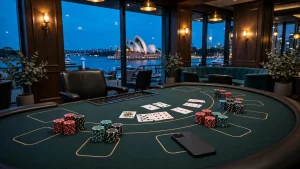
Live dealer baccarat makes the dealer part of the experience in a way a digital display cannot. A real person handles physical cards in a studio; a camera carries the deal to a virtual baccarat table, where the betting prompt appears in real time. The screen is not merely illustrating a sequence generated elsewhere. It shows a human performance, with the pauses, gestures and routine of a table game.
That distinction has a social history. Baccarat has long been presented as a game of ceremony as much as arithmetic: a formal table, a dealer’s measured movements and players gathered around a shared event. Streaming carries some of that staging into a private screen. The studio supplies the setting; the viewer supplies the audience. The old table becomes a broadcast.
The dealer’s role is practical as well as theatrical. Cards are handled in view of the camera, and the live feed connects each stage of the game to prompts on the virtual table. Those prompts let participants follow the timing of the round and respond while it is under way. The stream therefore has two rhythms: the physical pace of the dealer and the digital pace of the interface. When they align, the game feels continuous. When the connection falters, the seam between studio and screen becomes conspicuous.
A live dealer baccarat table is not a room full of players in the ordinary sense. Participants may be watching from separate places, while the interface gathers their activity around one televised dealer. Some specialist reviews report that chat with the dealer or other players may be available, though this is a feature to verify for the particular table rather than an inherent part of every broadcast. Where it exists, chat adds a small human channel to an arrangement otherwise built from camera, cards and on-screen controls.
That channel can change the atmosphere without changing the basic structure. A greeting or brief exchange makes the table feel less like a sequence of buttons. Yet the dealer is also working to a production routine: keeping the game legible to the camera and the prompts in step with the action. The apparent intimacy has a frame around it. The studio is both workplace and stage.
The webcam view matters because it lets the audience observe the physical dealing rather than simply receive a result. It does not turn a remote viewer into someone seated at the table; it offers visibility into a managed broadcast. The cards, dealer and table are real, while the surrounding experience—account controls, prompts and chat, if provided—is mediated by software. That mixture is the defining texture of live play.
There is a quiet tension in it. A centuries-old table ritual reaches people through a system designed for immediate response, and the human presence makes the screen seem less abstract even as distance remains. The dealer is visible; the room is not shared. The distinction is easy to overlook.
This description is informational, not an invitation to gamble. Live dealer gambling is for adults aged 18 and over. Gambling can cause financial harm, and the website accepts no liability for losses. Anyone affected by gambling should seek support and consider stepping away from gambling activity.
Online baccarat is not a single format with a single source of outcomes. International platforms offer both live dealer baccarat and RNG baccarat, and the difference is more than a change of screen design. One format presents a physical deal as it happens; the other uses software to determine the result. Both carry the name of the same game, but they ask for different kinds of attention.
In live dealer baccarat, cards are dealt at a table and the action is shown through a studio stream. The pace depends partly on the table’s format and the time taken for each round to move forward. That visible process gives the game a human rhythm: there is a pause while a hand is dealt, then a new round begins. The dealer and the physical cards are part of what is being watched, not merely decoration around a digital result.
RNG baccarat has no physical cards behind the outcome. Algorithm-based software determines what happens, with the result presented on screen rather than produced by a dealer’s hand. The distinction is plain, though its implications are easy to miss: a digital table can resemble a traditional one while the event itself is being generated by software. The visual language may borrow the old table; the mechanism is different.
Neither format is inherently a more authentic version of baccarat. The live table makes the dealing process visible, while RNG baccarat removes that process from view. For some players, the interest lies in watching a hand unfold; for others, a software-led game may feel more direct. The formats offer different experiences, not different guarantees about what a result will be.
Tempo separates live tables further. A specialist review reports a pace of 40–50 hands per hour for standard live baccarat, while Speed tables exceed 80 hands per hour. Those figures describe a marked difference in how quickly rounds pass, rather than a change to the game’s identity. The slower table leaves more room between hands; the faster format compresses that interval. A name like “Speed” is unusually literal.
Speed does not mean that the cards have become software-generated. It remains a live format, with physical cards and a dealer, but the table is organised to move at a higher rate. That distinction matters when comparing it with RNG baccarat: a faster live table changes the tempo of a physical deal, whereas RNG baccarat changes the source of the outcome. Similar screens can conceal unlike processes.
Features a physical deal shown via studio stream with a human rhythm and dealer presence.
Uses algorithm-based software to determine outcomes without physical cards or a dealer.
A live format organized to move at a higher rate, exceeding 80 hands per hour.
The difference also shapes what a session feels like. A live table places the round in a sequence of visible actions, with pauses built into the dealing. RNG baccarat presents outcomes without that studio performance. One invites attention to the event taking place at the table; the other makes the software’s result the central fact. Neither needs to be dressed up as a superior way to play. They are simply two ways of delivering a casino game baccarat players may recognise.
For anyone comparing online casino baccarat games, the useful distinction is therefore not “real” against “fake.” Live dealer baccarat uses real cards, while RNG baccarat relies on algorithm-based software. Standard and Speed live tables then differ in reported pace, not in that underlying distinction. The table may be physical, the screen may be convincing, and the hand may pass quickly; what determines the outcome still depends on which format is being used.
The betting area of a live baccarat table presents three familiar choices: Banker, Player or Tie. These labels identify the outcomes being backed, not different ways for the participant to handle the cards. The dealer conducts the hand; the player selects an outcome before the deal proceeds. The winning side is the hand closest to nine.
That simple choice is the part of the table layout that matters most at first glance. The screen places the options alongside the live game, turning a traditional card-table decision into a sequence of prompts and selections. It is an interface built around anticipation: a choice is made, then the dealer’s actions determine whether it was successful. The ceremony belongs to the table; the decision belongs to the player.
The three options do not carry equal implications, a distinction that becomes clearer when considering their mathematical risk. For the moment, the practical point is that a hand can be approached by backing either named side or by selecting a tie. No special equipment is required to make that selection. The live format combines a streamed dealer with a virtual betting surface, so the table itself is represented on screen rather than gathered around in person.
A specialist review reports that live baccarat is available on Android and iOS devices. In practical terms, the mobile screen becomes both viewing window and betting interface: the streamed table and the available choices occupy the same device. A phone or tablet changes the scale of the display, not the underlying division between the dealer’s task and the player’s selection.
Trial access is less straightforward than it may be in a software-only game. A specialist review describes trial play as possible but limited, because live tables have a finite number of seats occupied by players. That is a feature of the format rather than a rule of baccarat: a physical dealer and a shared table create a more constrained arrangement than an outcome generated entirely by software. Practice access may therefore depend on whether a seat is available and whether the table offers a trial option.
This distinction matters when interpreting the word “free”. It can describe a mode of access, but it does not mean that every live table has an open practice seat. Live dealer games may be offered only for real money, so the presence of a live stream should not be taken as evidence that a no-cost mode exists. Access conditions are part of the table, not a footnote to it.
For Australian audiences, this is descriptive information, not an invitation to use an offshore casino. Gambling is restricted to adults aged 18 and over. Gambling can cause financial harm, and Jackpotjillcasinohubau.com is not liable for losses incurred through gambling.
At baccarat sites, strategy is often presented as a question of choosing a side, then staying with it or changing course as the table seems to change. The arithmetic is less theatrical. Each available bet carries a house edge: a mathematical measure of the portion of stakes the game is expected to retain over time. It describes repeated play, not the fate of a particular hand. A short session can depart sharply from the average. Chance has no obligation to be punctual.
For live baccarat, the Banker bet has a house edge of 1.06%, while the Player bet stands at 1.24%. The difference is narrow, but it is real: on the stated figures, Banker is the lower-cost choice in mathematical terms. That does not make it a reliable way to win, nor does it tell anyone what the next result will be. It only compares the long-run disadvantage attached to those two selections.
The Tie bet is a different proposition. Its house edge is 14.36%, far above the figures for Banker and Player. A tie may look attractive because it is a distinct outcome rather than one side of the contest, but the larger edge changes the calculation. A dramatic payout, where offered, cannot be read in isolation from the likelihood and terms of the bet. The arithmetic is not improved by the suspense surrounding it.
This is where baccarat strategy can be stripped of its more extravagant claims. A staking pattern may organise decisions: fixed amounts, increases after a loss, or a switch after a run of results. Such patterns can alter the size and timing of stakes, but they do not alter the house edge attached to the underlying bet. A sequence of outcomes may feel like evidence that a table has acquired a direction. Feeling is not a probability model.
Nor does selecting a preferred baccarat shoe turn a betting system into an advantage. The relevant distinction is between choosing how much risk to take and changing the game’s mathematical terms. The former is a matter of discipline and exposure; the latter does not follow from a record of previous hands. A strategy can limit how quickly money is put at risk, but it cannot promise a favourable result.
For anyone comparing the best baccarat casino sites, the word “best” cannot sensibly mean a place where the arithmetic has been defeated. The same basic wager remains the same wager, even when the interface gives it polished surroundings. Banker has the lowest edge among these choices; Tie has the highest. That is useful information, not a winning system. The table remains indifferent.
Currency can alter the cost of a transaction before a baccarat hand is dealt. An AUD-denominated wallet avoids the 2.5–4% conversion margin applied to balances held in USD or EUR. The distinction is easy to miss when a balance is displayed in another currency: the number on screen is not necessarily the amount ultimately represented in Australian dollars.
AUD-denominated wallets can avoid conversion margins of 2.5–4%. Additionally, live baccarat may only contribute 5–15% toward wagering requirements for bonuses.
Payment-method roundups for Australian-facing gambling services list PayID, bank transfers, Visa and Mastercard, e-wallets and cryptocurrency among the methods encountered. That is a description of reported options, not a recommendation or an invitation to make a deposit. A payment method’s appearance on a list does not establish that a service is lawful or accessible in Australia. Bitcoin is one cryptocurrency sometimes discussed in this context; using it does not remove exchange-rate exposure or other financial risks.
Bonuses add another layer of arithmetic. A baccarat casino bonus may come with wagering conditions, and the game’s contribution can be lower than the headline amount suggests. A specialist review reports live baccarat contributions in the range of 5–15% toward wagering requirements. That figure should not be treated as a universal rule: the terms attached to a particular offer determine how play is counted, and conditions can differ. A small contribution can make a bonus take longer to clear than its advertised value implies.
The practical calculation is not simply bonus against deposit. It includes the currency in which the balance is held, any conversion margin, the contribution assigned to baccarat, and the conditions governing withdrawals. A bonus can look substantial while remaining difficult to use. The arithmetic is less decorative.
In Australia, real-money online casino services are prohibited for operators under the Interactive Gambling Act 2001. This information does not promote or provide access to such services. Gambling can cause financial harm; this website is not liable for losses. For people aged 18 and over only. If gambling is causing harm, seek support from a qualified service.
A baccarat scoreboard compresses a hand into a small result, but the arithmetic behind that result is deliberately spare. Picture cards count as zero. When a hand’s total passes ten, the digit on the left is discarded; the remaining digit is the figure recorded. The display therefore does not preserve a running sum in the way an ordinary addition exercise would. It reduces the sum to a single figure.
That reduction can make a total look less substantial than the cards that produced it. A hand whose cards add to more than ten is not shown as a two-digit result: only its final digit matters. The scoreboard is not making a mistake or rounding anything. It is applying the game’s own notation, a compact convention that turns arithmetic into something immediately legible across a table.
Picture cards make the system less intuitive to anyone expecting their printed rank to count. Their face may carry the visual authority of a high card; for the total, it contributes nothing. That distinction is easy to miss when the cards are being dealt quickly and the screen is presenting outcomes in a row. The image and the value are not the same thing.
A further card is dealt when the hand’s total is under five. That threshold gives the table a mechanical rhythm, while the scoreboard supplies the record after the calculation has been made. The screen is useful precisely because it does not ask players to reconstruct every sum from memory. Still, a run of results is a record, not an explanation: each entry tells what was recorded, not why a future hand should follow the same pattern.
There is a small cultural confidence in this notation. The game takes arithmetic that might otherwise invite argument and makes it short enough to settle at a glance. A face card can look important and count as nothing; a larger sum can be reduced to its final digit. The scoreboard treats both as matters of procedure, not interpretation.
For anyone reading a casino baccarat display, the essential habit is to separate the card’s appearance from its counted value, then read the hand total in the game’s reduced form. The symbols may look familiar. Their arithmetic has its own quiet rules.
The word “small” can describe the table, the number of seats or the scale of the wager; it does not, by itself, establish what a hand costs. A mini baccarat table may look less imposing than a full-size arrangement, but the name alone is no guide to its minimum stake. The table’s displayed rules are the useful detail.
A specialist review reports live baccarat minimums in the $5–$10-per-hand range, while $1 tables are uncommon. These figures should be read as that review’s snapshot, not as a fixed market standard: table limits can differ between games and may change. A low entry point, where available, also says nothing about how long a session lasts or how much a player may lose. Small stakes are still stakes.
Availability has another dimension: time. A live table may operate within scheduled sessions, and a schedule can affect when it is open. A specialist review notes that live baccarat schedules may impose time restrictions and recommends checking the selected site’s timetable. That detail matters particularly when a table appears in a lobby but is not continuously dealing. A listing is not a promise of a seat at every hour.
The arrangement resembles a theatre more than a machine: the table exists as a live event, with an opening and a pause, while a digital lobby can make everything look permanently on display. The distinction is practical rather than glamorous. A scheduled table can be unavailable even when the game remains visible.
These details do not make an online casino lawful in Australia. The Interactive Gambling Act 2001 prohibits operators from providing real-money online casino games to people in Australia; offshore services may also be blocked. No operator recommendation is implied here.
18+ only. Gambling can cause financial harm. Jackpotjillcasinohubau.com is not liable for gambling losses. If gambling is causing harm, seek support and consider self-exclusion.
Baccarat is organised around a simple comparison: a bet is placed on the Player hand or the Banker hand, and the side whose total is closest to nine wins. “Player” and “Banker” are labels for the two hands, not descriptions of who is playing or dealing. The house rules determine how a winning bet is paid, so the same outcome can have different consequences at different tables.
In the conventional version, winning Banker bets are subject to a 5% commission. This charge is the price of a payout structure that would otherwise give the Banker side an advantage; it is taken from winnings rather than from the original stake. The arithmetic is small enough to look like housekeeping. It is still part of the rule.
No Commission Baccarat removes that charge, but the name does not mean every Banker win is paid in full at the ordinary rate. A specialist review describes some versions as changing payouts for particular Banker totals instead. The table’s stated rules therefore matter more than the label: a player comparing variants needs to see which outcomes receive adjusted payments before placing a bet.
These are casino rules designed to keep the game legible while assigning a price to each possible result. They do not make outcomes predictable, and a lower-looking fee does not erase the house’s terms. Gambling carries a financial risk; Jackpotjillcasinohubau.com is not liable for losses. 18+ only. Gamble responsibly.
No Australian-licensed operator may offer online baccarat to people in Australia. The restriction applies to operators; the law does not set out a general criminal penalty for an individual merely for playing at an offshore casino.
Australians can find live baccarat on international casino platforms that accept Australian players, but there are no locally licensed online casinos officially operating in Australia.
Yes. International platforms offer live baccarat, streamed from a studio with a real dealer and physical cards; these services are not locally licensed Australian online casinos.
It is baccarat played at a virtual table while a live professional dealer handles physical cards in a streamed casino setting. Players bet on the Banker, Player, or Tie, and the hand closest to nine wins.