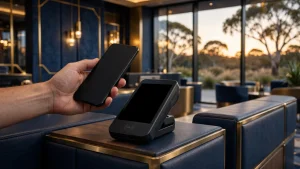
Australia’s everyday payment landscape cannot verify an offshore operator’s BPAY options, withdrawal routes or available games.

Australia’s payment habits are varied without being especially ceremonial. Contactless credit and debit cards are accepted almost everywhere in the country, as are mobile wallets such as Google Pay and Apple Pay. Consumers are also comfortable moving between cards, phone-based payments and services linked to banks, including PayPal. A payment method can be familiar in daily life and still tell very little about whether a particular online service will accept it.
That distinction matters when BPAY appears beside casino-related terms. National payment customs describe what people encounter across ordinary commerce; they do not establish the payment methods available in an online operator’s cashier. A card tapped at a shop, a wallet used for a purchase and a bank-linked service may all belong to the same broad landscape of familiar payments. Their familiarity does not make them interchangeable, nor does it show that an offshore gambling operator offers any one of them.
BPAY’s place in this landscape therefore cannot be inferred from the broad acceptance of contactless cards and mobile wallets. The two observations answer different questions. One concerns payment practices across Australia; the other concerns the specific options presented by an individual online service. A country’s established habits are not a cashier’s menu.
This is an easy distinction to lose in a phrase such as “Australian online casino”. The national label can make a service sound local, while the payment question sounds settled by association: Australians use a method, so perhaps a site aimed at Australians takes it. But a geographic description does not demonstrate that the operator is Australian, that it provides services lawfully in Australia, or that BPAY appears among its payment options. Those are separate matters, and none follows automatically from everyday familiarity with digital payments.
The same caution applies to mobile use. A phone can hold a digital wallet, display a banking service or open a website; that does not mean every payment route available on the device is accepted by every service reached through it. “Mobile casino” describes the screen or means of access, not a special payment category. BPAY does not become a mobile-wallet option simply because the word mobile appears nearby.
There is a social history in the ordinary switching between payment types. People do not owe allegiance to a single instrument. A card may suit one transaction, a phone wallet another, and a bank-linked service a third. That flexibility is part of the modern payment environment. Yet flexibility at the level of consumer habit should not be mistaken for a universal arrangement between a payment provider and every merchant. Acceptance remains specific to the service and transaction in question.
So the phrase “casino sites that accept BPAY Australia 2026” is best understood as a question, not as evidence that such acceptance exists. The wording may gather together a familiar national payment term, a type of online service and a year. None of those elements verifies the others. The year does not certify a current cashier option, and the national framing does not turn an overseas operator into a local one. A payment claim needs to be tied to the actual service, rather than assembled from the country’s general habits.
Even an operator’s display of a payment method would answer only a narrow practical question: whether that method is offered in that setting. It would not, by itself, establish the operator’s status under Australian law or make the service a protected local transaction. Australian consumer law does not protect players who use offshore casinos. That boundary is more consequential than the convenience implied by a payment label.
The broader Australian picture is clear enough: contactless cards and mobile wallets are widespread, and people move comfortably among cards, wallets and bank-linked services. The BPAY question is narrower. General payment familiarity supplies context, not proof of acceptance by a casino cashier. That difference is small in wording and large in consequence.
A statement that a casino accepts BPAY for deposits sounds precise. It appears to identify both a payment route and a purpose: money going into an account. But the wording alone establishes very little. It does not show that BPAY is available to Australian customers, that a particular operator accepts it, or that a deposit would be completed under any stated conditions.
That distinction matters because payment claims often travel farther than the evidence behind them. A phrase on a comparison page may describe an operator in another country, a feature that has since changed, or a general payment option that is not available to every customer. The sentence can remain online after the cashier has changed. A confident label is not the same thing as a working option.
Nor does an amount in a deposit claim settle the matter. A figure attached to a BPAY search may be a requested minimum, a promotional threshold, or simply wording supplied by someone asking whether such a deposit exists. Without a confirmed operator and a current, applicable cashier, it cannot establish what amount would be accepted. Repeating the figure as though it were a verified entry point would turn a question into a promise.
The same caution applies to claims about “best” BPAY casinos. A ranking requires comparable information: which operators actually offer the method to Australians, what conditions apply, and whether those conditions are consistent enough to assess. A headline cannot supply those missing comparisons. It may be a useful sign of what someone is trying to find, but it is not evidence of a functioning deposit route.
There is a broader reason to treat payment labels carefully. Australian payment habits are not proof of what an offshore gambling cashier accepts. Cards, mobile wallets and services linked to banks have a familiar place in everyday transactions, but that familiarity cannot be transferred automatically to a casino account. A method used in ordinary commerce does not thereby become an available gambling deposit option.
The word “deposit” can also make a claim seem more complete than it is. It says what the payment is meant to do, not whether the transaction is enabled, accepted by the operator, or available to a person in Australia. It does not establish who processes the payment or which terms apply. Those details cannot be filled in by inference from the name of a service.
This is why a list of casinos said to accept BPAY would need more than repeated mentions of the same claim. Multiple pages can repeat one unconfirmed assertion; repetition does not make it independent confirmation. A site name alongside a payment logo is still not enough to demonstrate that an Australian customer can use that method to deposit. The evidence would need to relate to the operator and to the relevant customer location, rather than to a generic description.
Even an apparently direct claim may be time-sensitive. Payment options can change, and a page that once described a cashier may no longer reflect its current state. An old statement cannot establish present availability simply because it remains visible. A fresh claim, meanwhile, still needs to say what it actually covers: an operator’s general service, a particular region, or a specific transaction route. Without that scope, the phrase is too broad to support a firm conclusion.
There is also a difference between a deposit claim and an endorsement. Naming a method does not establish that a site is suitable, lawful for operators to provide to Australians, or protected by Australian consumer law. Australian consumer law does not protect people using offshore casinos. Payment wording should not be allowed to lend an air of local legitimacy to a service simply because it uses a familiar Australian term.
The careful reading, then, is a narrow one: a BPAY deposit claim indicates that somebody has made an assertion about funding an account. It does not, on its own, verify a casino, an amount, or availability to Australians. That boundary is less satisfying than a ready-made list, but it is more useful than mistaking a label for a transaction.
A claim is not a cashier.
Money entering an account and money leaving it are separate transactions, even when a search phrase places both under the same payment label. A casino cashier might describe one route for adding funds and another for sending a balance out. The name attached to a deposit does not, by itself, identify the route for a withdrawal. Two directions; two sets of conditions.
That distinction matters when “instant BPAY withdrawal” is used as though it were a single, self-explanatory feature. “Instant” could describe the moment a request is submitted, the time an operator takes to approve it, or the period before funds appear through a payment provider. Those are not interchangeable events. A rapid request is not necessarily a rapid arrival, and a deposit method does not settle either question.
A deposit is a payment into an account. A withdrawal is a request to transfer money out of it. The stages involve different decisions: whether an incoming payment can be accepted, whether an outgoing payment can be made by a particular route, and how long each stage takes. Treating them as one feature turns a label into a promise it has not made.
The reverse assumption is equally unreliable. A casino that accepts a payment method for deposits does not thereby promise to return funds through that same method. Outgoing payments may have their own available routes and requirements. Without a specific, current statement covering withdrawals, the deposit label cannot establish those details. This is not a technicality; it is the difference between getting money onto an account and getting it back off.
The same care applies to claims about “no deposit” offers or instant access to real-money play. Such wording does not describe a withdrawal route. Nor does it establish that a payout can be made immediately, that a particular payment service will be used, or that the conditions for receiving funds match those for adding them. One phrase cannot do the work of a transaction policy.
Even a stated payout method would not, by itself, answer every practical question. The payment route, any operator review, account checks and the timing of each stage are distinct matters. Online casinos typically require customers to complete a Know Your Customer assessment before financial transactions. That requirement is separate from the question of whether BPAY is available for an outgoing payment, and it cannot be used to infer a processing time.
There is a familiar asymmetry in payment language. Deposits are often described as an action a customer can take; withdrawals are described as an outcome that depends on a separate process. Search wording compresses both into a neat promise of instant movement. Financial systems are less obliging than grammar. A label may name a proposed route, but it cannot tell whether a transfer has been approved, processed or received.
Nor does the word “instant” supply a clock. It needs a defined starting point and an endpoint. If a claim does not say whether it refers to submission, approval or receipt, it leaves the important interval blurred. A timetable for deposits would not fill that gap: it concerns funds moving in, not funds moving out. The direction changes the question.
For Australian audiences, language about real-money casino payments also sits within a wider legal setting. The Interactive Gambling Act 2001 makes it illegal for operators to provide online casino games to people physically located in Australia. A payment claim should not be mistaken for confirmation that a service is lawful or available to residents. Australian consumer law does not protect players using offshore casinos. A cashier label is no legal shelter.
The practical reading is narrow but important: a deposit claim says nothing conclusive about a withdrawal route, its conditions or its timing. “Instant” is meaningful only when the transaction stage and endpoint are clear. Without that separation, a search phrase can make an incoming payment sound like a guaranteed return journey. Money has never been known for following metaphors.
A payment label can make an offshore gambling service look like a local convenience. It does not make the service lawful. In Australia, the central question is not whether a cashier displays BPAY, but whether an operator may provide real-money online casino games to people in the country.
The Interactive Gambling Act 2001 places that boundary on operators: offering online casino games to Australian residents is prohibited. The rule concerns the service being supplied, not the vocabulary used to describe its payment options. A site presenting itself as Australian-facing, or claiming to accept a familiar Australian payment method, does not thereby become an authorised local casino.
Enforcement belongs to the Australian Communications and Media Authority, or ACMA. Its role is to enforce the Act, including the restrictions on prohibited interactive gambling services. This is not a system in which an offshore operator becomes legitimate simply by holding a licence issued elsewhere. The Australian framework does not provide a local licensing route for real-money online casinos serving residents.
That distinction matters because the language of online commerce often blurs location and permission. A website may be accessible from a screen in Australia, use Australian currency in its descriptions, or refer to Australian customers. Such details describe how a service presents itself; they do not settle whether it may legally offer casino gambling here. Nor does a payment method settle that question. A cashier is a commercial interface, not a legal instrument.
A “best” label sounds like a judgement made after comparison. For BPAY, that would mean establishing not just that a payment option is mentioned, but that the same conditions have been checked across the sites being compared. A name beside a payment logo cannot carry that burden.
A meaningful comparison would need consistent details: whether BPAY is actually available to Australian customers, what the cashier says about its use, and whether any costs or account conditions apply. Those details would also need to be current. Payment arrangements can vary between operators and change over time, so a claim on a review page or a banner is not, by itself, a stable basis for ranking.
There is a further problem with the word “best”. It hides the measure being used. A ranking based on ease of payment would not necessarily match one based on fees, transaction conditions or customer support. Without comparable criteria, two lists might both look confident while measuring entirely different things. Confidence is cheap. Comparability is not.
This is why a BPAY casino list cannot responsibly be treated as a recommendation merely because several websites are grouped under the same label. The label does not establish that their payment terms match, or even that the same service is available to each Australian visitor. A casino bonus advertised alongside a payment method is also a separate claim; their proximity does not prove that the payment method qualifies for the offer or that the stated conditions apply in a particular account.
The distinction matters in Australia, where online casino games are prohibited services for operators to provide to people in the country. Australian consumer law does not protect players using offshore casinos. A ranking should not make an offshore service appear locally endorsed or safer simply by putting it first.
A defensible verdict would need a transparent yardstick and evidence gathered on the same basis. Without that, “best BPAY casino site” is a polished conclusion looking for its comparison. A tidy ranking can conceal untidy uncertainty.
A cashier and a game catalogue answer different questions. The cashier describes how an account may be funded or managed; the catalogue describes what an operator makes available. Putting BPAY beside a payment option would not, by itself, show that any particular game could be accessed through it. The payment label and the games are separate pieces of information.
That distinction matters because payment wording can make a site appear more specific than it is. A reference to BPAY might concern a cashier function, while a separate page describes the operator’s games. Combining those details into a claim about “games with BPAY” turns two separate statements into one unsupported promise. A payment route is not a feature of a game, and it does not certify a game’s availability.
The reverse inference is just as weak. A game being listed by an operator would not establish that BPAY could be used to fund an account connected with it. Nor would a payment option establish that it applied to every part of a site. The relationship would need to be stated clearly by the operator and remain consistent across its payment terms and game information. Labels alone cannot do that work.
There is also a legal distinction behind the wording. Under the Interactive Gambling Act 2001, operators may not provide real-money online casino games to people physically located in Australia; the Australian Communications and Media Authority enforces the Act. Australian consumer law does not protect people who use offshore casinos. A payment reference should not be mistaken for assurance that an offering is lawful, locally protected or available to Australian residents.
The public language around online payments often compresses several separate systems into a single phrase: an account, a cashier, a payment provider and a catalogue. Compression is tidy; evidence is less so. BPAY, as a payment label, cannot settle questions about what an operator offers, and a game description cannot settle how an account may be funded. Each claim belongs to its own part of the service.
For that reason, descriptions of games and descriptions of payment options should be read as separate claims, not joined by implication. A shared page, logo or menu does not make them interchangeable. The distinction is modest, but consequential.
The word “Australian” can describe an intended audience, a currency setting or a phrase in a site’s branding. It does not, by itself, establish where an operator is based, which rules govern it or whether BPAY is available. A site presented as an Australian casino is not necessarily an Australian business; the label is not proof of local status.
The same distinction applies to payment wording. Calling a service a BPAY casino, or describing it as an online casino for Australians, does not demonstrate that its cashier supports BPAY for customers in Australia. Nor does an Australian-themed page establish that a payment option works through an Australian bank. Those are separate claims, and one cannot stand in for the other.
That separation matters because the legal position turns on who provides the service and where the customer is located, not on the language used to describe a website. Under the Interactive Gambling Act 2001, operators must not offer online casino games to people in Australia. The Australian Communications and Media Authority enforces the Act. An operator’s use of Australian wording does not alter that boundary.
The law’s focus is the provider, rather than an explicit criminal offence for an individual using an offshore site. That does not make an offshore service equivalent to a locally protected one: Australian consumer law does not protect players who use offshore casinos. Geography in a heading is cheap; legal recourse is not.
A careful reading therefore keeps three questions apart: whether a business is Australian, whether a payment method is actually supported, and whether the service may lawfully be offered to people in Australia. The phrase “Australian casino with BPAY” answers none of those questions on its own. It expresses a combination of location and payment expectations, not evidence that either expectation is met.
This is less a puzzle of terminology than a warning about labels. National language can make a service feel local while leaving its ownership, payment arrangements and legal position entirely unsettled. A familiar word is not a safeguard.
A BPAY label attached to a cashier does not, by itself, identify a route for receiving money. A payment method can be described in connection with an account without establishing that it can carry a withdrawal in the opposite direction. The distinction matters: a name in a list is not a payout policy.
For someone looking into a BPAY withdrawal from an online casino, the practical questions would be specific. Does the operator offer BPAY for payouts, or only list it elsewhere in the cashier? Are there eligibility conditions, fees or processing rules? Does the route depend on how the account was funded? Without those details, a claim that a casino supports BPAY says little about how winnings could be returned. No inference should fill the gap.
The word “withdrawal” can also conceal different stages. An operator may need to review an account before processing a financial transaction; online casinos typically require customers to complete a Know Your Customer assessment before financial transactions. That does not establish a BPAY payout method, or explain how long any review or transfer might take. Those are separate matters.
Searches for BPAY withdrawals at pokies sites do not change the underlying distinction. Australian wording in a site description does not prove a local payout arrangement, and the presence of a payment name does not establish that the method is available for every kind of transaction. Cashier labels can be suggestive. They are not a receipt.
There is a more consequential boundary around offshore casino services. The Interactive Gambling Act 2001 prohibits operators from offering online casino games to Australian residents, and the Australian Communications and Media Authority enforces the Act. Australian consumer law does not protect players using offshore casinos. A payment route, even if described clearly by an operator, cannot change that position.
The sensible reading of any BPAY withdrawal claim is therefore narrow: it needs to refer explicitly to payouts, not merely to BPAY in general. Until an operator’s terms establish that distinction, there is no sound basis for treating the method as a way to receive funds. The wording matters.
A payment method is not established by its name appearing beside a casino-related claim. For BPAY, the practical questions are specific: whether an operator accepts it, what steps a transaction requires, whether a fee applies, and what conditions govern payment. None can be answered by assuming that a familiar Australian payment service works wherever a cashier is available.
That distinction matters because a payment route is a set of arrangements, not merely a label. An operator would need to identify BPAY as an accepted option and explain the transaction process. Any fee or restriction would also need to be stated for that service. Without those details, a description of paying by BPAY risks turning a possibility into an apparent instruction.
The wider Australian payment culture offers little proof either way. Contactless card payments and mobile wallets are accepted almost everywhere in Australia, and consumers are comfortable moving among cards, wallets and bank-linked services such as PayPal. Those habits show that people use several kinds of payment; they do not establish that BPAY is available at a particular online cashier. Familiarity is not acceptance.
Nor does the word “casino” settle the matter. Payment arrangements belong to an operator’s own cashier and terms. A general description of BPAY cannot establish what any individual operator permits, or what happens if a transaction cannot be completed. The same restraint applies to fees: none should be presumed absent or present without a clear statement for the particular service.
So a precise account of this method would need to set out the accepted route, the steps involved, any charges and any applicable conditions. Without those particulars, a confident-sounding payment guide would be mostly atmosphere. A label is not a transaction.
In Australia, this question also sits against a legal boundary: the Interactive Gambling Act 2001 prohibits operators from offering online casino games to residents, and the Australian Communications and Media Authority enforces the Act. Australian consumer law does not protect people using offshore casinos. Payment wording cannot alter that position.
A payment label and a game category describe different things. Seeing BPAY mentioned alongside casino-style games does not establish that the payment method is accepted, or that those games are available to people in Australia. The words can be placed beside one another in a description; that arrangement is not proof of a working connection.
This distinction matters because a cashier concerns how an account is funded, while a game catalogue concerns what an operator offers. Neither tells the whole story about the other. A reference to BPAY cannot verify a particular game, and a mention of a game category cannot verify a BPAY transaction. The association is linguistic, not evidence.
There is a further Australian context. The Interactive Gambling Act 2001 prohibits operators from providing real-money online casino games to people in Australia. A payment claim does not alter that boundary. Nor does naming a game category turn an unsupported payment statement into a reliable one.
The internet is fond of collapsing separate questions into a single phrase. It is efficient for a search box, less so for a real-world decision. Here, the careful reading is the plain one: a claim about BPAY is not a claim about game availability, and neither should be inferred from the other.
No bridge is established.
Limits are set by each casino and can vary. Check the casino’s cashier for its current deposit and withdrawal limits.
Jackpot City Casino, Spin Palace, Ruby Fortune, Ignition Casino, Joe Fortune and PlayAmo are listed as accepting Amex deposits for Australian players.
Yes, Amex casino deposits are processed instantly. Withdrawals can take up to five days to clear.
Yes, some Australian online casinos accept Amex deposits, though acceptance can vary and a bank or Amex may block a transaction.
Amex deposits typically have no fee, but a casino may add a 1.5% surcharge and Amex cards incur a 3% currency conversion fee. Withdrawal fees may also apply.
Amex deposits are processed instantly.