A practical guide to demos, bonus terms, cash-outs, legal boundaries and the limits of strategy.
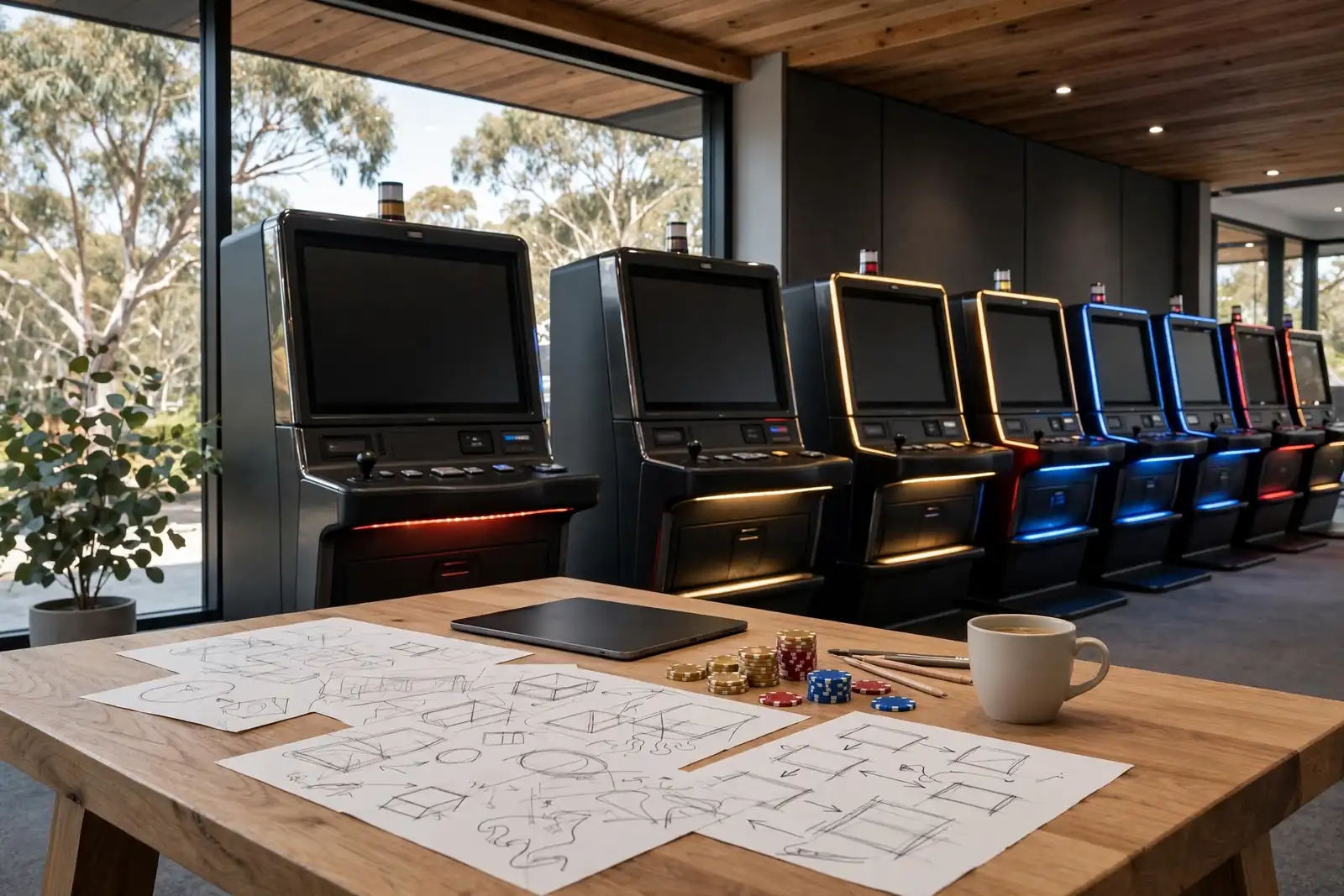
Australian talk about pokies often begins with a title rather than a technical category. Big Red, Lightning Link and Queen of the Nile are names that sit in a much larger landscape of games, studios and casino software. Their familiarity can make that landscape seem like one continuous thing. It is not. A game title, the company that supplies a game, and the software through which a casino presents it are different parts of the arrangement.
Aristocrat, Microgaming, NetEnt, Play’n GO, Pragmatic Play, Quickspin, Evolution Gaming and KA Gaming are names associated with game provision. Big Red, Lightning Link and Queen of the Nile, by contrast, are product names. Keeping those categories separate matters: a provider is not a particular game, and a familiar title does not tell anyone what else sits around it in a casino’s catalogue. Nor does a name establish a game’s quality or make it suitable for a particular person. Familiarity is not a verdict.
That distinction is easy to lose when games are encountered through menus, promotional imagery or remembered titles. The menu makes a catalogue look like a shelf: one name beside another, each reduced to a small image and a few words. But the visual neatness is a convenience of presentation, not evidence that the games share a maker, structure or purpose. The same caution applies to titles such as Boomerang Bonanza, Kangaliens, Red Sands and Redroo. They belong to the vocabulary of pokie offerings; the names alone do not reveal their provider or mechanics.
Choosing a Mines casino game in Australia means checking the operator details that are available before deciding where to play. This list offers a concise reference to the stated licensing, deposit and payout information.
Rollero Casino
Rollero Casino is listed with a Curaçao Gaming Control Board licence, OGL/2023/176/0095, held by Hollycorn N.V.
LuckyVibe
LuckyVibe is listed with a Curaçao Gaming Control Board licence, OGL/2023/176/0095, held by Hollycorn N.V.
House of Pokies
House of Pokies has an international iGaming licence, though the source does not name the jurisdiction. Its stated PayID payouts take 1–24 hours, and the minimum deposit is A$30, or A$10 with PayID.
Wild Tokyo
Wild Tokyo is listed as Curaçao-licensed and has a minimum deposit of A$10. Stated payout times are 30–60 minutes for crypto and 1–5 days for fiat.
Uptown Pokies
Uptown Pokies is listed as Curaçao-licensed and has been operating since 2017. Its stated minimum deposit is A$20.
MrPacho
MrPacho lists payout times of 30–120 minutes for crypto and 24–72 hours for fiat. Its stated minimum deposit is A$30.
Golden Pokies
Golden Pokies is listed as Curaçao-licensed.
WinSpirit Casino
WinSpirit Casino is listed with a Curaçao eGaming licence, OGL/2024/923/0383, held by Antillephone N.V. Its stated minimum deposit is A$30.
JustCasino
JustCasino is listed with a Curaçao Gaming Control Board licence.
Kingmaker
Kingmaker lists crypto payouts at approximately 90 minutes and fiat payouts at 1–5 days. Its stated minimum deposit is A$30.
The broader machine landscape also includes progressive jackpots. These grow as play accumulates across linked machines or networks, rather than being a fixed prize attached to every individual play. Some progressives are local to a machine or venue; others connect many machines, or a fleet of games within an online operator’s offering. The distinction changes the scale on which a jackpot builds, but it does not turn a title into a promise. A large figure on a display is an outcome of a system, not a measure of what any one player can expect.
Jackpot eligibility can have its own conditions. A game may set a minimum bet before a play qualifies; A$1.00 is one possible example, not a universal threshold. Contribution rates and qualifying bets are details of the particular game’s terms, not facts that can be inferred from a title or its artwork. The small print is part of the machine, even when the screen gives it less room than the spectacle.
There is a quiet social history in these names. They translate machinery into characters, places, animals and stories, giving an impersonal device something more recognisable to hold on to. That observation does not explain why any particular person plays, and it should not be mistaken for a theory of individual behaviour. It does show how entertainment is packaged: technical systems acquire a surface, and the surface becomes easier to remember than the system underneath. The name travels. The conditions remain less visible.
Return to the software layer and another distinction appears: a percentage attached to a game is not a personal forecast. KA Gaming’s slot RTP figures typically fall between 94% and 96%. RTP, or return to player, is a statistical measure used to describe a game over a very large volume of play. It does not predict the result of a particular session, and it should not be read as a proportion guaranteed back to an individual. The number describes a model, not a receipt.
This is where the wider catalogue of pokies should be kept apart from Mines. The word “slot” can lead towards one set of products and assumptions; the name Mines points to a different subject, not another familiar pokie title in the same list. Putting both under the broad label of casino games does not make their identities interchangeable. A catalogue can place unlike things under one roof. That is not the same as saying they are the same thing.
The distinction is modest, but useful. Providers, titles, software and game categories answer different questions. A familiar name says little by itself. The machinery is wider than the name.
“Mines” belongs in a different conversation from the familiar Australian pokie names. A pokie is a machine game, with its own title and presentation; Mines is referred to as a casino game. That distinction matters because the word “casino” describes a broad setting, not a shared set of rules. A game’s name alone cannot tell anyone how it works.
The short title also creates a problem of identification. “Mines” may be used as a label for a game, but a label is not the same as a complete product identity. Without a clearly attributable version, the title cannot establish who made it, what rules apply, or what actions a player would take. Those details should not be supplied by guesswork simply because a familiar-sounding name appears in a casino catalogue or page heading.
This is where casual descriptions tend to outrun what they can support. A page may call something a Mines casino game without explaining whether that name identifies one specific release or is being used more loosely. The distinction is not pedantic: rules and interfaces belong to particular versions, not to a bare word. Treating every use of the title as interchangeable can turn an uncertain label into a false description.
Nor does the word “Mines” settle the game’s mechanics. It does not, by itself, explain how a round begins, what choices are available, how a result is determined, or whether those details differ between versions. A precise account would need to be tied to an identified game and its own rules. Otherwise, even a confident-sounding explanation risks describing a different product—or inventing one.
That restraint is especially important because casino language often compresses unlike things into one convenient shelf. Pokies have a familiar place in Australian gambling culture, and named machines can be discussed as part of that landscape. A casino game carrying the name Mines should not be folded into the same category merely because both appear under a casino label. Similar surroundings do not make similar games.
The distinction also limits what can be inferred from a provider name. A company known for other casino products cannot be assumed to have made a game called Mines. Nor can a provider associated with one version automatically be credited with every game using the same title. Attribution needs to match the specific release. Otherwise, a name borrowed from elsewhere can lend an air of certainty without actually identifying anything.
Searches for “Mines casino game Australia” may bring together pages that use the same words for different purposes: a product listing, a general description, or a reference to a particular version. These are not equivalent forms of evidence. A listing can show how a site labels something; it does not necessarily establish the game’s full identity or explain how it plays. The title may be easy to recognise while the object behind it remains unclear.
There is a social reason to care about such precision. Gambling products are presented through names, symbols and categories that make them feel legible. But legibility is not knowledge. A catchy title can travel farther than its rules, and an online label can sound settled before the underlying product has been pinned down. The tidy category is often the last thing to arrive.
For Mines, the soundest description is therefore narrow: it is discussed as a casino game, not as a pokie, and the name alone does not establish a particular provider, ruleset or set of mechanics. That is not an invitation to fill the blank with familiar conventions. It is a boundary around what the label can responsibly mean.
Any gambling remains an adult activity, and problem gambling can cause serious harm, particularly to vulnerable people. That human cost is easy to lose sight of when a game is reduced to a name and a few lines of promotional copy. The name is not the game.
An online search for Mines can make the game seem like a borderless piece of software: a title entered into a browser, a screen that loads, a wager placed. Australia’s rules interrupt that impression. The relevant boundary is not the name of a game or the location of a server, but the service being offered to people physically in Australia. Under the Interactive Gambling Act 2001, operators cannot lawfully provide real-money online casino games to people in the country.
That distinction matters for searches for an online Mines casino. A result appearing on a screen does not establish that the service may lawfully be offered in Australia, and a familiar casino label does not alter the rule. Online casino-style games fall within the prohibited category when supplied to Australian customers. The law addresses the operator’s conduct; the administrative work of monitoring and enforcement belongs to a federal agency.
The Australian Communications and Media Authority, usually called ACMA, is responsible for enforcing the Act and monitoring compliance with federal interactive gambling laws. Its role is not simply to publish a rule and wait for the internet to become orderly. When ACMA identifies a website providing prohibited gambling services, or advertising them in Australia, it can ask internet service providers to block access to that site. The request works at the level of the connection: an address may become harder to reach from within the country, though a block does not erase the site or turn it into a lawful service elsewhere.
Blocking is one instrument in a broader enforcement process. ACMA reports that more than 1,455 illegal gambling and affiliate websites have been blocked since November 2019 after enforcement action. The figure includes affiliate sites as well as gambling websites, a useful reminder that the machinery surrounding a prohibited service can be part of the problem too. A page need not take a bet itself to help direct attention towards one.
There is also a record of services leaving the Australian market after enforcement began. Here the public figures do not align: one account says more than 210 illegal services have withdrawn since 2017, while another puts the total at more than 190. The difference should remain visible rather than being polished into a single, falsely exact count. Both versions describe withdrawals following the start of ACMA enforcement, but they do not agree on how many services that amounts to.
A block and a withdrawal are not the same event. Blocking limits access through Australian internet providers; withdrawal describes a service ceasing to operate in the market. Neither measure promises that every prohibited site will vanish from every screen. Enforcement online is a continuing contest between public rules and businesses able to change domains, branding or technical arrangements. The small administrative act of asking an ISP to block a website sits inside that larger effort.
This is why the phrase “Mines online” cannot be treated as a neutral description of availability. A game title may circulate internationally, but an Australian-facing real-money casino offer belongs to a regulated legal category, not to a loophole created by search results or offshore hosting. ACMA’s blocking powers give the boundary practical force, even when the internet makes geography look optional.
The numbers, meanwhile, describe enforcement activity, not a safe catalogue of what remains reachable. A site missing from a block list is not thereby approved; a site that can be opened is not thereby lawful. That is the unglamorous distinction at the centre of the system. Access is not authorisation.
“Free” is a small word with a large job. In a casino context, it can describe play that uses no money, a promotional balance subject to conditions, or simply a page’s claim about how a game is presented. Those meanings are not interchangeable. A free-play label does not, by itself, establish that a particular Mines version exists, what it offers, or whether anything shown can later be withdrawn.
That distinction matters because casino language often places unlike things close together. A game may be described as free while appearing beside real-money options; a balance may be called a bonus while remaining subject to conditions. Neither the surrounding design nor the cheerful vocabulary turns restricted funds into cash. The word “free” can refer to the cost of a particular interaction, not to the wider service or every consequence attached to it.
For Mines, the phrase is best treated as a description someone might use, not proof of a playable free version. It says nothing definite about the game’s format, rules, availability, or whether a session would involve a real-money account. Those details cannot be supplied by the adjective. The adjective is doing enough already.
A genuinely no-cost activity and real-money gambling belong in different categories. In the first, no stake is put at risk and no winnings are available to withdraw. In the second, money is involved, and the possibility of a balance changing is part of the arrangement. Calling both “free” because one screen or feature has no immediate price blurs the boundary that matters most.
The distinction also helps separate free play from a cash bonus. Bonus funds are not cash. If they are subject to wagering requirements, the amount shown cannot simply be treated as withdrawable money; conditions may require further betting before bonus-derived winnings can be released. That is not the same as a no-cost game session. It is money-shaped, but not money in hand.
The same caution applies to phrases such as “fake casino Mines.” “Fake” may mean a simulated setting, a game without cash stakes, or merely a site that looks like a casino. It is not a reliable description of the underlying arrangement. A realistic screen does not prove that money is involved, and a “free” label does not prove that it is absent. The relevant distinction is what the activity actually permits and requires, not the costume it wears.
In Australia, the age threshold for gambling is eighteen. But an age rule does not turn free-play wording into evidence that a casino service is lawful or that a real-money feature is available. Nor does it make a no-stake screen equivalent to a regulated product. The word “free” answers, at most, a narrow question about cost; it cannot settle the legal or financial character of everything around it.
There is a social history in the label, too. Casinos have long presented play as entertainment, and entertainment language can soften the edges of a transaction. “Free” sounds like an invitation without consequence. Sometimes it may describe a genuinely no-cost experience. Sometimes it may sit beside balances, account prompts, or conditions that alter what the offer means. The difference is not a matter of tone.
For anyone trying to understand what a Mines free-play claim means, the careful reading is modest: it is a claim about cost, not a guarantee of access, mechanics, or cash value. Without a clear description of the specific activity, those further conclusions remain unwarranted. “Free” is not a whole set of terms.
The word “demo” sounds precise, but by itself it says very little. Attached to Mines, it may describe a page’s label, a title in a catalogue, or a claim about a game version. It does not, on its own, establish that a playable demonstration exists, that it is the same Mines game being discussed elsewhere, or that its presentation reflects any real-money version.
That distinction matters because a name can travel more easily than a game. Search results and listings may repeat familiar wording while leaving basic questions unanswered: who made the version, what it contains, and whether the word “demo” refers to an actual playable mode or merely a description. Repetition is not corroboration. A claim does not become more informative because it appears in several places.
Nor does the label settle what a demonstration would show. It cannot establish rules, outcomes, interface behaviour or the relationship between a sample and any other version. Those details require evidence tied to the specific game, not assumptions borrowed from the general meaning of “demo” or from another game with the same name. Mines is a short name; certainty does not come bundled with it.
There is also a difference between a description and a verified feature. A page can call something a Mines casino demo without proving what is available behind that description. The wording may be enough to identify the subject of a claim, but not enough to confirm its substance. That is a modest standard, and a useful one. Promotional language often asks a single word to carry more weight than it can bear.
In Australia, context matters too: a label does not alter the status of an online gambling service or establish that access is lawful. That is not a verdict on any particular page. It is simply a reminder that “demo” is a description, not a regulatory category.
A careful account therefore stops at the boundary of what the label supports. It can report that a demonstration is being claimed; it should not turn that claim into a promise of access, a description of mechanics, or proof of how a game works. The difference is small in wording and large in meaning.
A label is not a guarantee.
A bonus headline describes an offer’s face value, not money ready to withdraw. Bonus funds are not cash: conditions can require a specified amount of wagering before winnings derived from them become eligible for withdrawal. The distinction is less glamorous than the headline, but more consequential.
A specialist review gives one illustration: a $100 bonus carrying a 40x wagering requirement calls for $4,000 in bets before bonus-derived winnings can be withdrawn. That is a particular example, not a universal rule. The multiplication is simple; the terms behind it are not. A requirement may apply to the bonus, the deposit, or both, depending on the written conditions. Those details change the total that must be wagered.
A specialist review also describes blackjack as contributing only 10% toward a wagering requirement. Where a game contributes less than the full amount, its bets move the requirement forward only in part. The headline multiple, then, cannot be read in isolation: the eligible games and their contribution rates shape how much play the condition actually demands.
Requirements stated in specialist reviews often fall within a 30–50x range, but that range is not a promise about any particular offer. A Mines promotion, a no-deposit offer, or a bonus code cannot be assumed to exist from the wording of a promotion search or from a general description of casino bonuses. Even when an offer is advertised, its own terms determine whether it applies to the game in question and what restrictions follow.
The small print matters most at the point where a bonus is mistaken for a balance. A number displayed as bonus value may come with game restrictions, a wagering threshold, or conditions attached to the resulting winnings. The arithmetic can be checked; the offer still has to be read as a set of conditions rather than a gift.
That is the difference between a bonus and usable cash. A promotional label can make the first feel immediate. The wagering requirement says otherwise.
The phrase “Mines for real money” makes the cash balance sound like the final measure of a session. In practice, a displayed balance and money received are not the same thing. Withdrawal rules can put a threshold between them, while checks may add another step before a first payment is processed.
Offshore gambling sites commonly set minimum withdrawal amounts between A$75 and A$150. A balance below the stated minimum may therefore remain unavailable for withdrawal until it reaches the threshold, depending on the site’s terms. That is a practical condition, not a feature of the Mines game itself. It also means that a small balance on screen should not be mistaken for an amount that can necessarily be transferred out.
To process a first withdrawal, sites commonly request identity and address verification documents, such as a passport or driver’s licence and a utility bill.
The first cashout may involve KYC checks. Commonly requested documents include a passport or driver’s licence, together with a utility bill. The purpose is to establish identity and address; the request can make a first withdrawal less immediate than later ones. The exact documents and process depend on the site, so no single checklist can be assumed to apply everywhere.
This paperwork is often treated as an administrative footnote. It is not quite that. A withdrawal depends not only on the balance but on the site’s threshold and its completion of the required checks. Those conditions matter before money is put at risk, particularly where the terms distinguish between deposited funds and winnings or impose separate restrictions. A game outcome cannot remove them.
For adults considering gambling, the plain accounting is therefore more useful than the label “real money”: what minimum amount can be withdrawn, what documents may be requested, and what conditions apply to the balance. These are questions about the payment process, not evidence that a particular Mines version is available or that a cashout will be accepted. A balance is not yet a payment.
The question of where to play Mines in Australia runs into a boundary between the person at a screen and the business providing the game. The Interactive Gambling Act 2001 restricts operators from offering online casino services to people in Australia. The restriction concerns the service offered to someone physically here; a site’s overseas address or its description of a game does not, by itself, change that.
Offshore casinos may accept Australian payments while operating under licences issued elsewhere. That combination can make a service appear locally available in the ordinary sense: a payment goes through, a page loads, and the account is presented as usable. But acceptance of an Australian payment is not evidence that the operator holds Australian authority to provide online casino games. Access and legal status are different questions.
The distinction is easy to blur because the internet makes a service feel less like a business crossing a border than a page simply appearing. The law, less impressed by the interface, places responsibility on the operator offering the prohibited service. Players are not criminalised for using offshore sites. That is not the same as saying that Australian law authorises those operators to serve them.
Names do little legal work. A Mines game, or a title styled as Lucky Mines, does not acquire a different status merely because it is branded differently or offered within an offshore casino. The relevant issue is the nature of the service and the location of the customer, not the neatness of the label.
This leaves a plain, if sometimes confusing, arrangement: offshore services may be reachable and may process Australian payments, while the law restricts their provision to people in Australia. A working payment route is not a regulatory endorsement. Nor does the absence of criminal liability for the player convert the operator’s service into a lawful Australian casino offer.
That boundary is not a recommendation about where to play. It is the frame within which the question has to be understood. A screen can make distance look trivial. The law does not.
A strategy for Mines can sound like a way to turn uncertainty into a system: choose a pattern, set a stopping point, repeat. The vocabulary is reassuring. It suggests that risk has been measured and can therefore be managed into submission. That is a larger promise than any gambling strategy can keep.
The distinction matters because a plan can shape a player’s decisions without changing what a game will deliver. A person may decide in advance how much money and time to spend, or when to stop. Those are limits on exposure, not methods for securing a win. Treating them as equivalent gives discipline a false glamour: the careful player may still lose, and a past result does not make a future one owed.
The phrase “Mines casino game strategy” also gathers together very different claims. Some concern personal habits; others imply a dependable sequence or a hidden advantage. The first can be described as risk management. The second needs evidence, not confidence dressed up as technique. A label connecting Mines with Spribe does not, by itself, establish what version is being discussed or whether any particular tactic applies to it.
This is where strategy writing often changes its subject without admitting it. It begins with play and ends by selling certainty. A cautious routine becomes a supposed edge; a short run of favourable outcomes becomes proof. Neither conclusion follows. Chance does not keep a ledger of earlier turns, and a pattern noticed after the event is not necessarily a pattern that can guide the next one.
The useful question is therefore not which tactic guarantees a result, but what a strategy can honestly do. It can help make boundaries explicit. It cannot remove the possibility of loss, make gambling an income source, or protect every player from harm. For people vulnerable to gambling problems, the consequences can be serious; a tidy plan does not make that risk trivial.
At eighteen or older, gambling still remains gambling: an activity with financial risk, not a puzzle that yields to persistence. The language of control is tempting. The outcome is not obliged to agree.
A reference to Casino Guru alongside Mines may look like a neat answer to a practical question: has the game been reviewed, listed or rated there? The association alone settles none of those things. A name appearing beside another name is not a review, and a result’s short description cannot substitute for the underlying page.
The distinction matters because third-party sites can organise information in different ways. A page might discuss a casino, a provider, a particular game or a broader category; those are not interchangeable subjects. Even when a page does concern a game called Mines, its existence would not, by itself, establish who made the version in question or whether another game with the same name behaves identically.
Nor does a rating, if one is found, amount to a guarantee. It is an assessment made under that site’s own approach, at a particular point in time. It cannot turn an uncertain identification into a settled one, or tell a player what an unfamiliar game will do. Labels travel more easily than evidence.
For the same reason, “Casino Guru Mines” should be read as a possible link between a publisher and a game, not as proof of a specific verdict. A reliable account would need to identify the exact game and make clear what the page actually evaluates. Without that, claims about a review, score or listing would go beyond what the name pairing supports.
This is a modest boundary, but a useful one: third-party material can help explain what it explicitly covers; it cannot certify what it does not. Mines remains a game name, not a finding. Gambling is for people aged eighteen or over, and gambling-related harm can be serious, particularly for vulnerable people.