Australian online casino restrictions sit alongside practical explanations of baccarat hands, table rules, commissions and live-game access.

In Australia, the legal dividing line is not drawn between one casino game and another. It sits between the kinds of services an operator may provide and the people to whom they are offered. Under the Interactive Gambling Act 2001, operators cannot provide real-money online casino games to people physically located in Australia. The category includes roulette, alongside other casino-style games. A game’s name, format or digital presentation does not move it outside that boundary.
That distinction matters for anyone encountering phrases such as “online casino roulette” or “live roulette” in a general discussion of gambling. Those words describe a type of game, not a permission to supply it to Australians. The law concerns the service and its provision to people in the country; it is not a special rulebook for roulette tables. The verified legal position applies to online casino games broadly, rather than establishing a separate set of roulette rules.
The result is a market with no locally licensed online casinos officially operating in Australia. That absence is not simply a gap in a directory of businesses. Australian licensing does not provide a route for an operator to offer real-money online casino games under the current framework. The Act prohibits Australian-licensed operators from doing so, and the wider prohibition applies to operators providing those games to people physically in Australia.
For live roulette in Australia, this list is a starting point for checking operator details before you choose a table. The available information does not confirm whether dealers speak English, so verify that directly with the operator.
Rollero Casino
Rollero Casino lists a Curaçao Gaming Control Board licence, OGL/2023/176/0095, held by Hollycorn N.V.
LuckyVibe
LuckyVibe lists a Curaçao Gaming Control Board licence, OGL/2023/176/0095, held by Hollycorn N.V.
House of Pokies
House of Pokies lists an international iGaming licence, though the jurisdiction is not named. PayID withdrawals are listed at 1–24 hours, and the minimum deposit is A$30, or A$10 with PayID.
Wild Tokyo
Wild Tokyo lists a Curaçao licence and a minimum deposit of A$10. Its listed payout speeds are 30–60 minutes for crypto and 1–5 days for fiat.
Uptown Pokies
Uptown Pokies lists a Curaçao licence and has been operating since 2017. The minimum deposit is A$20.
MrPacho
MrPacho lists a minimum deposit of A$30. Its stated payout speeds are 30–120 minutes for crypto and 24–72 hours for fiat.
Golden Pokies
Golden Pokies lists a Curaçao licence.
WinSpirit Casino
WinSpirit Casino lists a Curaçao eGaming licence, OGL/2024/923/0383, held by Antillephone N.V. Its minimum deposit is A$30.
JustCasino
JustCasino lists a Curaçao Gaming Control Board licence.
Kingmaker
Kingmaker lists a minimum deposit of A$30. Its stated payout speeds are about 90 minutes for crypto and 1–5 days for fiat.
The distinction between a domestic licence and a foreign one can blur in online language. A service may be described as an international casino, or may present itself as available across borders. Neither description changes the legal boundary for provision to customers in Australia. Nor does the fact that a game is familiar from other settings alter its status when supplied as an online casino service. The law is concerned with the activity, not the polish of its interface.
There is a social history inside that blunt line. Gambling has long been divided by place and form: a venue, a machine, a table, a screen. Legislatures draw boundaries around those settings because access, advertising and the organisation of gambling are public questions, not merely private preferences. Online delivery makes the venue less visible, but not legally weightless. A screen can carry a service across borders; the statute still treats the provision of online casino games to people in Australia as a matter for regulation.
The Act’s penalties underline that its principal force falls on those providing prohibited services. For an individual, the maximum daily penalty is $360,000; for a body corporate, it is $1.8 million per day. These are maximum penalties under the law, not a measure of what happens in every case. The scale is nevertheless a clear statement about where the statute places responsibility for operating such a service.
That does not mean the law treats a player as an operator. The legal frame does not impose a fine or criminal prosecution on an individual merely for playing at an offshore casino without a local licence. The distinction is important, but it should not be mistaken for approval, a local licence, or a guarantee about a particular service. Absence of player liability is not the same thing as a lawful Australian online casino market.
Advertising has its own boundary. Real-money interactive gambling services, including online casinos, must not be advertised to Australian audiences. That restriction is part of the same public framework: the law does not permit the local promotion of a service that operators are prohibited from supplying in the country. Search results, overseas branding and promotional language can make the landscape look more ordinary than it is. Ordinary-looking is not a legal category.
For roulette, then, the relevant Australian context is not a catalogue of approved online tables. It is the general prohibition on providing real-money online casino games to people in Australia. That statement does not determine every question about roulette played elsewhere or in other settings; it sets the boundary for online casino provision here. The boundary is the point.
18+ only. Gambling can cause financial harm. Jackpotjillcasinohubau.com is not liable for gambling losses.
A bonus is not simply money added to a balance. Where wagering conditions apply, the terms determine which games count toward them and how much each game contributes. That distinction matters because a displayed bonus amount can conceal a much slower route to satisfying its conditions. The rules belong to the offer, not to the name of a game.
A specialist review reports live baccarat contribution to wagering requirements in the range of 5–15%. That is a description of terms reported by one source, not a dependable rate across platforms or offers. The applicable rules can differ, so the contribution stated in the offer’s own terms is the figure that matters. If the terms are unclear, a percentage copied from elsewhere cannot fill the gap.
Contribution is not the same as a payout or a prediction of winnings. It describes how play is counted against a wagering condition. A lower contribution means more of a player’s activity may be needed for the same condition to be met; a higher one means more is credited. Neither changes the cards or makes a hand more likely to win. Promotional arithmetic and game outcomes occupy separate columns.
This distinction also prevents a common category error. A roulette bonus, a no-deposit offer, or a promotion attached to a particular roulette variant cannot be inferred from information about baccarat. The contribution figure above concerns live baccarat only. It establishes no roulette bonus terms, no eligibility rules and no special treatment for cryptocurrency deposits. A game name in an offer is not a substitute for reading its conditions.
The same care applies to No Commission Baccarat. A specialist review describes this format as removing the 5% commission normally taken from a winning Banker bet, while allowing the operator to alter payouts for certain Banker totals. The label therefore describes one adjustment, not a guarantee that every Banker win returns the same amount as under standard rules. The changed payout conditions are part of the bargain.
That is why “no commission” should not be read as “no difference.” If commission disappears but a payout changes in specified cases, the practical effect depends on those cases and on the table’s stated rules. A neat label can make a rule sound simpler than it is. The detail is where the game lives.
Bonuses and table rules should not be blended. A wagering contribution affects how promotional conditions are calculated; a commission or altered payout affects settlement of a bet. One concerns the accounting attached to an offer, the other the terms of a game. A bonus does not erase a table’s payout structure, and a table variant does not establish what a promotion will count.
This is descriptive information, not an invitation to gamble. In Australia, online casino-style services are prohibited for operators providing them to people in the country, and this discussion does not endorse or direct anyone to such services. Gambling can cause financial loss; Jackpotjillcasinohubau.com is not liable for losses. 18+ only. If gambling is causing harm, support is available through appropriate local services.
The distinction between live dealer baccarat and RNG baccarat is not a choice between two sets of rules. It is a difference in how the game is produced. In the live format, a real dealer handles physical cards in a casino studio, and the table is streamed. In RNG baccarat, software determines the outcome through an algorithm rather than through cards dealt by a person.
That difference changes what the game presents to its audience. Live dealer baccarat places a human action at the centre: the cards exist on a table, and a dealer handles them as part of a streamed game. The result is not generated by an algorithm acting alone. Yet the presence of a dealer does not make the experience an ordinary visit to a casino. The game still reaches its players through a digital screen, with the studio serving as the setting for a remote audience.
RNG baccarat takes a different route. Its outcomes are produced by algorithm-based software, not by a dealer drawing physical cards. The game is therefore digital in a more complete sense: both the setting and the mechanism determining the outcome belong to software. That does not mean the two formats are simply “real” and “fake”. The distinction is more precise. One uses a streamed, physical card game; the other uses software to determine results.
The language of casino games often treats a live table as though it were only a visual wrapper around the same underlying product. But the format is part of the experience. A human dealer and physical cards make the process visible in a way that an algorithmic outcome is not. Conversely, a stream does not turn software into a physical game. The camera may show a studio, but the defining feature of RNG baccarat remains the algorithm.
This is why broad labels can mislead. “Online baccarat” describes where the game is accessed, not how its outcomes are produced. A player looking at a screen could be watching a live dealer or using an RNG version; the shared device does not make the two formats equivalent. The difference lies behind the image: in one case, a dealer handles cards in a studio, while in the other, software determines the result.
That contrast also explains why descriptions of one casino game cannot automatically be transferred to another. A phrase such as “live” may suggest a dealer and physical equipment, but only the details of a particular game establish what is actually present. The mechanics of baccarat do not prove anything about how a roulette product is made, whether it uses a physical wheel, or who appears on screen. Familiarity with one table is no substitute for evidence about another.
The live format is a performance in the literal sense: a person handles cards in a studio for a remote audience. The RNG format is a calculation presented as a game. Neither description needs to be dressed up as a verdict on quality. They name different ways of producing an outcome, and different relationships between what is seen and what determines the result.
The screen is not the table.
Baccarat reduces a hand to a small arithmetic question: which side finishes nearer to nine? The available bets are Banker, Player and tie. A wager on Banker or Player follows the side named; a tie wager rests on both sides ending level. The winning hand is the one whose total is closest to nine.
The arithmetic is deliberately spare. Picture cards contribute nothing to the count. When a hand’s combined value passes ten, the digit on the left is discarded: a total of twelve, for instance, is read as two. The aim is not to build a large number but to finish near the upper end of a narrow scale. Baccarat makes restraint part of its mathematics.
A further card can enter the hand according to its total. If the cards add to less than five, the hand receives another card. That rule matters because the next card may alter which side is closer to nine; it is not a signal that a player has chosen to draw. The hand develops under its own procedure, while the bet has already identified the outcome being followed.
This is the useful distinction between betting and playing the hand. The player selects a side or a tie; the cards are then counted and compared. There is no need to decide which card should be dealt. The table’s small set of choices can make the game look simpler than its vocabulary suggests, but the arithmetic is the engine beneath the apparent ceremony.
Nine is a boundary, not a target that can be exceeded and kept intact. Once a total goes above ten, its left digit disappears from the count. A hand with a larger combined value can therefore finish with a modest baccarat total. This can feel counterintuitive to anyone carrying ordinary addition into the game, where a larger sum would normally remain larger. Baccarat uses a different convention, and the convention determines the result.
The tie option also has a distinct place in that structure. It is not a third hand competing to reach nine; it is a bet on the two named sides ending with equal totals. The comparison still turns on closeness to nine, but a tie wager concerns equality between the hands rather than which one is nearer. The three choices describe outcomes, not three different ways of controlling the deal.
There is a social elegance to rules that ask little of the player’s hand and much of the player’s attention. The cards move; the room watches; a handful of numbers decides which side came closer. Yet a straightforward count should not be mistaken for a method of ensuring a result. Each hand is settled by its own cards. Arithmetic explains the outcome, not a way to command it.
For adults only: gambling carries financial risk. Jackpotjillcasinohubau.com is not liable for gambling losses.
Baccarat’s central choice is a wager on the Player hand or the Banker hand. The labels sound like roles in a contest, but the bet is about which side will finish nearer to nine; the hand with the closer total wins. A tie is the third possible outcome, when neither side is closer because the totals match.
That structure gives the table a peculiar formality. The players choose a side, while the cards determine which side has the better claim. “Banker” does not mean that the house has a separate hand in the ordinary sense of a player competing against a dealer. It names one of the outcomes on which a wager can be placed. The distinction matters because the language of the table can make a simple comparison sound like a contest between people.
The tie wager sits apart from the two main choices. It is not another name for backing either side, but a bet that the hands will finish level. The three labels therefore describe different possible results, not three participants. In practice, the rules’ apparent simplicity leaves room for a separate question: how a winning Banker wager is settled.
Under the usual commission arrangement, a winning Banker bet carries a five per cent commission. No Commission Baccarat removes that charge, but the absence of a commission does not necessarily mean that every Banker win is paid in precisely the same way as before. A specialist review describes some versions as altering payouts for particular Banker totals instead. The name advertises what has been removed; it does not, by itself, explain what may have replaced it.
That is the wrinkle. Commission is a settlement rule, not a change to the basic contest between the two hands. The object remains to back the side closest to nine. But when a table removes a charge and adjusts selected payouts, the wording on the table becomes part of the rules that matter to a wager. Two games bearing the same broad label can require attention to their own payout terms.
The familiar Banker and Player choices may look like the whole of baccarat, with the tie as a side door. Yet the financial meaning of a successful bet depends not only on which hand wins, but also on the table’s settlement convention. A commission can be visible as a deduction; a modified payout may be less conspicuous until the relevant total appears. Neither changes the winning hand, but both affect what a win returns.
So “No Commission” should be read narrowly. It signals the removal of the stated Banker commission, not a promise that every Banker result receives an unchanged standard return. Baccarat’s main rule is a comparison; its finer terms are contractual housekeeping. Less theatrical, more consequential.
A house edge is a way of comparing the mathematical cost attached to different bets over repeated play. It is not a prediction of what will happen in a particular hand, and it does not tell a player when a bet is due to win. In live dealer baccarat, the published figures differ sharply according to whether the wager is on Banker, Player or a tie.
The Banker bet carries a house edge of 1.06%, while the Player bet is listed at 1.24%. The gap is small, but it is still a difference in the game’s underlying arithmetic. These figures describe the relative expected disadvantage built into each option, not a guaranteed loss on every stake or a measure of how much any individual session will cost. Short runs can depart from the long-run expectation in either direction.
Carries a house edge of 1.06%.
Listed with a house edge of 1.24%.
Has a substantially higher house edge of 14.36%.
The tie bet stands apart: its house edge is 14.36%. That is substantially higher than the figures attached to either side bet. A tie can look appealing because it names a clear event, but the apparent simplicity of the choice says nothing about its mathematical cost. The edge is the relevant comparison, not the drama of the outcome or the way a bet feels at the table.
Those percentages belong to baccarat. They are not casino roulette odds, and they cannot establish which roulette bets offer the best odds, what a roulette strategy might achieve, or which live roulette casino is preferable. Baccarat and roulette are different games, with different rules and calculations; borrowing one game’s figures for the other would turn a precise number into misinformation.
That distinction matters because game names often sit close together in casino menus and promotional language. A table may be labelled live, but the word describes a format, not a shared mathematical structure. A baccarat edge cannot serve as evidence about roulette, any more than a roulette layout explains a baccarat wager. The numbers answer a narrower question: how the listed Banker, Player and tie bets compare within live dealer baccarat.
House-edge figures also have limits as a guide to individual outcomes. They do not remove chance, promise a stable result, or make a bet safe. A lower edge means a lower theoretical disadvantage under the relevant rules; it does not convert gambling into a reliable way to make money. The tie figure is especially instructive: the bet’s name may sound like a neutral alternative between the two sides, while its mathematical position is anything but neutral.
For readers comparing game options, the cleanest reading is therefore a restrained one. Banker and Player have relatively close listed edges; the tie bet has a much higher one. None of these figures is a roulette measure or a recommendation to wager. They describe the structure of baccarat, not a winning system.
18+ only. Gambling carries a risk of financial loss. Jackpotjillcasinohubau.com is not liable for losses incurred through gambling.
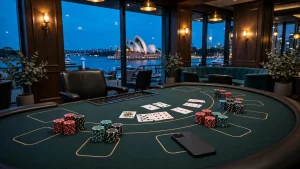
A live table makes its presence known through a camera. In live dealer baccarat, the setting is a casino studio; the table appears on screen as a virtual space, with a professional dealer handling the game in real time. The stream gives the proceedings a human pace: a hand is dealt, a prompt opens the betting window, and the action moves on.
That is a different spectacle from the wheel suggested by roulette. A wheel gives the eye a single moving centre; baccarat’s camera follows a dealer and the table. The distinction matters because a search for live roulette in Australia, especially with an English-speaking dealer, can sound like a request for a particular scene. The baccarat stream described here is not evidence of roulette being offered, or of the dealer speaking any particular language.
The webcam is more than decoration. It lets viewers watch a real person deal rather than see an outcome appear on a digital display. Betting prompts arrive during the broadcast, tying the interface to the pace of the table. The experience sits between a broadcast and a game: the dealer is visible, while the betting takes place through the virtual layout. A camera does not make the room public; it makes the room legible.
There is a small social theatre in that arrangement. The dealer’s gestures and the timing of each prompt give the proceedings a sequence that software alone does not reproduce. Yet the stream should not be mistaken for proof of a local venue, a local licence, or a particular language service. It is a studio feed delivered to a screen.
The wheel remains elsewhere. That is not a complaint about baccarat, but a useful boundary around what the viewing experience actually is. Roulette depends on a wheel; the baccarat stream centres on cards, a dealer and the table. One image cannot be substituted for the other merely because both appear under the broad label of casino games.
This material concerns adults aged 18 and over. Gambling can cause financial harm, and losses are the responsibility of the person gambling; Jackpotjillcasinohubau.com is not liable for them. Responsible gambling means recognising when play is causing harm and seeking appropriate support. A polished stream does not soften the financial risk.
A live table changes the financial threshold for taking part. A specialist review describes live-dealer games as often being restricted to real-money play, which means a player cannot necessarily approach them as a cost-free demonstration. The distinction matters: a streamed table may look like entertainment at a distance, but access can depend on having money in an account.
For Australians, that practical detail sits inside a strict legal boundary. The Interactive Gambling Act 2001 prohibits operators from providing real-money online casino games to people in Australia; roulette is among the casino-style games covered. A label such as “European Roulette” does not alter that position or establish that a real-money table is lawfully available. The phrase identifies a product category, not permission.
Currency introduces a separate cost. An account held in Australian dollars avoids the 2.5–4% conversion margin applied to balances in US dollars or euros. With a foreign-currency balance, conversion can take a share of the funds before the game itself has any bearing on the outcome. It is a quiet charge, and therefore easy to mistake for part of the game’s ordinary cost.
That distinction should not be blurred into a claim about winning. A roulette result cannot be made more favourable by choosing a wallet currency; the currency affects conversion, not the wheel. Nor does a page describing a real-money table make online casino play lawful in Australia. The law addresses operators, while the currency question concerns what a balance may cost.
The wider point is less glamorous than the table’s lighting: a live stream can make remote play feel immediate, while the legal and financial conditions remain outside the frame. The frame matters.
18+. Gambling can cause financial harm. This website is not liable for losses.
Australians do play baccarat through international casino platforms that accept customers from the country. That fact describes a pattern of use, not an approval or a recommendation. Under the Interactive Gambling Act 2001, operators cannot provide real-money online casino games to people in Australia; access to offshore services is also subject to blocking and enforcement.
The language of a “winning system” often shifts attention from the conditions that govern a transaction. A betting method cannot change the terms a platform sets for withdrawals, nor can it make a payout certain. In baccarat, the game’s outcomes remain separate from the site’s administrative rules. Treating those as one problem is a convenient way to overlook the less glamorous part: getting funds out.
A specialist review reported weekly withdrawal caps of $5,000–$10,000 at offshore sites. That is a report from one review, not a dependable market-wide standard. Limits can be site-specific and subject to change, so the figure should not be read as a promise that any particular platform will permit a withdrawal at that level. The cap itself is only one condition; the applicable terms determine how it works.
That distinction matters more than a confident claim about a roulette system or a baccarat pattern. A site’s promotional language may make control sound like a property of the player, while withdrawal conditions remain in the operator’s hands. No sequence of bets can settle that imbalance. Dry arithmetic, then a separate set of terms.
Roulette and baccarat are different games, and a claim about a method for winning at one should not be mistaken for evidence about the other. Nor does a persuasive site description remove the legal boundary around online casino services in Australia. These are not small print details; they shape the entire transaction.
18+ only. Gambling can cause financial harm, and losses are the responsibility of the person who incurs them; Jackpotjillcasinohubau.com accepts no liability for gambling losses.
Table limits and dealing speed shape the feel of live baccarat more than its simple betting choices do. They also determine how long a session can stretch and how quickly decisions arrive. Those are practical details, not evidence of a better chance of winning.
A specialist review puts the minimum on many live baccarat tables at $5–$10 per hand, describing $1 tables as uncommon. That is a report about table listings, not a fixed market rule: limits can differ between platforms and tables. A low minimum may make a seat seem accessible, but repeated hands still turn small individual stakes into a real-money risk.
The same kind of review distinguishes standard tables, reported at roughly 40–50 hands an hour, from Speed tables, which can exceed 80. The faster format leaves less time between decisions. Pace is part of the product, not a strategy. A quicker hand does not make a wager safer.
At the other end of the scale, a specialist review reports that some VIP baccarat tables may set limits as high as A$20,000 per bet. The word “some” matters: this is not a general table limit, and a ceiling is not a recommendation. High limits describe access for large stakes; they say nothing about whether a player will win.
Trial access is constrained by the physical arrangement of a live table. Unlike an unlimited stream of simulated seats, a live table has a finite number of places, and specialist reviews describe trial play as limited for that reason. Availability can therefore be a matter of open seats, rather than a promise that every visitor can join.
These details should be read as descriptions of table conditions, not as an invitation to play. In Australia, real-money online casino games are prohibited services for operators to provide to people in the country. Gambling can cause financial loss; Jackpotjillcasinohubau.com is not liable for losses arising from gambling. 18+ only. If gambling is causing harm, support is available through local gambling-help services.
Yes, international casino platforms that accept Australian players offer live dealer baccarat, with a real dealer dealing physical cards on a streamed table.
Yes, Australians can access live baccarat through international platforms that accept Australian players. However, there are no locally licensed online casinos operating in Australia.
The Banker bet has the lower house edge in standard live baccarat: 1.06%, compared with 1.24% for Player and 14.36% for Tie.
Some live baccarat schedules may impose time restrictions. Check the schedule for the table you choose.
Yes, trial play may be available, but it is often limited because live tables have a limited number of seats.
Australians regularly play baccarat online through international casino platforms that accept Australian players.