Australian retail wallet use does not confirm online casino support; payment acceptance, game access and withdrawals require separate evidence.
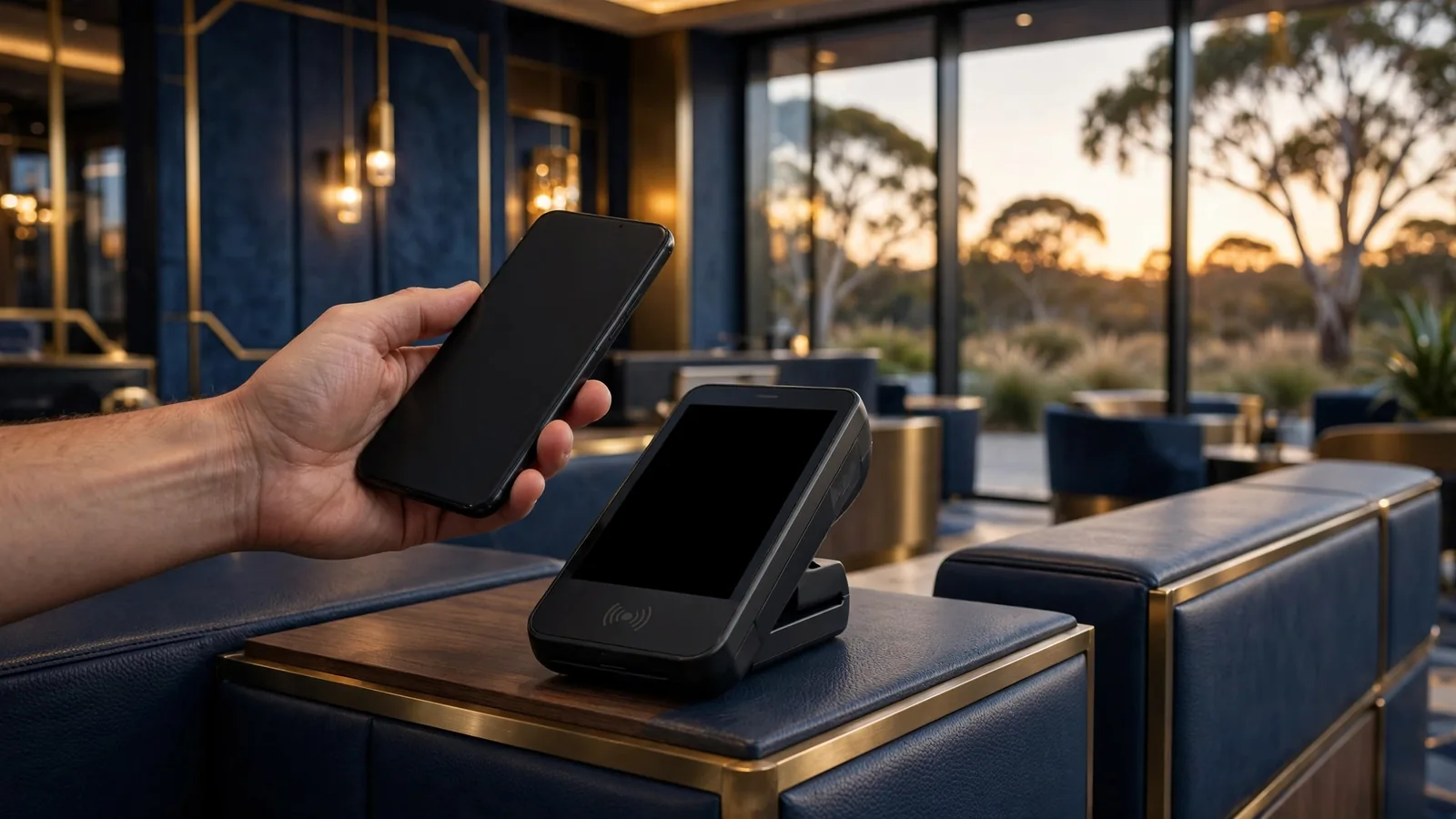
In Australia, tapping a phone at a shop counter is an ordinary part of paying. Contactless credit and debit cards are accepted almost everywhere, and mobile wallets such as Apple Pay and Google Pay are similarly familiar. The habit has settled into daily life: a card, a phone and a bank-linked service such as PayPal can each serve as the means of payment, depending on the setting.
That familiarity can make an online payment method seem like a simple extension of the checkout. It is not. A wallet’s broad acceptance across Australian retailers says nothing, by itself, about whether a particular online service accepts it. The phrase “Australian casino that accepts Apple Pay” joins two separate ideas—local payment habits and a casino’s own payment arrangements—and the first does not establish the second.
There is a more consequential distinction behind the uncertainty. Under the Interactive Gambling Act 2001, operators cannot lawfully provide real-money online casino games to people physically in Australia. This includes casino-style services such as poker, table games and slots. The Australian Communications and Media Authority is responsible for enforcing the Act. A familiar payment symbol cannot change the legal character of the service displaying it.
Apple Pay availability can vary, so check the casino’s current cashier options before signing up. This list gives you a starting point for reviewing the available operator information for Australia.
Rollero Casino
Rollero Casino is listed with a Curaçao Gaming Control Board licence, OGL/2023/176/0095, held by Hollycorn N.V.
LuckyVibe
LuckyVibe is listed with a Curaçao Gaming Control Board licence, OGL/2023/176/0095, held by Hollycorn N.V.
House of Pokies
House of Pokies lists an international iGaming licence, though the jurisdiction is not named. Its minimum deposit is A$30, or A$10 with PayID, and PayID payouts are listed at 1–24 hours.
Wild Tokyo
Wild Tokyo lists a Curaçao licence and a minimum deposit of A$10. Its stated payout times are 30–60 minutes for crypto and 1–5 days for fiat.
Uptown Pokies
Uptown Pokies is listed as operating since 2017, with a Curaçao licence and a minimum deposit of A$20.
MrPacho
MrPacho lists a minimum deposit of A$30. Stated payout times are 30–120 minutes for crypto and 24–72 hours for fiat.
Golden Pokies
Golden Pokies is listed with a Curaçao licence.
WinSpirit Casino
WinSpirit Casino lists a Curaçao eGaming licence, OGL/2024/923/0383, held by Antillephone N.V. Its minimum deposit is A$30.
JustCasino
JustCasino is listed with a Curaçao Gaming Control Board licence.
Kingmaker
Kingmaker lists a minimum deposit of A$30. Its stated payout times are about 90 minutes for crypto and 1–5 days for fiat.
Nor does the appearance of an offshore site make it part of Australia’s regulated consumer landscape. Australian consumer law does not protect players who use offshore casinos. A polished cashier can borrow the visual language of ordinary online retail, but that resemblance is not a guarantee of local protections—or evidence that the payment route is available.
The gap, then, is not between a country that uses mobile wallets and one that does not. Australians readily move among cards, phone wallets and bank-linked services. The gap is between that everyday comfort and a claim about a specific, prohibited service. Familiarity at the checkout is real. Casino acceptance is a different claim.
A wallet logo is not a licence.
Apple Pay has an ordinary place in Australian commerce. Mobile wallets, including Apple Pay and Google Pay, are accepted almost everywhere in the country. That familiarity can make a wallet icon seem like a reliable clue when an online service claims to accept it. For online pokies, however, the clue is incomplete: widespread use at everyday checkouts does not establish that a casino accepts Apple Pay.
 Payments & Crypto Options for Australian CasinosExplore Australian casino payment topics, from cards and e-wallets to prepaid options and cryptocurrencies such as Bitcoin, Bitcoin Cash and Ethereum.
 Casinos That Accept Neteller in Australia: What Is KnownLearn why a search phrase cannot verify casino availability, Neteller withdrawals, or bonuses, and how Australian context shapes the claims.
The distinction is easy to lose because the same name covers different settings. A person can tap a phone at a shop, use a wallet connected to a card, and still find that a particular online merchant does not offer the wallet as a payment choice. Acceptance belongs to the merchant and the transaction, not simply to the technology. A casino claim therefore needs evidence tied to that operator and its Australian-facing payment arrangements. Familiarity is not confirmation.
There is a more consequential complication in Australia. The Interactive Gambling Act 2001 prohibits operators from providing real-money online casino-style games to people in Australia. The prohibition covers pokies as well as poker and table games; it is not a distinction between one type of casino game and another. The Australian Communications and Media Authority is responsible for enforcing the law, including action against prohibited services. Offshore services may be actively blocked, so an online page or payment symbol should not be mistaken for proof that a service is legally available in Australia.
This changes what “Australian online pokies that accept Apple Pay” can responsibly mean. The phrase may describe a hope for a familiar payment method, but it cannot be treated as a dependable directory category. General Australian acceptance of Apple Pay says nothing about whether a particular gambling operator offers it, whether a transaction would go through, or whether an offshore service may lawfully provide real-money casino games to people in Australia. Those are separate matters, and the first cannot settle the others.
The difference is also visible in the way payment symbols work. A logo can indicate a method the business says it supports; it does not, by itself, establish the terms attached to that method or confirm that an Australian customer can use the service. Support may depend on the operator’s actual cashier and payment arrangements. In a regulated shop, the symbol is a simple convenience. In this setting, it sits beside a legal boundary that changes the meaning of the whole transaction.
There is a quiet social history in that contrast. Australia has made contactless payments part of the texture of daily life, where a phone can stand in for a card without much ceremony. Online gambling law draws a less casual line. The ease of the payment gesture does not make the service behind it lawful. Convenience has travelled further than permission.
Nor does a wallet’s presence make an offshore casino a locally regulated business. Australian consumer law does not protect people who use offshore casinos. That matters because a payment method may feel familiar while the service accepting it remains outside the protections attached to Australian consumer-facing businesses. The interface can look local; the legal position need not be.
A careful account of the topic therefore has to keep three questions apart: whether Apple Pay is common in Australian commerce, whether a particular casino says it accepts Apple Pay, and whether that casino may provide real-money games to people in Australia. The first is established in everyday life. It does not prove the second, and neither a logo nor a payment option overrides the third.
That is less satisfying than a list of supposedly compatible pokies sites, but it is more accurate. No operator or game should be presented as an Australian Apple Pay option on the strength of general wallet use. In this market, the payment badge is not a passport.
A small deposit sounds like a simple question of scale: how much must be paid to begin? With Apple Pay and online casinos in Australia, that question cannot be separated from a more basic one: whether the payment route is actually accepted by a gambling operator serving people in Australia. Familiarity with a wallet in ordinary commerce does not settle that point. A payment method’s presence in shops says nothing conclusive about its availability for an online gambling transaction.
That distinction matters when a specific amount appears in the claim. A figure such as ten dollars can look unusually concrete, but precision is not proof. Without an established operator, payment route and deposit condition, it cannot be treated as an Australian Apple Pay casino minimum. Nor can it establish that a deposit of that size would be accepted, credited, or available for play. The number may be a searcher’s hoped-for threshold; it is not, by itself, a payment term.
In ordinary Australian retail life, mobile wallets are deeply familiar. Contactless card payments and wallets such as Apple Pay are accepted across much of the country, and people move between cards and services linked to their banks with little ceremony. But the checkout counter and an online gambling cashier belong to different systems. The first demonstrates a routine payment habit. It does not establish a gambling operator’s acceptance policy, account eligibility rules or transaction handling.
The word “cashier” can make the distinction sound procedural, as if a wallet were simply another button waiting to be pressed. Yet a payment route depends on decisions made by the operator, the payment provider and the financial institution involved. General adoption of Apple Pay cannot establish that those parties support a particular gambling transaction. Nor does a wallet logo, if encountered in a broad description, settle what the logo means for deposits by Australian customers.
The limits are sharper because Australian law does not treat online casinos as an ordinary retail category. Under the Interactive Gambling Act 2001, it is illegal for operators to provide real-money online casino games to people physically located in Australia. The Australian Communications and Media Authority is responsible for enforcing that law. This is a restriction on service provision, not a declaration that every familiar payment technology becomes a casino payment method by association.
A deposit claim therefore has two separate layers. One concerns whether a payment method is accepted for a particular transaction. The other concerns whether the underlying gambling service may lawfully be offered to people in Australia. Treating the first as a harmless technical detail can obscure the second. A polished payment screen does not change the legal character of the service behind it.
Minimum-deposit language also tends to compress several different ideas into one figure. A stated minimum might refer to an account’s general funding conditions, a particular method, or a promotion’s terms; those are not interchangeable. For Apple Pay, no amount can be inferred merely from the fact that Australians use the wallet elsewhere. And an amount described without a clearly established service and payment route has little practical meaning. It is an attractive little certainty, but certainty all the same is not.
This does not mean Australian consumers are unfamiliar with digital payments. The opposite is true: cards, mobile wallets and bank-linked services are part of everyday financial life. That familiarity can make a casino deposit seem like a continuation of a routine already mastered. The resemblance is misleading. A familiar interface does not guarantee a familiar level of consumer protection, and Australian consumer law does not protect players who use offshore casinos.
There is a wider social story in that gap. Payment systems are designed to make exchange feel frictionless; regulation is often designed to put friction back where a market has been judged unsafe or unlawful. The two impulses coexist in the same pocket-sized device. A person may use a wallet for ordinary purchases throughout the day, while the law draws a firm boundary around real-money online casino services offered to people in Australia. Convenience does not erase that boundary.
So claims about an Apple Pay deposit, including a supposedly small minimum, need more than an amount and a wallet name to carry weight. They require a real, identifiable payment arrangement—and the legal setting cannot be edited out of the description. Without those elements, a figure should not be presented as a usable Australian deposit threshold. Small print cannot make the larger question small.
Calling a casino site “best” suggests that a comparison has been made: that the options are identifiable, their relevant features have been checked, and the same standard has been applied to each. A payment-method label alone cannot carry that weight.
That restraint matters because a polished comparison can look like a consumer guide while quietly doing something else: directing people towards a service that Australian law does not permit operators to provide. The Interactive Gambling Act 2001 prohibits operators from offering online casino games to people in Australia. The restriction concerns the operator’s conduct; the Act does not expressly make an individual player’s use of an offshore site a criminal offence. Those are distinct points, and neither turns an unsupported payment claim into a reliable recommendation.
The Australian Communications and Media Authority, or ACMA, enforces the Act. Its role is part of the practical context for any claim about casino sites aimed at Australian residents. A ranking that treats overseas availability as ordinary local choice leaves out the legal conditions that shape the market. It may also give a false impression that a site has been assessed, endorsed or made safe for Australian consumers merely because it appears in a comparative list.
No such reassurance follows from a “best” label. Nor does the label establish that Apple Pay is accepted, that an account can be opened, or that a service is lawful for an operator to offer in Australia. Each of those propositions would need separate support.
There is another imbalance worth noticing. The interface of a digital service can feel intimate and local: prices appear in familiar currency, payment brands are recognised, and the page may be designed for a particular audience. But a familiar surface does not change the legal status of the underlying service. Australian consumer law does not protect players who use offshore casinos. That matters when a comparison is framed as a guide to choosing among offers, because the ordinary protections associated with a local consumer transaction cannot simply be assumed.
A responsible evaluation therefore has to distinguish three things that are often compressed into a single promotional phrase: whether an operator’s site makes an Apple Pay claim, whether that claim is supported by current evidence, and whether the service may lawfully be offered to people in Australia. A positive answer to one does not settle the others. A logo, a copied payment-method list or an unqualified ranking is not a substitute for that distinction.
The word “best” is especially slippery here. It can imply a measured advantage even when no common criteria are stated; it can also make a commercial listing sound like neutral public information. Where Australian law prohibits operators from offering online casino games to residents, a ranking of supposed Apple Pay casinos risks presenting the prohibited service as a normal marketplace. The careful course is not to convert uncertain claims into a shortlist, but to explain what can and cannot be established without steering people towards offshore gambling.
That is less satisfying than a league table. It is also more honest.
A wallet logo can make a payment claim look complete. It is not. Apple Pay appearing beside a cashier’s payment options would not, by itself, establish that winnings can be sent back through the same route, much less that they would arrive instantly. Depositing and receiving a withdrawal are separate stages, governed by separate arrangements. A neat icon cannot stand in for the terms of either.
“Instant” is particularly slippery. It may describe an initial payment step, an operator’s handling of a request, or the time until funds become available. Those are not interchangeable meanings. A phrase promising an instant Apple Pay casino withdrawal needs evidence about the whole process, including whether Apple Pay is supported for payouts at all. Without that distinction, speed becomes a word with a glossy surface and no dependable measure beneath it.
Nor can a claim about a wallet’s general use at shops settle what happens in a gambling cashier. Everyday familiarity with mobile payments is one thing; an operator’s actual withdrawal rules are another. The first does not certify the second.
The distinction matters because a payment method can be accepted for one direction of travel but not the other. A casino could, in principle, permit a particular route for deposits while requiring another method for withdrawals. That possibility is not proof of Apple Pay support in either direction. It is a reason to treat “Apple Pay accepted” and “instant withdrawal to Apple Pay” as two different claims, each requiring its own clear terms.
The legal setting makes the promotional language more consequential. Under the Interactive Gambling Act 2001, operators cannot provide real-money online casino games to people in Australia. The prohibition covers casino-style services such as poker and table games as well as other online gambling games. The Australian Communications and Media Authority is responsible for enforcing the Act, and offshore services are subject to active blocking and enforcement. A fast-payout promise does not alter that position.
The law places the obligation on operators rather than making a player criminally liable simply for using an offshore site. That does not make offshore play a protected consumer activity. Australian consumer law does not protect people who use offshore casinos, leaving a sharp divide between the confidence of a payment badge and the recourse available if a withdrawal is delayed or disputed. A familiar wallet is not a local safeguard.
This is why “instant Apple Pay withdrawal” should not be read as a verified service description merely because the words appear together. A genuine claim would need to specify that Apple Pay is an available withdrawal route, define what “instant” refers to, and state the conditions that can affect the timing. A logo alone supplies none of that. It is decoration, not a timetable.
The same caution applies to claims about real-money pokies with immediate payouts, whether described as new, best, or available without a deposit. Those labels do not establish that a lawful service exists for people in Australia, or that Apple Pay can return winnings. They join several separate promises—access, payment route and speed—and present them as one. The joins are where the evidence would need to be.
Instant is a claim, not a guarantee.
In Australia, Apple Pay is part of ordinary payment life. Mobile wallets, including Apple Pay and Google Pay, are accepted almost everywhere in the country. That familiarity can make the phrase “accepts Apple Pay” sound like a straightforward description of a business, as though a wallet’s presence at the local checkout settled the matter elsewhere too.
It does not. Widespread acceptance across Australian shops says nothing conclusive about whether a particular online casino has Apple Pay available. A payment method may be common in everyday commerce and still be absent from a casino’s payment options. The two settings are not interchangeable.
The distinction matters especially in a country where the legal status of online casino services is not a footnote. The Interactive Gambling Act 2001 makes it illegal for operators to offer real-money online casino games to people in Australia. The law addresses the service provider; it does not explicitly criminalise an individual player for using an offshore site. Those are separate points, not a general permission slip.
Nor does the existence of a foreign-facing website make the underlying service lawful in Australia. Offshore casino services are subject to blocking and enforcement, and Australian consumer law does not protect people who use offshore casinos. A familiar wallet logo cannot change the legal character of the service or supply the protections that do not apply.
This is why a claim that a casino “takes Apple Pay” needs to be understood narrowly. At most, the phrase would describe a payment option offered by a particular operator in a particular context. It cannot be inferred from Apple Pay’s near-ubiquity in Australian retail, and it does not establish that the operator may lawfully provide online casino services to Australians. Payment acceptance and legal status are different questions.
The broad 2026 question—whether there are casinos that accept Apple Pay in Australia—therefore cannot be answered by pointing to the country’s general comfort with mobile wallets. That habit belongs to the ordinary economy. Online casino services sit in a different legal category, one that the Interactive Gambling Act expressly restricts for operators serving people in Australia.
There is a quiet mismatch here: a modern payment habit meets a law that draws a firm boundary around the service being paid for. The technology can travel easily; the legal permission does not travel with it.
“Accepts Apple Pay” is not a verdict on legitimacy, accessibility or consumer protection. It is not proof that a casino is available to Australians, and it should not be read as an endorsement or invitation to use one. In this setting, the phrase can describe a payment claim—but it cannot settle the more consequential question of whether the service may lawfully be offered.
A payment method and a catalogue of games answer different questions. Apple Pay, where offered by a service, concerns how a transaction might be made; it does not establish what content that service provides, whether the service is accessible in Australia, or whether its operation is lawful here. A wallet logo cannot carry all that weight.
A payment method concerns how a transaction is made, while game access concerns what content is provided and whether the operation is lawful under the Interactive Gambling Act 2001.
That distinction matters because descriptions of “casino games with Apple Pay” can blur the payment rail with the activity being paid for. The presence of a mobile-payment option would not, by itself, verify that particular games are available through it. Nor does the name of a game or a general claim about a mobile casino establish that Apple Pay is accepted by an operator. These are separate claims, and each needs its own evidence.
In Australia, the legal boundary is not a technicality about checkout design. The Interactive Gambling Act 2001 prohibits operators from offering real-money online casino games to people in Australia. The prohibition covers online casino-style services; changing the payment method does not change the nature of the service. The Australian Communications and Media Authority is responsible for enforcing the Act.
The law is directed at operators, and it does not explicitly criminalise a player for using an offshore site. That distinction should not be mistaken for approval, protection or a guarantee of access. Australian consumer law does not protect players who use offshore casinos. The line is uneven, but not obscure.
So a claim about Apple Pay cannot establish that games are legally offered to Australians, while a claim about game access cannot prove that Apple Pay works at checkout. Payment acceptance, content availability and legal status remain distinct matters. Treating them as one can make a service appear more settled than it is. A logo answers only a narrow question.
A wallet shown at the deposit stage does not, by itself, establish that winnings can be returned to the same wallet. Payment acceptance and withdrawal eligibility are separate decisions: a cashier may treat incoming and outgoing funds differently, and the presence of Apple Pay in one part of a payment flow says nothing conclusive about the other.
That distinction matters in searches for an online casino that pays out through Apple Pay. A logo can look like a complete promise, though it may only describe a way to fund an account. Claims about an Apple Pay withdrawal route need to be read as claims about withdrawals specifically, not inferred from a deposit option.
Before financial transactions, online casinos commonly require customers to undergo Know Your Customer checks. These checks concern identity and account verification; they do not establish which payment method can receive a withdrawal. Nor does completing them turn a wallet used for payment into a confirmed destination for winnings.
The language of “withdrawal to Apple Pay” can also blur what is being described. It may refer to a casino’s own payout process, a card or bank route associated with a wallet, or simply a general expectation that money returns the way it arrived. Those are not interchangeable.
In Australia, this question sits within a wider legal boundary. The Interactive Gambling Act 2001 makes it illegal for operators to provide real-money online casino games to people physically located in the country. The Australian Communications and Media Authority enforces that law. Australian consumer law does not protect people who use offshore casinos, and the fact that a payment method is familiar elsewhere does not change that position.
No, payment acceptance and withdrawal eligibility are separate decisions; a cashier may treat incoming and outgoing funds differently.
No, Know Your Customer checks concern identity and account verification, not which payment method can receive a withdrawal.
No, Australian consumer law does not protect people who use offshore casinos.
So a casino withdrawal involving Apple Pay should not be treated as established merely because Apple Pay appears among deposit methods. A clear withdrawal policy would need to say whether the wallet is eligible as a payout destination and under what conditions. Without that distinction, “accepts Apple Pay” remains an incomplete description. The small print matters.
A request for an Apple Pay pokies list bundles two claims that need to be kept apart: whether a payment method is accepted by an online casino, and whether the service offers a particular kind of gambling. A wallet symbol, even if displayed somewhere, would not establish both. Nor does a general claim about Apple Pay use in Australia establish that an online gambling operator accepts it.
That distinction matters especially for slot-specific wording. An operator’s payment information, where it exists, would need to say what it accepts; a game catalogue would be a separate matter. Without operator-specific evidence, describing “slots with Apple Pay” as an available category would turn a search phrase into an unsupported promise. A list would be no better: its format can lend authority to claims that have not been established.
There is a larger boundary behind the payment question. Under the Interactive Gambling Act 2001, operators cannot lawfully provide real-money online casino-style games to people in Australia. That prohibition covers slots alongside poker and table games. The Australian Communications and Media Authority is responsible for enforcing the Act. A payment method does not alter the legal character of the service.
The practical accessibility of offshore sites does not make them lawful offerings for Australian residents, and Australian consumer law does not protect people who use offshore casinos. That is a more consequential distinction than whether a wallet appears at checkout. A familiar payment brand is not a licence, a safeguard, or evidence that a particular service may lawfully be supplied.
So a reference to Apple Pay and casino slots should be read narrowly: it raises a payment-support question, not proof of a compatible game or a legitimate local service. The logo cannot do that work.
A casino bonus is a promotion, not a feature of a payment wallet. Putting Apple Pay beside a bonus claim does not establish that an offer exists, who could receive it, or what conditions would apply. The pairing may sound like one neat package; in practice, payment and promotion are separate matters.
In Australia, that distinction sits within a stricter legal setting. The Interactive Gambling Act 2001 makes it illegal for operators to provide real-money online casino games to people physically located in Australia. The prohibition covers casino-style games, including poker, table games and pokies. Advertising real-money online casinos to Australian audiences is also banned. A bonus claim attached to such a service does not become an ordinary retail offer merely because it is framed around a familiar wallet.
Nor does a polished promotion settle the question of consumer protection. Australian consumer law does not protect players who use offshore casinos. That leaves promotional language with little of the reassuring weight it might carry in an ordinary domestic transaction. Fine print can describe conditions; it cannot change the legal character of the service or create local protection.
This is why an Apple Pay casino bonus should not be treated as a dependable category of offer. The name of a payment method beside promotional wording proves neither that Apple Pay is accepted nor that a bonus is available. It is a label, not a promise with legal force.
The distinction is less glamorous than the language of bonuses, which is precisely the point. A wallet is a way to pay. A promotion is an inducement. In Australia’s online casino market, neither phrase turns a prohibited service into a protected one.
Limits are set by each casino and can vary. Check the casino’s cashier for its current Amex deposit and withdrawal limits.
Jackpot City Casino, Spin Palace, Ruby Fortune, Ignition Casino, Joe Fortune and PlayAmo are listed as supporting Amex deposits for Australian players. Check the casino’s cashier to confirm availability.
Amex deposits typically have no fee, but a casino may apply a 1.5% surcharge, and Amex cards incur a 3% currency conversion fee.
Some casinos do not allow withdrawals to Amex, and withdrawals generally require a previous Amex deposit. A casino may also charge a withdrawal fee.
Amex deposits are typically free, although a casino may add a 1.5% surcharge. A 3% currency conversion fee applies to Amex cards, and withdrawal fees may also apply.
Amex may block payments to a particular website, and Australian banks may also block gambling transactions on Amex. Check with Amex or your card issuer about the declined payment.
Check the casino’s cashier for American Express as a deposit option. Availability can vary between casinos.