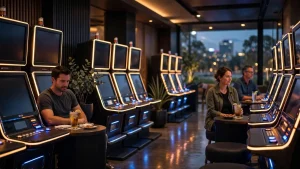
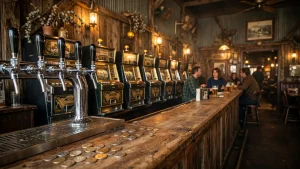
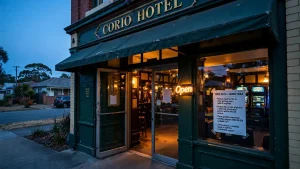
Venue hours do not confirm machine access, and online listings cannot settle availability at a specific moment.
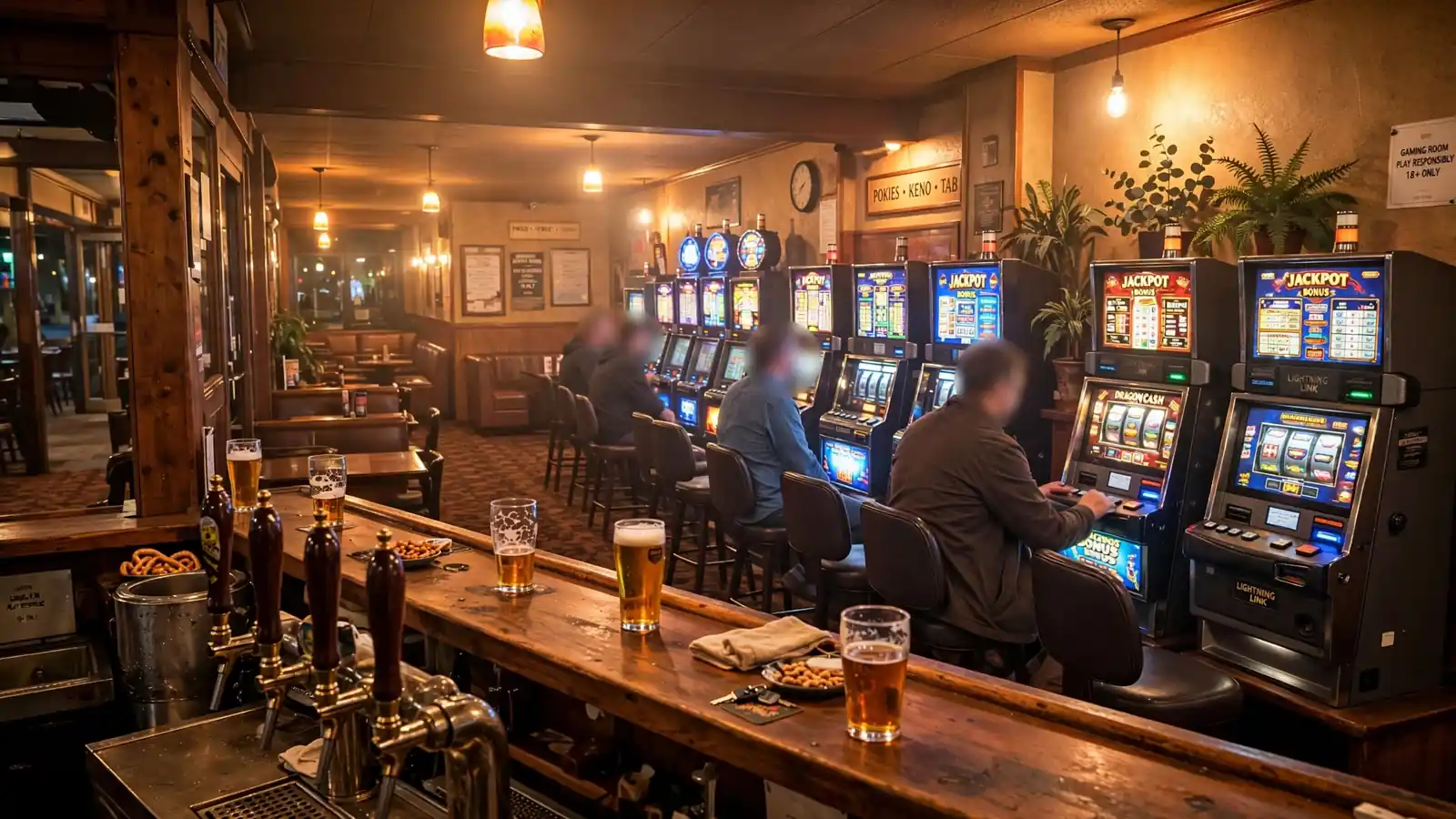
“Open now” sounds like a simple status. For a venue with pokies, it can describe only one part of the situation: whether the premises are operating at the moment. It does not, by itself, establish that poker machines are available to play. The venue and its machines are not the same thing, even when they share a roof.
That distinction matters because a current listing may show a venue as open without answering the question that prompted the check. A machine could be unavailable, or the information displayed online could be out of date. Neither possibility can be ruled in or out by the word “open” alone. For a definite answer about access at a particular moment, the venue itself is the relevant source.
This is less dramatic than a flashing sign, but more useful.
A venue’s operating status concerns the premises. Machine availability concerns whether poker machines can actually be used then. A person checking whether NSW pokies are open now may be asking both questions at once, though a venue listing may answer only the first.
Choosing pokies in New South Wales for 2026 means checking the available operator and payment information before deciding where to play. This list gives a concise reference point using only the details provided for each operator.
Rollero Casino
Rollero Casino is listed with a Curaçao Gaming Control Board licence, OGL/2023/176/0095, held by Hollycorn N.V.
LuckyVibe
LuckyVibe is listed with a Curaçao Gaming Control Board licence, OGL/2023/176/0095, held by Hollycorn N.V.
House of Pokies
House of Pokies has an international iGaming licence, though its jurisdiction is not named in the source. PayID withdrawals are listed at 1–24 hours, and the minimum deposit is A$30, or A$10 with PayID.
Wild Tokyo
Wild Tokyo is listed as Curaçao-licensed. Its stated withdrawal times are 30–60 minutes for crypto and 1–5 days for fiat; the minimum deposit is A$10.
Uptown Pokies
Uptown Pokies is listed as Curaçao-licensed and operating since 2017. Its minimum deposit is A$20.
MrPacho
MrPacho lists crypto withdrawals at 30–120 minutes and fiat withdrawals at 24–72 hours. Its minimum deposit is A$30.
Golden Pokies
Golden Pokies is listed as Curaçao-licensed.
WinSpirit Casino
WinSpirit Casino is listed with a Curaçao eGaming licence, OGL/2024/923/0383, held by Antillephone N.V. Its minimum deposit is A$30.
JustCasino
JustCasino is listed as licensed by the Curaçao Gaming Control Board.
Kingmaker
Kingmaker lists crypto withdrawals at approximately 90 minutes and fiat withdrawals at 1–5 days. Its minimum deposit is A$30.
The distinction also applies when someone is already on site. A building can be admitting visitors while a particular service or area is not available. It is sensible, therefore, not to treat an open sign, a map listing or a general venue page as confirmation that machines are operating. Those sources may offer a starting point, not a live account of every facility.
Current conditions are a moving target. A venue’s own telephone line or current notice is better suited to confirming whether it is operating and whether machines are available at that time. If the information is unclear, asking both questions separately avoids the familiar problem of receiving a correct answer to the wrong one.
Questions about pokies being open early, late, or at a particular hour are still questions about a specific venue’s current arrangements. A phrase such as “open at six” or “open at seven” cannot establish that every venue follows the same schedule, or that machine access matches the broader premises schedule. Nor does a past listing prove what is happening today.
The word “now” is especially perishable. A page that was accurate when last updated may not reflect a temporary change, and a general schedule cannot confirm a moment’s access. Where an early or late visit depends on machine availability, direct confirmation is more reliable than inferring it from a broad opening label. Typical hours are a separate matter; they do not settle what is available at this instant.
There is also a difference between finding a venue described as open and being entitled to use its machines. In NSW, the legal age for gambling on poker machines is eighteen. Venues must check identification for poker machine gambling, and an underage person cannot lawfully gamble on them. Identification is not ornamental paperwork: it is part of enforcing that boundary. The legal restriction is the point; a current opening status does not override it.
An “open now” label says nothing about a machine’s payout percentage. It is not a measure of how often a machine pays, what it might return, or whether a particular session will produce a win. Opening status and game outcomes answer entirely different questions. Combining them in one search does not make one a guide to the other.
Nor does a venue’s open status promise uninterrupted access. A listing can be a useful indication that the premises are operating, but it is not a guarantee about the availability of every facility. The practical check is narrow: confirm the venue is open, then confirm whether poker machines are available. If the answer matters enough to shape a journey, a current confirmation matters more than a broad label.
Gambling also carries no reliable route from a session to money needed for rent or groceries; that hope is an illusion. A session budget should be set in advance, within the player’s bankroll. Losses are not a reason to raise bets in an attempt to recover them. These cautions do not determine whether a venue is open, but they do put the decision to enter a session in its proper frame.
“Open” is a door, not a promise.
The phrase “best paying” suggests a machine that can be identified in advance and approached with confidence. Pokies do not offer that kind of certainty. A title may have a published return-to-player figure, a jackpot feature or a reputation among players, but none of these tells anyone what the next spin will do. The game’s mechanics describe probabilities over time, not a promise about a particular session.
Every online pokie uses a Random Number Generator (RNG) to determine its outcomes. Each spin is independent: the RNG does not keep score, and a run of losses does not make a win due. Nor does a recent win make another one more likely. That is the essential limit of pattern-spotting. A sequence may look meaningful to a person watching it unfold; the next spin is not obliged to continue or correct it.
RTP, or return to player, is a theoretical measure of the share of wagers a pokie pays back across a very large number of spins. It is not a forecast of what one player will receive, and it does not mean that an individual’s stake is returned in a neat proportion. A short session can land far above or below the theoretical figure. The longer horizon belongs to the calculation, not to a guarantee made to each player.
That distinction matters when comparing titles described as the best-paying pokies in NSW. A number attached to RTP can help explain a game’s stated long-run design, where that information is available. It cannot rank the likely result of tonight’s play, and it does not make one spin safer than another. “Best” can also refer to different things: a player may mean a bonus feature, a jackpot, a familiar theme or simply a game they enjoy. Those preferences should not be mistaken for evidence of better returns.
Dragon Link, Lightning Link and Starburst are examples of named games that can be examined for their rules and features. Their names alone establish no payout ranking. Before play, the useful questions are practical ones: how are wins formed, what triggers a feature, and does the game include a progressive jackpot or a separate bonus-entry option? Understanding the rules will not predict the outcome, but it can prevent a feature’s presentation from being confused with a promise.
Progressive jackpot pokies work differently from an ordinary spin in one important respect: a small portion of each bet is added to a growing jackpot pool. The prize can therefore accumulate across play, while the chance of winning it remains uncertain. A larger displayed jackpot is not a schedule, and it does not make the next spin more likely to pay it. The moving total is a feature of the pool, not a signal from the RNG.
Bonus-buy features are different again. Instead of waiting for a bonus round to appear through ordinary play, a player pays a set amount to enter it directly. A report by psu.com describes buy-bonus prices in the range of 50 to 100 times the stake; that figure is a reported description, not a fixed rule for every title or jurisdiction. The purchase changes how the bonus is entered, not whether its outcome can be known in advance. The cost is immediate; the result remains uncertain.
The vocabulary around pokies often turns design into promise. “High paying”, “hot” and “due” can make a random process sound as if it were negotiating with the player. It is not. RTP describes a long-run theoretical return, jackpots pool contributions, and bonus buys charge for direct entry to a feature. None of them changes the independence of a spin.
A sensible boundary follows from that uncertainty: set a session budget based on the available bankroll, do not chase losses, and do not raise bets in an attempt to recover them. No title can make a loss-recovery plan reliable. The mechanics are specific; the certainty is not.
A website’s availability in New South Wales does not make its business lawful in Australia. The Interactive Gambling Act 2001 prohibits operators from providing real-money online casino games, including pokies, to people physically located in the country. An Australian-based business cannot lawfully offer online casino play to local customers. Offshore operators are also not authorised to serve Australians under that law, even when their websites can be reached from an Australian connection.
That distinction matters when a search for online pokies turns up a site presenting itself as an Australian option. A page may use local language, display Australian dollars or accept visitors from NSW; none of those details amounts to Australian authorisation. Gambling sites operating lawfully in Australia need an ILGA licence, but that is not a licence for online casino games. The law draws a boundary around the service, not merely around its branding.
For players, the position is different from the operator’s. Australian players are not criminally liable simply for using an offshore casino, but those platforms are not regulated under Australian law. If a dispute arises, the protections and routes for resolving it are limited, and winnings may not be protected if the operator fails. An offshore licence does not turn the site into a locally regulated provider. It describes the operator’s status elsewhere.
The border can also appear as a technical barrier. Online casinos and game providers may use a player’s IP address to estimate their location. If the address points to Australia, a site may block access or omit particular titles from its lobby. A game that does not appear, or refuses to load, may therefore be unavailable because of a regional restriction rather than a fault with the device. Which titles are accessible can change with the operator’s or provider’s rules.
There are historical examples. NetEnt blocked its wide-area progressive jackpot games from Australia in 2016; Mega Fortune and Hall of Gods were among the affected titles. NYX Gaming, now associated with Next Gen, also region-blocked games including Foxin’ Wins and Doctor Love. These examples show that a familiar title’s presence on an international game catalogue says little about whether it will be available to an Australian IP address today.
A VPN can make an internet connection appear to come from another country, but using one to reach region-blocked pokies may breach the site’s terms. An operator may suspend an account for doing so. A changed digital location does not change the player’s physical location or the legal position of the service. It is a workaround, not a permission slip.
Promotional offers need the same distinction between a headline and the conditions beneath it. A no-deposit bonus or free spins may look like play without a cost, yet winnings can be subject to wagering requirements before withdrawal, along with other terms that affect whether cash can be paid out. A report on psu.com describes free-spin winnings as carrying wagering requirements between 20x and 50x. That is a reported range, not a universal rule: the terms attached to an offer govern that offer. Pokies may count fully toward a requirement, but the amount of qualifying play needed can still make a withdrawal less straightforward than the promotion suggests.
The language of “best paying” or “high limit” does not resolve any of these questions. A game’s advertised features cannot establish that it is accessible from NSW, and a bonus cannot establish that an offshore operator is protected by Australian regulation. Online access crosses a border in seconds. The law does not disappear with it.
A venue described as being near an airport may still be outside the terminal precinct, in a neighbouring suburb, or in a different local area altogether. The phrase is a starting point for checking a map, not confirmation that poker machines are available inside an airport or at any particular nearby address. Search results can blur those distinctions by grouping places according to distance, transport links or broad regional labels.
The same caution applies to a request for pokies near an NSW airport. The airport’s name does not establish which venue is closest, whether a venue has Electronic Gaming Machines (EGMs), or whether the machines are accessible to the public. A venue listing and its own information are better evidence of its address and facilities than a label attached to a map pin. If the location matters, the actual street address matters more than the search result’s shorthand.
There is a small geography lesson in this. Airports are built to connect places; search tools often make the surrounding places look like one. But a road across a regional boundary can lead into another jurisdiction, where local rules and venue arrangements may differ. A result referring to NSW and Victoria should therefore be checked for the state in which the venue is physically located. Being close to the border does not make a Victorian venue an NSW venue, or establish that a cross-border option suits an NSW-based search.
“Near me” is similarly elastic. It can depend on the device’s location settings and on how a service defines nearby, while a broad result may cover an area larger than the person intended. Airport searches can be especially imprecise because the airport, its access roads and the nearby suburbs are not interchangeable places. A result should be treated as a lead to verify, not as a promise of proximity or facilities.
That distinction is useful for CBD searches too, though a city-centre venue cluster is a different question from an airport-area one. Here the issue is not which district has the most venues, but whether the location implied by a short label matches the place being considered. A pin can be close in a map sense and still be inconvenient in practice.
For physical venues, the legal age for playing poker machines in NSW is 18, and venues check identification. Anyone below that age cannot legally gamble on the machines. Location does not soften the rule. Nor does a nearby venue make gambling a remedy for rent, groceries or other financial pressure; that hope is an illusion. Losses should not be chased by raising bets, and a session budget should be set from money available for entertainment, not essential expenses.
The sensible result of an airport or border search is a verifiable address and a clear understanding of which side of a jurisdictional line it sits on. Proximity is not proof.
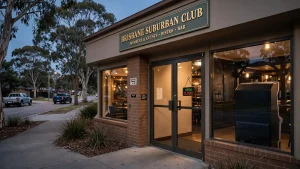
A search for pokies venues in New South Wales can mean several different things: a club with Electronic Gaming Machines (EGMs), a casino, or simply a place in a particular neighbourhood where machines are part of the venue’s offer. Add “CBD” and the map narrows, but the underlying question does not change. A central location describes where a venue is; it says nothing by itself about the machines, the atmosphere or the suitability of a visit.
That distinction matters because “best” is often asked as though it were a property that can be read from a postcode. It is not. A venue may be prominent, large or easy to locate without having machines that are better for any particular player. A club’s scale can be measured in operational machines; quality, by contrast, depends on what someone means by it. There is no sensible way to turn size into a promise about outcomes.
The clearest statewide comparison available concerns Club Liverpool. Among clubs in NSW, it operates more poker machines than any other club. That makes it a useful reference point for scale, not a verdict on the best pokies venue in NSW. The distinction is plain, though it is often lost in lists that treat a large count as a recommendation. A larger floor is still a larger floor.
In a central business district, venues sit amid offices, transport links, hotels, restaurants and the ordinary traffic of a city. That density makes location-based searches useful for orientation, but not for judging what happens inside. A pin on a map can confirm proximity; it cannot establish that a venue has a preferred atmosphere, a particular range of machines or a better experience than another club.
The same caution applies to lists of NSW clubs with pokies. A list can help identify names and locations, but the word “best” needs a separate measure. For one person, it might mean a convenient location; for another, a quieter room or a venue that also offers food and social activities. Those are different considerations, and none follows automatically from the number of EGMs.
Club Liverpool is therefore a concrete example of a club with exceptional machine capacity by the state-club comparison, not a universal answer to every CBD or statewide search. It is outside the logic of a CBD-only comparison to treat a prominent suburban club as though location were irrelevant. The map matters. So does the question being asked.
Clubs also occupy a particular place in Australian social life. They are not merely rooms built around gambling: many are community institutions, with dining, sport or functions alongside their gaming areas. That mixed role helps explain why venue searches can blur together. A person may be looking for a club as a social destination, while a search result foregrounds its machines; another may be looking specifically for EGMs and encounter a venue whose public identity is much broader. The label does not tell the whole story.
A venue’s own information is the practical starting point for confirming its address and the facilities it describes. Third-party listings can be useful for comparing locations, but old entries and broad category labels can leave out distinctions that matter. The number of machines, where they are situated and the character of the surrounding venue are separate details. A headline ranking may compress them into a single confident-sounding claim.
For anyone comparing clubs, it helps to separate measurable facts from preference. Machine count is measurable; “best” is an assessment that needs a stated basis. Neither one predicts a result at the machines. The size of a gaming area cannot turn chance into certainty, and a venue’s prominence is not evidence that a particular visit will be more rewarding.
Entry and gambling also have a legal boundary. In NSW, poker-machine gambling is for adults aged 18 and over. Venues must check identification for people gambling on poker machines; using false identification or attempting to gamble below the legal age can carry legal consequences. A venue’s welcoming public spaces do not remove that boundary. It is a rule of access, not a footnote to the club’s marketing.
Self-exclusion is another reason a venue search can mean more than finding a machine. The term refers to seeking restrictions on one’s own access to gambling, but the details of how it is arranged should be confirmed through the relevant venue or NSW gambling-support channels. It should not be confused with a machine setting or a feature that can be inferred from a club’s size. The scale of a venue tells nothing about whether a particular person should enter it.
Self-exclusion involves seeking restrictions on one's own access to gambling. Specific arrangements should be confirmed through the venue or NSW gambling-support channels.
A careful comparison, then, keeps three questions apart: where a venue is, what kind of place it is, and what can actually be established about its gaming facilities. Club Liverpool stands out on the narrow measure of operational machine numbers among NSW clubs. That is a substantial distinction, but not a ranking of experiences or outcomes. In the CBD, as elsewhere, a central address remains an address.
A venue’s published schedule and the availability of its Electronic Gaming Machines (EGMs) are related, but they are not the same thing. A listing that describes a venue as open around the clock says something about its operating hours; it does not establish that pokies can be played continuously. Access to machines may depend on the venue’s own arrangements, so a timetable should not be read as a promise of uninterrupted play.
That distinction matters when looking for venues described as open all day and night. “Twenty-four-hour” can refer to the venue, a particular service area or the way a listing categorises its hours. Without a clear statement from the venue about its gaming facilities, the label leaves the important part unanswered.
Opening hours are most useful when they come directly from the venue and specify what they cover. A general listing may be incomplete or out of date; a venue’s own published information can clarify whether stated hours apply to the entire premises or only to certain facilities. Where that distinction is not made, the schedule cannot settle whether machines will be available at a particular time.
The same care applies to NSW pokies hours more broadly. A broad description of trading hours does not automatically describe gaming-room hours, and a venue that operates late is not necessarily a source of continuous access to pokies. The wording may be brief; the distinction is not.
The phrase “open now” adds a separate complication. It describes an apparent status at the time of checking, whereas a published schedule describes planned hours. Neither, by itself, confirms that the gaming area is accessible or that machines are operating. A direct check with the venue is the clearest way to resolve that practical uncertainty.
Hours are not the only condition governing access. In NSW, the legal age for gambling on poker machines is 18, and venues check identification for people seeking to gamble. Underage gambling can have legal consequences. A late opening does not alter those requirements.
There is also a small cultural oddity in the language of the all-night venue: it makes time sound like a feature of the machines, when it is really a feature of the premises. The distinction belongs to ordinary administration, not to the game.
A careful reading of opening information therefore separates three things: the venue’s stated schedule, the hours that apply to its gaming facilities, and whether those facilities are available at the moment in question. Only the first may be answered by a general timetable. The rest requires information specific to the venue.
A request for pokies in Parkes is a local question, not a small version of a statewide league table. A result about NSW as a whole may point to clubs, casinos or game titles elsewhere; it does not establish what is available in Parkes. The same caution applies to Port Macquarie: another town name does not make its venues a useful proxy for Parkes.
The practical starting point is the venue itself. Its official information can establish whether it has Electronic Gaming Machines (EGMs), where it is, and what conditions apply to entry. Maps and directory listings can help identify candidates, but they may be incomplete or out of date. A local name appearing in a broad result is not proof that a particular machine, game or service is currently offered.
“Best pokies NSW” can mean several different things: a preferred game, a venue with a large gaming area, or simply somewhere nearby. Those are not interchangeable measures. A club’s size or prominence does not show that its machines are more favourable, and a statewide label cannot settle a personal preference. Without comparable, current information, a ranking would be decoration.
Parkes should therefore be assessed on its own terms: the location, the venue’s published details and whether the information is current. For a town-specific decision, direct confirmation matters more than a page that groups every NSW venue under one heading. That is less dramatic than a state ranking. It is also more useful.
In NSW, gambling on poker machines is restricted to people aged 18 or older. Venues must check identification for poker machine gambling; anyone who does not meet the legal age requirement may face legal consequences for non-compliance. Entry rules and venue policies still need to be checked with the venue.
The wider setting matters, but it should not be mistaken for local evidence. A general account of NSW pokies can explain the state context; it cannot confirm which machines are at a Parkes venue. And the label “best” is not a promise of an outcome. Each spin is uncertain, not a way to recover money already lost. A session budget based on available funds, and no increase in bets to chase losses, keep that distinction visible. Money hoped for as rent or grocery relief is not a reliable plan; gambling offers no such certainty.
A town deserves more than a statewide search result pasted over it. In Parkes, the useful answer begins with a verified local venue—not an invented ranking.
A Crown-related search can point to a brand, a venue, or an assumption that the two settle every practical question. They do not. Crown Sydney is a named casino operator, but the name alone does not confirm that a particular pokie room, machine selection or cash-payout arrangement is available at a NSW venue.
That distinction matters because “Crown” is not a description of a game. It does not identify a pokie’s mechanics or tell anything reliable about its likely return. A claim that one room is the best in NSW would need a clear measure and current evidence; the size or prominence of a brand is not such a measure. Nor does a general reference to Crown establish that any particular game is installed.
Venue details should be checked against current information issued by the venue and relevant NSW authorities, including Liquor & Gaming NSW. A name appearing in a listing is not the same as confirmation of an operating facility or its offerings. Facilities and game availability can change, and an old photograph or directory entry may preserve a version of the story that has since moved on.
The same caution applies to questions about the largest cash payout from a pokie. There is no single figure that can be responsibly attached to all NSW machines on the basis of a brand name. A displayed jackpot, a machine’s rules and the way a venue handles a payout are distinct matters. Without current, specific terms, a headline maximum is more likely to blur those distinctions than answer the question.
A jackpot can attract attention; it cannot turn gambling into income planning. Losses should not be chased by raising bets, and a session budget should be set from money that can be lost without affecting essentials. Hope is not a household budget.
NSW requires people to be at least eighteen to gamble on poker machines. Venues must check identification for machine gambling, and ignoring the age rule can carry legal consequences. That obligation is separate from whether a venue uses the Crown name or has a particular room.
The useful conclusion is modest: a brand can identify what to investigate, but it cannot verify a NSW pokie offering, rank a room, or supply a dependable cash-payout ceiling. Each claim needs its own current confirmation.
Cashless gaming and pre-commitment can sound like two names for the same change. They are not. Cashless describes how money is handled; NSW’s mandatory pre-commitment systems require players to set a loss limit before playing. That requirement is a player-protection measure, not evidence that a particular Electronic Gaming Machine (EGM) accepts cashless payments or that a venue has replaced cash altogether.
The distinction matters because a Newcastle venue’s machines cannot be classified as cashless merely from the state rule. Availability and arrangements need to be confirmed with the venue itself. A general description of a club or its gaming room does not establish how a particular machine can be funded. “Cashless pokies in NSW” is therefore a question about a specific payment arrangement, not a reliable description of every pokie in the state.
Pre-commitment works differently: it puts a loss limit in place before play begins. It does not predict outcomes, make a session cost-free, or turn a machine into a cashless one. A limit is useful only as a boundary that is respected; increasing bets to recover losses defeats its purpose. A session budget should be set in advance and kept within the available bankroll. Losses are not a route to rent or grocery money.
Newcastle is a separate matter of place. A request for the best pokies there may mean a nearby venue, a particular atmosphere, or simply a convenient location. None of those meanings establishes that one venue has better machines, and a town-level label cannot verify what equipment or payment options are available on site. Venue information is the relevant evidence for those practical details.
The broader point is modest: a protection rule, a payment method and a location are three different things. NSW requires pre-commitment, but that fact alone says nothing about cashless availability in Newcastle. Nor does it rank the city’s machines. The vocabulary travels faster than the evidence.
Yes. The Interactive Gambling Act restricts operators based in Australia from offering online casino games such as pokies, blackjack and roulette.
Australian players can technically use real-money pokies on offshore platforms, but those platforms are not regulated under Australian law. Australian-run online casinos cannot legally offer these games to people in Australia.
An online pokie uses a Random Number Generator to determine each spin, and every spin is independent of previous results. RTP describes the theoretical share of wagers paid back over a very large number of spins, not the result an individual player can expect.