A practical guide to distinguishing poker formats and checking accommodation, dining, access and other venue details.
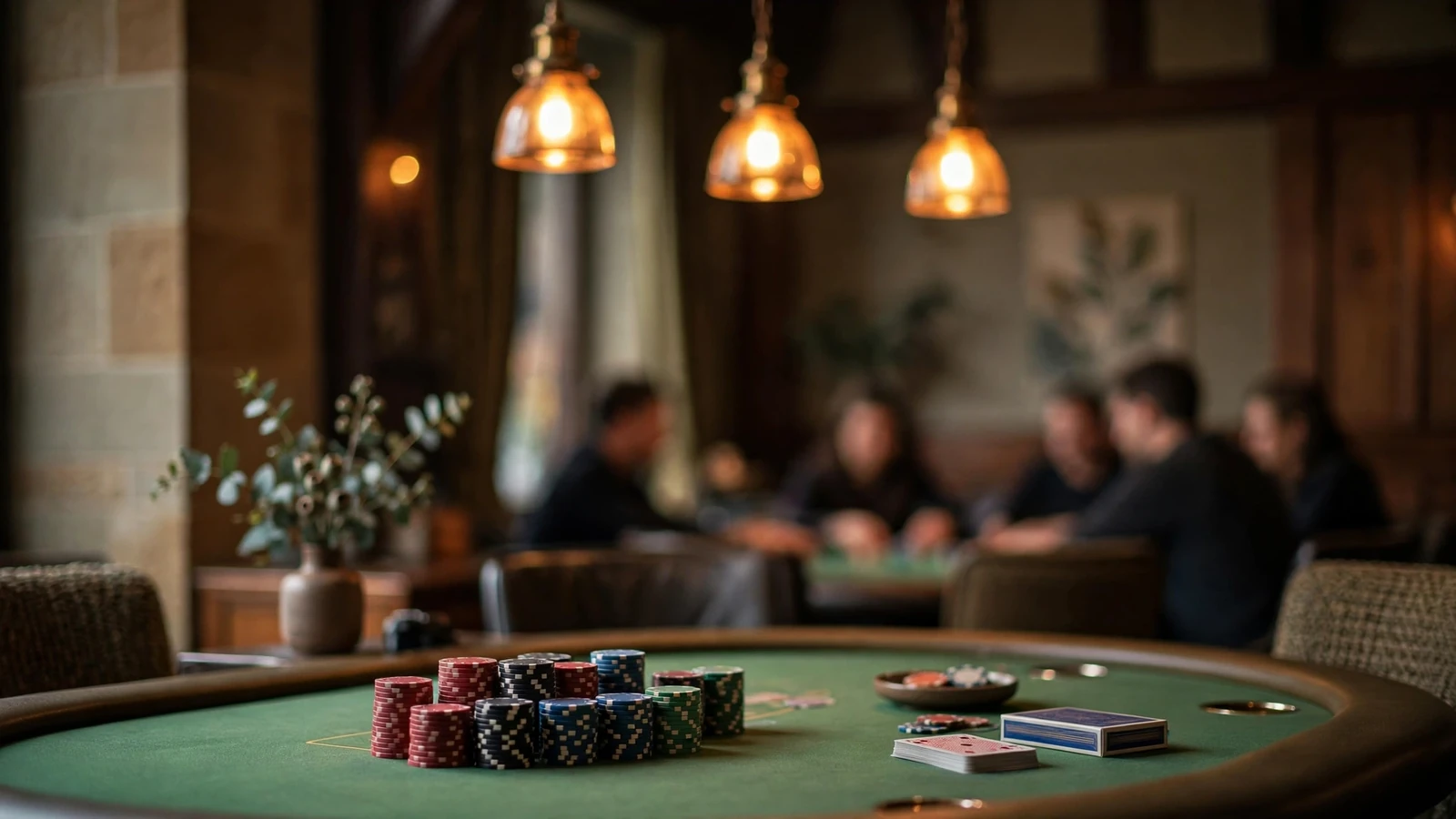
Poker has an unusually elastic name. It can mean a live table, a tournament with an organised structure, a game played on a screen, or simply a poker machine—an Electronic Gaming Machine (EGM) whose title borrows the game’s vocabulary. Those are different activities, with different rules and different practical arrangements. A description of poker at a Hobart casino is useful only when it makes clear which one it means.
A live poker room is not established by the presence of EGMs, nor by a venue’s general association with gambling. It involves players competing against one another under a defined set of rules, with a host or dealer and some method of managing seats, chips and play. Tournament poker adds further particulars: registration, a start time, a format, a structure for play and an explanation of how the event ends. Without those details, “poker tournament” is a label, not a usable account of an event.
That distinction matters because the word *poker* can do quiet promotional work. It evokes skill and sociability, even when the product being described is a machine game governed by chance. The mechanics are not interchangeable. Every online pokie uses a Random Number Generator (RNG); each spin is independent, and the outcome of an earlier spin does not set up the next one. A poker table, by contrast, describes play among participants. Calling both simply poker blurs a difference that should remain visible.
Choosing an online casino from Hobart calls for checking the details that matter to you, including licensing, payment options and deposit requirements. This list offers a concise starting point for reviewing the available information.
Rollero Casino
Rollero Casino lists a Curacao Gaming Control Board licence, OGL/2023/176/0095, held by Hollycorn N.V.
LuckyVibe
LuckyVibe lists a Curacao Gaming Control Board licence, OGL/2023/176/0095, held by Hollycorn N.V.
House of Pokies
House of Pokies lists an international iGaming licence, though the source does not name the jurisdiction. PayID withdrawals are listed at 1–24 hours, and the minimum deposit is A$30, or A$10 when using PayID.
Wild Tokyo
Wild Tokyo lists a Curacao licence and a minimum deposit of A$10. Its stated payout speeds are 30–60 minutes for crypto and 1–5 days for fiat.
Uptown Pokies
Uptown Pokies lists a Curacao licence, has been operating since 2017, and has a minimum deposit of A$20.
MrPacho
MrPacho lists a minimum deposit of A$30. Its stated payout speeds are 30–120 minutes for crypto and 24–72 hours for fiat.
Golden Pokies
Golden Pokies lists a Curacao licence. That is the available licensing detail for this operator.
WinSpirit Casino
WinSpirit Casino lists a Curacao eGaming licence, OGL/2024/923/0383, held by Antillephone N.V. Its minimum deposit is A$30.
JustCasino
JustCasino lists a Curacao Gaming Control Board licence. No further operator details are provided here.
Kingmaker
Kingmaker lists a minimum deposit of A$30. Its stated payout speeds are about 90 minutes for crypto and 1–5 days for fiat.
The same care applies to a claim about a room. A venue-specific description would need to establish whether live poker is actually offered, what kind of play takes place and what arrangements govern access. A photograph, a general gaming page or a passing reference to poker would not settle those questions. Nor would the word “room” alone establish a dedicated space: it might describe a facility, a section of a venue or merely the language used in a listing. Precision is less glamorous than a felt table. It is also more useful.
Tournament information has its own small grammar. Players need to know whether an event is scheduled, whether it is open to entrants, how registration works and which format applies. A tournament announcement that omits these essentials can leave the impression of a regular programme without actually establishing one. Repeating the word “tournaments” does not supply a schedule; nor does a general reference to poker establish that an event will run on a particular day. The details have to belong to the venue and the event, not to the familiar shape of an online listing.
There is a broader Australian distinction behind the terminology. The Interactive Gambling Act 2001 makes it illegal for operators to provide real-money online casino games, including poker, to people physically located in Australia. That rule concerns online services offered to customers in the country. It does not turn a web page describing a physical venue into evidence that a live poker room exists, and it does not make poker machines equivalent to live poker. Different setting, different question.
For Hobart, the careful account is therefore narrower than the phrase “poker at the casino” might suggest. A reliable description would identify live poker separately from EGMs and would attach any tournament claim to clear, current event particulars. In their absence, a room, a regular schedule or a particular tournament format cannot responsibly be presented as a feature of the venue. A precise distinction is not a disappointing substitute for local detail; it is what prevents an assumption from dressing itself as a fact.
That caution is especially important in a market where gambling terms carry legal and commercial weight. The machinery of a pokie can be described in general terms: its RNG produces independent outcomes, and a player’s previous spins do not influence the next. Such a description says nothing about live poker facilities in Hobart. Likewise, the existence of poker as a card game says nothing about whether a casino runs a tournament. One fact cannot be made to stand in for another merely because the names overlap.
The useful boundary is simple: poker-machine play is not a poker room, and the idea of a tournament is not a tournament listing. Local claims deserve local particulars. Without them, restraint is the more accurate form of coverage.
Accommodation near a casino is a question of geography before it is a question of luxury. “Near” may mean a short walk, a brief drive or simply a place within the same part of a city; the word alone does not establish which. For a stay in Hobart, a useful comparison needs named properties and a clear basis for describing their location. Without that, a list of nearby hotels would be little more than guesswork dressed as a recommendation.
The distinction between accommodation around a casino and a casino hotel matters. A property may be independently operated and have no connection to the venue, even if it appears in the same travel search. Conversely, a hotel associated with a casino belongs in a separate discussion of its own rooms and booking arrangements. Keeping those categories apart makes it easier to understand what is being offered, and by whom.
Distance deserves more than an adjective. A listing should say how proximity was measured: walking route, road distance or another practical basis. Straight-line distance can make two places look close while concealing a less direct route. Travel time may also depend on the chosen transport and conditions, so it should not be treated as a fixed property feature. A map and a current route check are more informative than “steps away,” a phrase that has never been required to carry a ruler.
Hobart casino accommodation deals call for the same care as any travel offer. A reduced headline rate may depend on dates, room availability, length of stay or booking conditions. The displayed price is not necessarily the full cost, and cancellation terms can alter the value of an apparent bargain. A comparison is meaningful only when it sets out what is included, what conditions apply and when the offer can be booked. A promotion connected with casino play should not be mistaken for a lodging discount unless the terms say that it is one.
The venue’s location is also a separate detail from the location of surrounding accommodation. A reliable comparison should use a confirmed venue address and identify the route between it and each property. That allows the reader to judge whether “near” suits the purpose of the stay, rather than relying on a broad neighbourhood label. The same principle applies to accommodation described as suitable for a casino visit: the description should be supported by a real, checkable connection, not merely a shared city name.
Travel listings can change, and prices and availability are especially time-sensitive. Property names, current booking pages and the conditions attached to a rate should therefore be checked close to publication. Old deal language can linger online after an offer has ended; a current date on a page does not, by itself, make every detail current. Clear sourcing is less decorative, and more useful.
For a Hobart stay, the practical comparison is between verified properties, their actual routes to the venue and the terms of the reservation. That keeps accommodation near the casino distinct from rooms within a casino hotel, while leaving room for independent places to be assessed on their own merits. A deal is only a deal when its conditions are visible. A location is only “near” when the distance can be checked.
A “casino hotel” can mean two different things: a hotel operated as part of a casino complex, or an independent property that happens to be close to one. The distinction matters in Hobart, where a room advertised as convenient for casino visitors is not necessarily part of the venue itself. Proximity is not ownership; a shared booking arrangement is not proof of a shared operation.
For a stay genuinely associated with a casino, the useful details are concrete: the hotel’s official name, the relationship between the accommodation and the gaming venue, the room categories available, and the terms attached to a booking. These establish what is being sold. A photograph of a hotel room, or a mention of the casino in a listing, establishes very little on its own.
Room descriptions should be read as specifications rather than atmosphere. Bed configuration, occupancy, accessibility, included services and cancellation conditions affect the stay in practical ways. So do the dates and times that govern arrival and departure. Those conditions belong to the hotel booking; casino opening hours are a separate matter and should not be inferred from them. A venue that operates late does not, by that fact alone, offer late check-in or a particular room arrangement.
The phrase “Hobart casino hotel” can also blur a second distinction: a casino’s rooms, if it has them, are not the same as hotels near a casino. The former calls for information from the hotel or casino operator about rooms and booking terms. The latter is a question of location and independent accommodation. Mixing the two can make a nearby property sound affiliated when it is not.
A reliable description of casino hotel rooms in Hobart would therefore identify the property before describing its amenities. It would state whether reservations are made through the hotel or another operator, whether a casino visit is included in any stay package, and what restrictions apply to that offer. A package should not be presented as a standing benefit unless its dates and conditions are clear. Promotional language can travel further than its terms.
The same care applies to claims about convenience. “On-site” should mean within the same property or complex, not simply in the surrounding area. “Casino view” should describe an actual room feature, not a general impression of the neighbourhood. And a hotel’s association with a casino should be stated plainly rather than left for the booking page to imply.
Opening hours and shows may shape a visitor’s plans, but they do not establish what a hotel stay includes. The casino’s schedule, an event listing and a room reservation each require separate, current information. Treating one as a substitute for another turns a useful travel detail into guesswork.
For anyone comparing a casino hotel with other places to stay, the basic record is modest: verified property identity, room details, booking terms and a clear account of the hotel’s relationship to the casino. Without those, “casino hotel” remains a label, not a description. That is a small distinction with a large room attached.
A visit to a physical casino in Hobart and access to an online casino are different matters, governed by different practical and legal questions. For a trip to a venue, parking is one of the details to settle before setting out. The availability of on-site parking, valet service or free parking should not be assumed: arrangements can change, and a label attached to a venue online is not a reliable substitute for current information from its own channels. The same caution applies to bingo or dining. A search for those activities does not establish that they are offered at a particular venue, or that they are available at the time of a visit.
The distinction matters because a physical casino is not an online casino merely because both use the word “casino”. Australian law treats online casino-style gambling separately. Under the Interactive Gambling Act 2001, operators based in Australia cannot provide real-money online casino games to people located in the country. That restriction covers games such as pokies, blackjack and roulette. A Hobart venue’s physical presence therefore does not make online casino services lawful for an Australian operator.
Offshore platforms sit outside Australia’s regulatory framework, rather than within a local licensing system. They are not regulated under Australian law, and the fact that an overseas service can be found online does not mean it has Australian oversight or the protections associated with a locally regulated provider. Australian law prohibits operators from supplying these online casino services to people in Australia. The legal position of the offshore operator should not be confused with a local venue’s arrangements for in-person visitors.
Access can also be restricted by location. Online casinos may use an IP address to identify the country from which someone is connecting and block games or services for excluded regions. In some cases, a restricted game may not appear in the lobby; in others, it may fail to load. These signs do not establish that the game is temporarily unavailable for an ordinary technical reason. A specialist review has reported that some providers have blocked certain games for Australian players in anticipation of possible legal reforms; that is a reported example, not a rule that applies to every provider.
A VPN can make a connection appear to come from another country, but using one to reach region-blocked pokies or other casino games while physically in Australia is against the platform’s terms and may result in account suspension. It does not turn an offshore service into an Australian-regulated one. A workaround is not a licence.
For a planned visit, the sensible distinction is plain: check current venue information for parking and any activities offered on site, and do not infer online availability from the existence of a physical casino. Hobart’s streets and a digital lobby answer to different rules.
A reliable contact number is useful only when it belongs to the venue and is current. For a Hobart casino enquiry, the safest reference point is the casino’s own official website or verified social-media account, rather than a number copied from an old directory listing. Business listings can lag behind changes; a familiar name beside a telephone number is not proof that the line still reaches the right place.
The same care applies to an address or map pin. A map result can identify a venue, but its label and directions should be checked against the operator’s current information before a visit is planned. This matters particularly when several businesses share a precinct or when a listing has been edited by users. A map is a useful instrument, not an authority.
Bar details call for more than a venue name. Current opening times, entry arrangements, age restrictions and any booking requirements can affect whether a particular space is accessible on a given night. Those particulars should be confirmed directly with the venue. A bar listing alone does not establish that it is open, that service is available at a specific hour, or that its arrangements have not changed.
Baccarat and craps are separate table games, and a casino’s general gaming description does not establish that either is currently offered at a particular venue. Availability can depend on the operator’s live offering, so a current venue contact is the appropriate place to check. Game names in a search result are not a timetable, nor a guarantee that a table will be operating when someone arrives.
Concert information needs the same distinction between a venue and an event. A casino may be associated in public listings with entertainment, but that does not confirm a concert date, performer, ticket availability or access conditions. For a specific performance, the organiser’s event page and the venue’s own notices are stronger references than an undated calendar entry. Ticketing details should also be checked at the point of purchase, since event arrangements belong to the event, not to a general casino listing.
These small checks are not bureaucratic ceremony. Hospitality and entertainment information changes more readily than a street address, while directories and map services preserve yesterday’s details with admirable confidence. The sensible order is simple: confirm the venue through its official channel, then verify the particular service or event directly. For an enquiry involving a bar, a baccarat or craps table, or a concert, one current answer is worth more than several copied listings.
A search for contact details, a map or a casino bar in Hobart therefore needs to end at a source that can answer for the present, not merely describe the past. Where a phone number is shown, it should match the operator’s own current contact information. Where a concert is advertised, its organiser should confirm the event. Where a game or bar is mentioned, the venue should confirm availability. No grand mystery. Just the usual distance between a listing and reality.
Breakfast, buffet service, rewards and recruitment are four separate questions, even when they are bundled under the idea of a casino resort. Each depends on details that can change: a meal service may be seasonal or limited to particular days, a buffet may not be offered at all, and a rewards programme can have its own eligibility rules. The word “resort” does not establish that any of these services exists at a particular Hobart venue.
That distinction matters most with food. A breakfast listing is not proof of a buffet, and a buffet reference does not establish that breakfast is included. Menus, service times, prices and booking conditions are venue-specific; none should be inferred from a general description of a casino. A result that looks current can also outlast the arrangement it describes. In hospitality, yesterday’s menu has a stubborn afterlife.
Rewards require the same care. The label alone says little about what a programme offers, how membership works or whether benefits apply to dining. A name or logo is not a substitute for its current terms. Without those terms, claims about discounts, points, complimentary meals or access would be guesswork, not useful guidance.
Employment searches have a different purpose. Someone looking for casino work needs a live vacancy, its duties and its application route, not a general account of the hospitality industry. A careers page or recruitment notice should identify the employer and state whether the position is still open. Job titles, shifts, qualifications and conditions belong to the individual listing; none can safely be supplied as a description of work at a Hobart casino without a current, venue-specific notice.
There is also a difference between a casino’s own vacancies and jobs elsewhere in the wider hospitality sector. Similar wording can lead to either, while “casino resort” may describe a broad idea rather than a verified employer or property. Before treating a role as connected to a casino, the employer named in the listing needs to be clear. The same principle applies to food: a venue’s association with gambling does not establish that it operates a breakfast room or buffet.
For anyone comparing these practical details, the useful evidence is plain: a current menu or service notice for breakfast, explicit information for a buffet, published terms for rewards, and a dated vacancy from the employer for work. If those particulars are not available, the sensible conclusion is not to fill the gaps with assumptions. Food service, loyalty benefits and recruitment are not interchangeable parts of a “resort” label.
The searches for breakfast and casino jobs in Hobart point toward ordinary needs—somewhere to eat, or a place to work. But the name attached to a venue cannot answer either question by itself. Specifics matter.
Whether the Hobart casino is open is a question that needs a current, venue-specific answer. Opening hours can change, and a past listing cannot establish today’s status. The same applies to searches about a reopening: the word can refer to a temporary closure ending, a particular facility returning to service, or a larger project reaching completion. Those are different claims, and none should be inferred from an old event notice or a general description of the venue.
A dependable update should identify what has changed and when. For a day-to-day opening claim, that means checking a current venue announcement or an official listing that clearly applies to the date in question. If those sources conflict, the discrepancy matters; a directory entry may remain online long after circumstances have shifted. “Open” is not a permanent property.
Events require similar care. A listing should be tied to a date and an organiser, and it should distinguish a scheduled performance from a past event or a general entertainment description. A calendar that has not been updated is evidence of an old plan, not proof that something is happening now. The cultural life of a casino is often presented as part of its appeal, but promotion and confirmation are not the same thing.
Development claims need an even firmer boundary. A proposal, an approval, construction work and a completed project are separate stages. A headline about plans does not show that work began; a report of construction does not establish completion or a reopening date. Any account of Hobart casino development should state which stage is being described and attach it to a dated, attributable update. Otherwise, the language of progress can make an intention sound like a finished fact.
Reviews are also time-bound. An assessment of a venue’s atmosphere or entertainment reflects the visit and conditions described, not necessarily the present offering. Useful reviews make their date clear and separate first-hand observations from promotional claims. Without that distinction, an old impression can circulate as current guidance.
For a review of the casino, the sensible standard is not a confident-sounding summary but a traceable one: the status, event or development should be supported by a recent statement from the venue or another responsible source. Where no such confirmation is available, the honest account is that the present position remains unconfirmed. That is less dramatic than a reopening headline. It is also more useful than certainty borrowed from yesterday.
A venue address looks like a small piece of information, until it is wrong. A map pin can point to an entrance rather than the public address, while an old directory listing may survive after practical details have changed. Anyone planning a visit to a casino in Hobart should confirm the address against the venue’s own current information before setting off, then check that the route leads to the intended entrance. The distinction is mundane, and useful.
That check matters especially when a place has several functions or access points. A street address, a drop-off point and an entrance used by visitors are not necessarily interchangeable. Third-party maps can help with orientation, but they should not be treated as the final word on where to arrive. An address copied from an undated listing is a thin sort of certainty.
Dress expectations are another detail that can be easy to misread. Rules may differ between gaming areas and other parts of a venue, and a policy can change. A photograph, an old review or a general claim about what casinos require is not a reliable substitute for a current house policy. The sensible approach is to check the venue’s own published guidance before visiting, particularly if the plan involves a specific area or event. No grand theory of eveningwear is needed.
A day spa is a more substantial question than a line in a directory. The word can refer to a dedicated treatment business, a hotel facility or a service located nearby; those are not the same arrangement. Before making plans, it is worth establishing whether spa services are actually offered at the venue, who operates them, what services are available and whether appointments are required. Those details should come from current business information, not from an assumption that a casino must have a spa because another casino does.
The same restraint applies to the idea of a casino spa in Hobart: proximity is not proof of affiliation, and a nearby treatment provider should not be described as part of the casino without confirmation. That distinction affects where a visitor goes and whom they contact if plans change.
For a visit built around a particular facility or dress expectation, the dependable sequence is simple: identify the venue through its current official listing, confirm the address and entrance, then check the relevant policy or service directly. The details are practical, not decorative. A pin on a map is not a welcome desk.
A restaurant search attached to a casino name can suggest a simple choice: arrive, sit down and order. In practice, the phrase may refer to a dining room inside the venue, a separate business on the same site, or restaurants nearby that have been grouped together in a directory. Those are different arrangements, and a shared location label does not establish who operates a venue or what it serves.
For anyone comparing restaurants associated with a Hobart casino, the useful details are concrete: the restaurant’s own name, whether it is part of the casino or merely close by, what kind of menu it offers, and whether reservations are handled by the restaurant or the wider venue. Those particulars should come from a current official venue or restaurant listing. An old directory entry can preserve a name long after its role, menu or operating arrangement has changed.
A casino rooftop bar is a separate question from casino restaurants. “Rooftop” describes a setting, not a dining offer: a bar may serve drinks without operating as a restaurant, while a restaurant may have no rooftop space at all. The label should not be treated as proof of either food service or a particular view. Current venue information is needed before making either assumption.
The distinction matters because hospitality names are often used loosely in online listings. A restaurant described as “at” a casino might be inside the building, in an adjoining complex, or simply in the surrounding area. A map pin can help establish proximity, but it cannot confirm the menu or whether a venue is part of the casino’s operation. For a meal planned around a casino visit, the restaurant’s own current information is the more reliable basis for deciding.
Menus also deserve a little attention beyond their headline category. A listing that says “Italian” or “modern Australian” gives a broad impression, not a guarantee of particular dishes, dietary options or service arrangements. Those can change, and details copied between listings may lag behind the restaurant itself. The sensible approach is to check the latest menu and booking information directly with the named venue, especially when a specific dish or dietary requirement is important.
That is less glamorous than a rooftop promise. It is also more useful. A clear restaurant name and a current menu tell more than a cluster of casino-related labels; the difference between dining inside the venue and dining nearby is worth settling before the evening is planned.
Food searches around a casino can point to quite different things: a place to buy a quick meal, a shared food-court arrangement, or dining elsewhere within the same complex. Those labels are not interchangeable. A food court implies a particular layout and choice of outlets; the phrase “food at the casino” says little about the format, service times or whether a venue is operating on a given day.
For Hobart, those practical distinctions matter more than a broad promise of choice. Current venue information is the sensible basis for confirming whether food is available on site, what kind of service is offered and whether access depends on an event or operating schedule. An old directory entry or an undated visitor comment may describe an arrangement that has since changed. Food is an everyday detail, but hospitality listings can age quietly.
The same caution applies to searches for a pool. A pool may belong to a hotel or another part of a wider property rather than to the casino itself; even where a facility exists, access can depend on who is staying there, its hours and any separate conditions. None of those points should be inferred from the word “casino” or from photographs that do not establish current access.
A useful venue listing would separate confirmed facilities from nearby services and state when its information was checked. That lets people distinguish an on-site food option from something in the surrounding area, and a pool available to visitors from one reserved for accommodation guests. Without that distinction, a polished description can turn an uncertain amenity into an imagined one. A small but consequential difference.
Yes. The Interactive Gambling Act prohibits Australian-based operators from offering online casino games such as pokies, blackjack and roulette to people in Australia. Offshore casinos are not regulated under Australian law, and some block Australian players or games.
An online pokie uses a Random Number Generator (RNG) to determine each result. Spins are independent, so previous outcomes do not affect the next spin.
NSW requires players to set a loss limit before playing poker machines through mandatory pre-commitment systems. The legal gambling age for poker machines in NSW is 18.
Check the game’s theoretical RTP and whether it has features such as free spins or progressive jackpots. Before accepting free-spin winnings, check the wagering requirement, which commonly ranges from 20x to 50x.