Australia’s rules distinguish offshore operators from individual players, while app access, payments, verification and safety bring separate considerations.
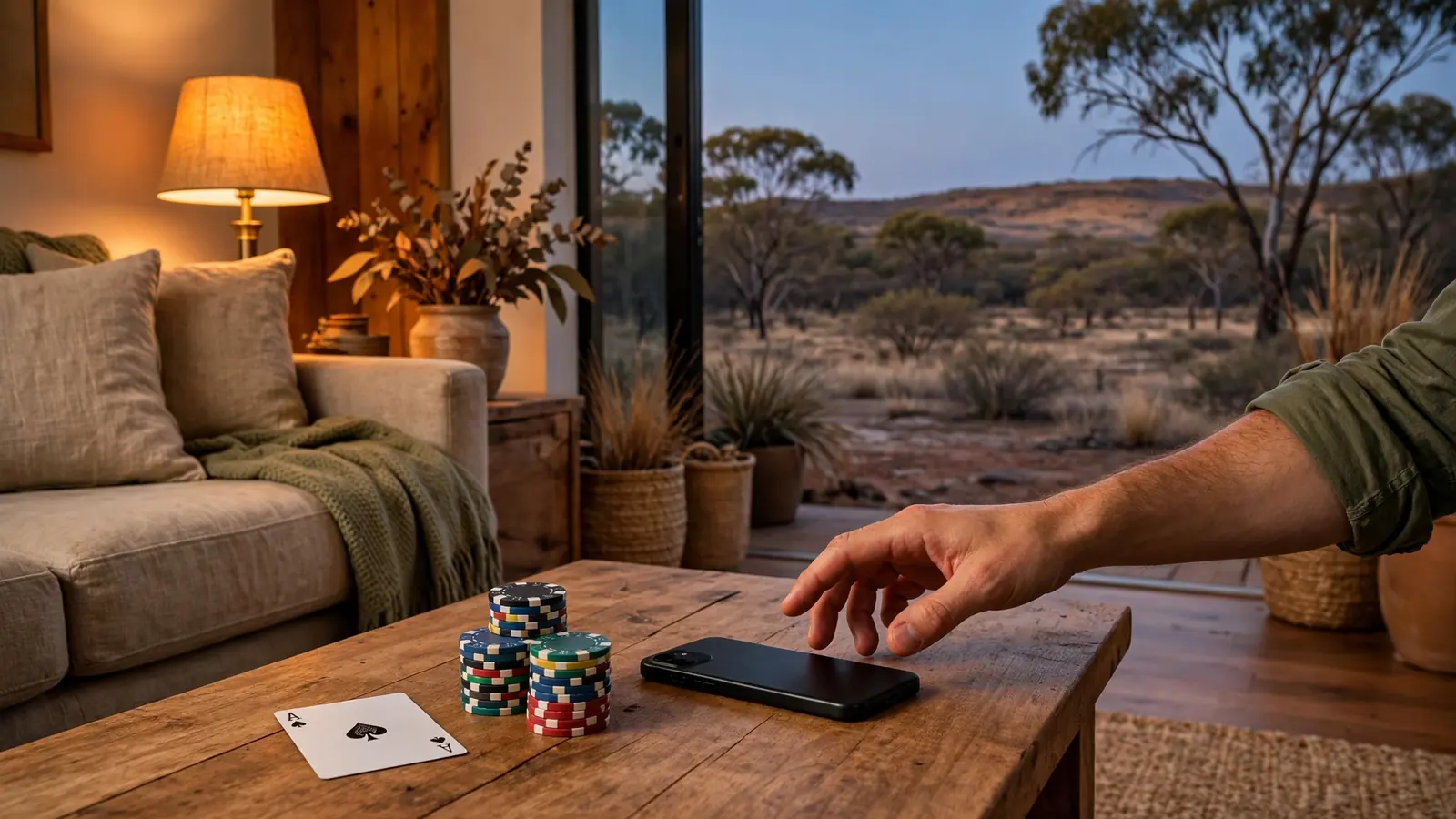
The phrase “real-money casino app” sounds like a product category, as ordinary as a banking app or a game downloaded from a store. In Australia, it describes a sharper divide: the law prohibits operators from offering online casino-style games to people in the country, while the Interactive Gambling Act 2001 does not make it illegal for an individual Australian to play through an offshore service. The distinction is between the operator’s conduct and the player’s position. It is not an endorsement of the service.
That difference can be easy to miss when a website presents itself as an international business with familiar games, account balances and a mobile-friendly interface. The legal issue is not resolved by calling the service an app, locating its company abroad or accepting cryptocurrency. Under Australian law, the offer of online casino-style games to people physically in Australia is prohibited. A foreign address does not turn that offer into a locally authorised one.
Services that accept Australians may identify licensing jurisdictions such as Curaçao, Malta, or Gibraltar. Those names describe offshore regulatory settings; they are not Australian permission to provide casino games here. A licence issued abroad does not remove the prohibition imposed on operators by Australian law, nor does it give an Australian punter the same local framework that applies to services licensed domestically.
Choosing a casino app is easier when you can check the details that matter before signing up. This list gives you a concise reference to the available licensing, deposit and payout information for each operator.
Rollero Casino
Rollero Casino is listed with a Curaçao Gaming Control Board licence, OGL/2023/176/0095, held by Hollycorn N.V.
LuckyVibe
LuckyVibe is listed with a Curaçao Gaming Control Board licence, OGL/2023/176/0095, held by Hollycorn N.V.
House of Pokies
House of Pokies lists an international iGaming licence, though the source does not name the jurisdiction. PayID withdrawals are listed at 1–24 hours, and the minimum deposit is A$30, or A$10 when using PayID.
Wild Tokyo
Wild Tokyo is listed as Curaçao-licensed, with a minimum deposit of A$10. Stated payout times are 30–60 minutes for crypto and 1–5 days for fiat.
Uptown Pokies
Uptown Pokies is listed as Curaçao-licensed and operating since 2017. Its minimum deposit is A$20.
MrPacho
MrPacho lists crypto payouts of 30–120 minutes and fiat payouts of 24–72 hours. The minimum deposit is A$30.
Golden Pokies
Golden Pokies is listed as Curaçao-licensed.
WinSpirit Casino
WinSpirit Casino is listed with a Curaçao eGaming licence, OGL/2024/923/0383, held by Antillephone N.V. Its minimum deposit is A$30.
JustCasino
JustCasino is listed with a Curaçao Gaming Control Board licence.
Kingmaker
Kingmaker lists crypto payouts at approximately 90 minutes and fiat payouts at 1–5 days. Its minimum deposit is A$30.
The practical distinction is consequential. If an offshore operator disputes an account or refuses to pay winnings, there is no Australian government body to which a punter can complain and expect the matter to be handled as a local casino dispute. An overseas licence may offer a route for complaints within its own jurisdiction, but that is not equivalent to Australian oversight or a guarantee of recovery. The operator remains distant; the consequences of relying on it are close at hand.
The Australian Communications and Media Authority actively blocks access to illegal gambling sites. Blocking is part of the enforcement landscape, not proof that every site is inaccessible at every moment. A page appearing on a phone does not establish that an operator may lawfully serve Australian customers, or that access will remain available. Nor does a blocked site become safe to reach by finding another route.
Using a VPN to reach a blocked casino can create further problems: the operator may treat that access as a breach of its terms, void winnings or close the account. A technical workaround is not a legal shield, and it can make a later dispute harder to explain.
For an individual, the legal position is different from the operator’s. Playing at an offshore mobile casino is not, by itself, an offence under the Interactive Gambling Act 2001. That does not mean the service is approved in Australia, that its claims have been checked by an Australian regulator, or that a player has a local authority to turn to if something goes wrong. Legal non-liability and consumer protection are separate matters.
Age is a clear threshold: registration and gambling are for people aged 18 or over. That rule does not depend on whether the service is presented as a website, a casino app or another mobile format. The interface can make an offshore business feel familiar; it cannot change either the age requirement or the operator’s legal position.
Offshore crypto-friendly casino services may accept cryptocurrency alongside other payment options. That description concerns how some businesses handle money; it says nothing by itself about reliability, fairness or the practical ability to recover funds. A payment method can cross borders quickly while a complaint remains caught between the operator, its licensing jurisdiction and a blocked or changing website. Technology moves more readily than accountability.
The same caution applies to claims that a casino app pays real money. A displayed balance is not the same as money received, and an operator’s promise is not an Australian guarantee. The central question is not merely whether a service lets an account be opened or a game be played. It is what happens when access is interrupted, terms are disputed or a withdrawal is refused—and whether any meaningful local remedy exists. In Australia, that last part is the weak point.
The resulting arrangement is unusual but not contradictory: Australian law places the prohibition on operators, while individual players are not made criminally liable simply for playing offshore. Yet a punter who chooses to engage with such a service is dealing outside the domestic protection framework. Location should be confirmed as accepted by the operator before any deposit is considered; acceptance does not make the service locally lawful. A border crossed by a website is still a border.
The phrase “casino app” suggests a download from an app store, followed by an icon and a service built specifically for a phone. For Australian-facing offshore casinos, that picture is often misleading. Access commonly comes through a mobile browser or a Progressive Web App (PWA), rather than a native app listed in a store.
Browser access is the simpler arrangement: the casino website opens in the phone’s browser, and its mobile version provides the account and games interface. Most Australian mobile casinos are reached this way, with the same account used on desktop. The device changes; the account does not. There is no separate mobile identity to create merely because the screen is smaller.
That arrangement also explains why the words “online casino app” can describe something that is not an app in the usual technical sense. A browser page can be designed to fit a phone without becoming a separate program installed through a store. The distinction matters because a polished mobile layout is not evidence of a native app, and an icon on a home screen does not necessarily mean that the underlying service has changed.
A PWA sits between a website and a conventional app. It is a shortcut to the casino website, but on a mobile device it can behave more like a native app. Rather than finding it in an app store, the user opens the casino website and may see an install or add-to-home-screen prompt. Tapping that prompt and confirming installs the shortcut on the device.
The sequence is deliberately modest: website, prompt, confirmation. The PWA remains connected to the website it represents; it is not an independent casino service with a separate account. That is why the same distinction applies whether a service is described as a mobile casino app, a casino app for mobile, or a website made easier to open from the home screen.
Browser play and a PWA therefore differ mainly in how the service is reached and presented. In a browser, the site is opened through the browser each time. With a PWA, its shortcut is placed on the device, making it feel more app-like to launch. Both routes lead to the casino website. Neither label, by itself, establishes that an operator is legitimate, safe, or entitled to provide real-money casino games in Australia.
That last point is not a technical quibble. The Interactive Gambling Act 2001 prohibits operators from providing real-money online casino games to people in Australia. Offshore crypto-friendly casinos may nevertheless present browser or PWA access, but the format does not alter the legal position of the operator. Access can also be disrupted: the Australian Communications and Media Authority blocks illegal gambling sites.
Anyone considering an offshore site must confirm that it accepts their location before depositing. Using a VPN to reach a blocked casino may breach its terms, void winnings, or lead to account closure. And if an offshore operator refuses to pay, there is no Australian government body to which a punter can complain for a remedy. A home-screen icon offers no special protection.
The appeal of a PWA is plain enough: it puts a website within easy reach without requiring a conventional store listing. The trade-off is equally plain. It is still access to a website, and the responsibilities and risks attached to that site remain. A shortcut is not a licence, a guarantee, or a regulator. Just a shortcut.
A welcome offer can be presented as bonus credit, free spins on pokies or a no-deposit reward. The label does not establish what can be withdrawn. On an offshore crypto-friendly casino, promotional credit is governed by the operator’s terms, and the advertised figure is only one part of the arrangement. Australia’s law prohibits operators from providing real-money online casino games to people in the country; a bonus headline does not alter that position.
The first question is whether the offer is genuinely available without a deposit. A “free” sign-up promotion may still require account registration, identity checks or a qualifying payment before any benefit can be used. Deposit offers, by contrast, may set a minimum qualifying deposit. That threshold can make a modest bonus less useful than it looks, particularly if the required payment is larger than the amount a punter intended to risk. The terms, not the headline, settle the distinction.
A wagering requirement states how much qualifying play must take place before bonus-related funds can be withdrawn. A specialist review describes welcome-offer requirements in the range of 30x to 50x the bonus amount; the same kind of review characterises anything above 40x as steep. These are assessments reported by a specialist review, not a guarantee about every offer or a lasting market rule.
The calculation can depend on whether the multiplier applies to the bonus alone or to the deposit and bonus together. That difference changes the amount of play required. Game restrictions matter too: the terms may exclude some games or count different games differently towards wagering. A bonus that appears generous on the sign-up screen can therefore take longer to clear than its headline suggests.
Then comes the clock. A specialist review reports that many offers impose a clearance window of 7–10 days, with the bonus lost if the deadline is missed. The operator’s own conditions should be treated as decisive for the particular promotion: check when the period starts, what activity qualifies and what happens to any remaining balance at expiry. A countdown is part of the offer, not decoration.
Searches for casino apps with real prizes or daily free spins often blur several things: promotional credit, spins restricted to selected games, and cash that can actually be withdrawn. They are not interchangeable. A bonus balance may be locked behind wagering, while a cashout cap can limit the amount released even after requirements are met. The terms may also set a maximum stake while bonus funds are active.
Before claiming any offer, read the wagering requirements, game restrictions, expiry dates and cashout caps. Minimum deposits and time limits belong in the same calculation. If the conditions are unclear, the apparent value cannot be assessed reliably. No bonus should be treated as free money simply because no payment is mentioned in its headline.
For any offshore offer, location eligibility must be confirmed before depositing. Using a VPN to reach a blocked casino may void winnings and lead to account closure. Offshore operators may advertise account rewards, but there is no Australian government body to complain to if one refuses to pay winnings. The promise is easier to print than to enforce.
An iPhone owner looking for a real-money casino app in Australia is more likely to find a casino website than a native app in Apple’s Australian App Store. Casino apps are rarely listed there, and browser play is the default. Offshore operators that accept Australians typically rely on a mobile website or a Progressive Web App rather than an app distributed through Apple.
That gap is not simply a matter of finding the right search term. The legal position shapes what can be offered: under the Interactive Gambling Act 2001, operators may not provide real-money online casino games to people in Australia. A site that can be opened on an iPhone is not thereby an Australian-authorised service. The individual player is not made liable under that Act merely for playing at an offshore casino, but the operator’s position is different.
In practice, the phrase “iPhone casino app” can describe several unlike things. It may mean a website opened in Safari, a shortcut-like PWA, or an application obtained outside the App Store. These are not interchangeable assurances of quality or legitimacy. A familiar icon on a home screen proves only that something was added to the device.
Offshore crypto-friendly casinos may offer access through a browser or PWA, but this is not a recommendation to use them. Before making any deposit, a punter must confirm that the site accepts people in their location. Using a VPN to reach a blocked casino may breach its terms, put an account at risk of closure and result in winnings being voided. The Australian Communications and Media Authority actively blocks illegal gambling sites; a page loading on an iPhone is no guarantee that it will remain accessible.
Sideloaded apps deserve particular caution. Installing an app outside Apple’s store does not certify its security; any protection depends on the operator and the software it supplies. A download may ask for permissions or access that are difficult to assess from a screen full of polished graphics. The installation itself is no seal of approval. Browser access avoids the question of an app download, but does not resolve the separate questions of legality, operator conduct or account security.
There is also a sharp limit to recourse. If an offshore casino refuses to pay winnings, there is no Australian government body to complain to for a remedy against that operator. The distance between an appealing interface and an enforceable local protection is substantial.
Bonuses do not close that distance. Before claiming an offer, its terms need to be read in full: wagering requirements, game restrictions, expiry dates and cashout caps can all affect whether bonus funds or resulting winnings can be withdrawn. The headline is the most visible part; the conditions do the governing.
For iPad users, the same store gap applies: browser-based access is the default, rather than a dependable catalogue of native casino apps. Apple’s device may be sleek; the regulatory and practical uncertainties sit elsewhere.
“Free” can describe two quite different things. A social casino app uses virtual credits for play; it is not the same product as a real-money gambling service. In Australia, social and free-play casino apps that use virtual credits are legal to use and can be downloaded directly from the Google Play Store or Apple App Store. Their presence in an official store reflects that different category, not a general approval of every service carrying a casino label.
The distinction matters because the language of casino play travels easily between products. “Free spins” may describe a feature inside a virtual-credit game, while the same words elsewhere can refer to an offer attached to real-money play. The phrase alone tells little. What matters is what the credits represent and whether the app is presenting entertainment with virtual balances or gambling for money.
A free casino game app can therefore resemble a casino without functioning as one. Familiar tables, spinning reels and a running credit balance are part of the visual vocabulary; they do not, by themselves, establish that money is being staked or won. The virtual balance is a game element, not a cash figure. That separation is the central point, though an interface may make it easy to overlook.
Store availability is useful context, but it is not a substitute for reading what an app actually offers. A listing should be understood in terms of its credit system and purpose, rather than its name or graphics. The word “free” is not a complete description: it may refer to access to play, to a particular feature, or simply to the language used in an app’s presentation. The store category and the app’s own terms provide more meaningful clues than a promotional phrase.
This is also why “safe” and “trusted” are not consequences of the word “free”. A virtual-credit app belongs to a different category from a real-money service, but the label alone does not establish anything about the quality of its design or handling of user information. The available distinction is narrower: social and free-play apps using virtual credits are legal in Australia and available through the two major app stores.
The appeal is partly one of resemblance without the same stakes. Casino imagery has long been built to make chance visible: the table, the wheel, the turn of a card. A phone can carry those symbols into ordinary moments, detached from the setting that once gave them a particular social meaning. Virtual credits keep the familiar theatre while changing what the balance signifies.
That is not a small difference. Nor is it a licence to treat every app with casino in its title as equivalent. One category offers play with virtual credits; another involves real money. The boundary is more important than the packaging.
On an iPhone or iPad, a deposit is generally made through the casino’s mobile website rather than a native app. The payment choices shown there can vary by operator and account. A specialist review describes PayID deposits as near-instant and typically free, but that is a report about a particular service offering, not a guarantee for every transaction. The available methods and any fees should be checked on the payment screen before proceeding.
A specialist review also lists PayID, BPAY, bank cards and cryptocurrency among mobile deposit options, with processing times that differ by method and operator. That list should not be mistaken for a fixed menu across Australian sites. An offshore crypto-friendly casino may present only some of those methods, and the conditions attached to a payment can matter as much as its speed.
POLi is not a current local option. Its Australian operations ended in September 2023, so it no longer processes transactions in Australia. A payment page that still presents POLi as available deserves scrutiny: an old reference may simply have been left in place.
Cards bring a different uncertainty. A specialist review notes that some Australian banks block or flag gambling-related card charges, which can cause a deposit to fail even when the card is otherwise working. A declined transaction is not necessarily evidence of a technical fault on the iPad; the bank may be applying its own restrictions. Repeated attempts can make little sense if the issuing bank is refusing the category of charge.
There is also a larger legal distinction behind the neatness of a mobile checkout. Australian law prohibits operators from providing real-money online casino games to people in Australia. Offshore sites may still appear accessible, but that does not make their services locally authorised. Their crypto-friendly payment options do not alter that position.
Any site considered must explicitly accept the punter’s location before a deposit is made. Using a VPN to get around a block can breach the operator’s terms, void winnings and lead to account closure. If an offshore casino refuses to pay, there is no Australian government body to complain to for recovery of those winnings. The checkout is not a safety net.
Where a deposit is tied to an offer, the terms should be read before it is claimed: wagering requirements, game restrictions, expiry dates and cashout caps can affect whether funds can be withdrawn. A prominent bonus label is not a payment condition, and the small print is where the real conditions sit. No shortcut there.
A balance displayed on a casino account is not the same thing as money received. A withdrawal passes through several stages: the casino may review the request, ask for identity documents, observe a pending period, and then send the funds through the chosen payment channel. Each stage has its own clock. The word “instant” tends to describe only one of them.
For a first withdrawal, identity checks commonly include a selfie or identity document and proof of address. This is usually called KYC verification. If the documents are incomplete or do not match the account details, the review can take longer; the payment method cannot speed up a request that has not yet been approved. The check also means that an account showing winnings may still be unable to withdraw them.
First withdrawals typically require identity checks, which may include providing a selfie, a valid identity document, and proof of address to verify the account holder.
After the casino releases a payment, the destination matters. A specialist review reports that e-wallet withdrawals may arrive within 24 hours after the casino’s pending period, but that is a reported timeframe, not a promise that applies to every operator or request. Bank transfers can take up to five business days, according to specialist reviews. Weekends, bank processing and the operator’s own handling can all affect when funds become available.
The distinction is easy to miss in claims about casino apps that pay cash. A payment service may process a transfer quickly while the casino has not yet approved it; conversely, a casino may mark a withdrawal as paid before the receiving bank has completed its work. The useful detail is therefore not simply the name of a payment method, but the operator’s written withdrawal policy: pending periods, identity checks, eligible methods and any conditions attached to cashouts.
Australian punters also face a particular divide. Real-money casino operators are prohibited from serving people in Australia under the Interactive Gambling Act 2001, while offshore crypto-friendly casinos may still present themselves as accessible. Before any deposit, the site’s terms need to be checked for confirmation that it accepts the person’s location. Using a VPN to reach a blocked casino may void winnings and lead to account closure.
There is no Australian government body to complain to if an offshore casino refuses to pay winnings. That absence matters more at withdrawal time than on a welcome screen. A “best casino app” label cannot establish that a cashout will be honoured, and a displayed balance is not a remedy. The boundary is stark.
A casino screen can look calm while the phone underneath it is struggling. A specialist review identifies weak connections, limited memory, outdated browsers and too many background apps as causes of mobile play problems. A frozen screen or interrupted session may therefore begin with the device, not the casino. That distinction can be difficult to establish after the fact, particularly when a disputed game round or balance is involved.
Account controls matter for a different reason: they set boundaries before play gathers momentum. A specialist review describes options such as deposit, loss and wager limits, session time limits, and self-exclusion. Their usefulness depends on the operator making them accessible and on the account holder setting them with care. They do not make gambling harmless, and a control on an offshore service is not a substitute for independent protection.
That is the limit. An offshore crypto-friendly casino may offer mobile access and account tools, but neither makes it an Australian-regulated service. If an offshore casino refuses to pay winnings, there is no Australian government body to which a punter can complain and expect the matter to be resolved. The distance between a polished interface and a meaningful remedy is not a technical glitch.
Access can bring another risk. The Australian Communications and Media Authority blocks illegal gambling sites, and a VPN used to reach a blocked casino may breach the operator’s terms. The casino may void winnings or close the account. Changing the apparent location does not strengthen a punter’s position; it can weaken it.
The device still has its ordinary part to play. A current browser, a stable connection and fewer background processes may reduce avoidable interruptions, but no phone setting can guarantee that an offshore operator will handle a dispute fairly. Nor does a smooth run of play prove that the account, game records or eventual payout will be protected.
Mobile casino gaming sits between two kinds of uncertainty: the familiar fragility of a phone and the more consequential uncertainty of dealing with a remote operator. Limits and self-exclusion tools can help contain the first decisions made at the account level. They cannot create local oversight where none exists.
The distinction is plain, if not comforting. A working app-like screen is not a safety net.
A casino app can be popular in conversation without being a downloadable product. In Australia, the label often points to a mobile service that opens in a browser, not software found in an app store. Casino apps are rarely listed on Google Play or Apple’s App Store here, and most mobile casino access takes place through a browser with the same account used on desktop.
That distinction matters when rankings and recommendations use the word “app” loosely. A list described as the most popular casino apps may be comparing websites, mobile layouts or account services rather than installed applications. Without a verifiable ranking, popularity is a claim about visibility or familiarity, not proof of downloads, quality or suitability.
The language also blurs different kinds of products. An app-store game using virtual credits is not the same thing as a real-money service accessed through a phone. Nor does a site that behaves like an app become an independently approved app merely because its pages fit a mobile screen. The label is convenient. The categories are not.
Where a page discusses offshore crypto-friendly casinos, that description should not be mistaken for an endorsement or a measure of standing. Their availability and terms can change, and a punter must confirm that a site accepts their location before depositing. A VPN used to reach a blocked casino may lead to an account closure or voided winnings. If an offshore operator refuses a payout, there is no Australian government body to complain to.
The sensible meaning of “popular”, then, is modest: a service may be widely discussed while remaining browser-based and difficult to compare with a conventional app. That says something about the language surrounding mobile gambling, but little about reliability. An app-shaped icon is not a credential.
On Android, the word “app” can describe rather different things. Casinos accepting Australian players typically provide access through a mobile browser or a Progressive Web App (PWA), rather than a native app listed in Google Play. The first runs as a website in the browser; the second remains a website, but can be placed on the device’s home screen and behave more like an app.
A PWA installation begins on the casino website. If an install or add-to-home-screen prompt appears, tapping it and confirming adds the shortcut to the device. That step does not turn the site into a separately vetted Play Store product. It simply makes the website easier to reopen, with an app-like appearance that can blur the distinction.
A native Android package obtained outside Google Play is different again. Sideloading means installing software from outside the store, and it carries security risks; safety depends on the operator behind it. An installation file’s presence on a phone is no evidence that the software or the service is trustworthy. A shortcut to a website and an independently installed program are not interchangeable.
Any real-money services in this area are offshore and crypto-friendly. Their availability can change, so location acceptance must be confirmed with the site before any deposit. A VPN used to reach a blocked casino may breach its terms, void winnings and lead to account closure. Nor is there an Australian government body to complain to if an offshore casino refuses to pay winnings.
The practical distinction is modest but important: browser access avoids installing a separate casino program, while a PWA offers a home-screen route to the same site. Neither format settles questions of security, location eligibility or recourse. App-like is not the same as protected.
Yes. Most Australian-facing offshore casinos can be accessed through a mobile browser, using the same account as on desktop; some also offer a Progressive Web App. Playing is not itself illegal for individual Australian players, but operators are prohibited from offering online casino-style games in Australia.
No. Most mobile casinos can be played in a browser, and some offer a Progressive Web App that can be added to a phone’s home screen.
Mobile casinos may support deposits by PayID, cards, BPAY or cryptocurrency, while e-wallets can be used for deposits and withdrawals. First withdrawals usually require identity and address checks, and the available withdrawal methods and processing times vary.
Yes. Welcome bonuses commonly carry wagering requirements of 30x to 50x the bonus, and many must be cleared within 7–10 days. Check the wagering requirement, minimum deposit and deadline before accepting an offer.
Yes. Responsible gambling controls can include deposit, loss and wager limits, session time limits, and self-exclusion.